
Football tactics are the plan a team follows to attack, defend and switch between the two: where each player stands, when they move, and how the group wins the ball back. This site breaks that plan into pieces you can use on a Saturday morning: the formations, the positions inside them, and the playing styles that decide how a shape behaves.
Everything here is written from the touchline of youth and amateur soccer, so each page ends with something you can set up, coach or watch for. Start with a formation, a position or a style below, or open the tactics board and move the players yourself.
Quick facts
What tactics are
The plan for space, time and players: who goes where, and when, with and without the ball.Formation vs tactics
A formation is the starting shape; tactics are how that shape moves during the game.Four moments
Attacking, defending, and the two transitions after the ball changes hands.Formation numbers
Count outfield players from defense to attack and always add up to 10; the goalkeeper is not counted.Youth formats (US)
7v7 around U9 and U10, 9v9 around U11 and U12, 11v11 from U13; leagues set their own rules.Where to start
Pick your team's shape in the formations table, then read the page for each position in it.
What football tactics are, and what they are not
Ask ten coaches what tactics in football mean and you will hear ten answers, but they all come back to three things: space (where the ball can go and where the opponent can hurt you), time (how quickly players must decide) and numbers (how many of your players against how many of theirs in one area). A tactic is any agreed behavior that tilts those three in your favor, such as the left back pushing high when the left winger comes inside, or the whole team dropping 10 yards when the opponent's center back has time to look up.
Strategy is the bigger picture: the style you want across a season, the type of player you recruit, how you want to win. Tactics are the match-day details that serve the strategy. A formation sits underneath both. It is only the starting picture, the shape on the team sheet. Once the whistle blows, a 4-3-3 can look like a 3-2-5 with the ball and a 4-5-1 without it, so always ask what a team does, not just how it lines up.
The four moments of a match
Every tactical plan, from an under-10 team to a professional side, has to answer four questions. Coaches call them the moments or phases of the game.
| Moment | The question | Typical answers |
|---|---|---|
| Attacking (in possession) | How do we move the ball into the final third and create chances? | Build short or go direct, width from wingers or full backs, runs behind, overloads on one side |
| Defending (out of possession) | Where do we try to win the ball back? | High press, mid block, low block, man or zonal marking |
| Attack to defense transition | What happens in the five seconds after we lose it? | Counter-press at once, or drop and get compact |
| Defense to attack transition | What happens in the five seconds after we win it? | Counterattack forward fast, or secure the ball and rebuild |
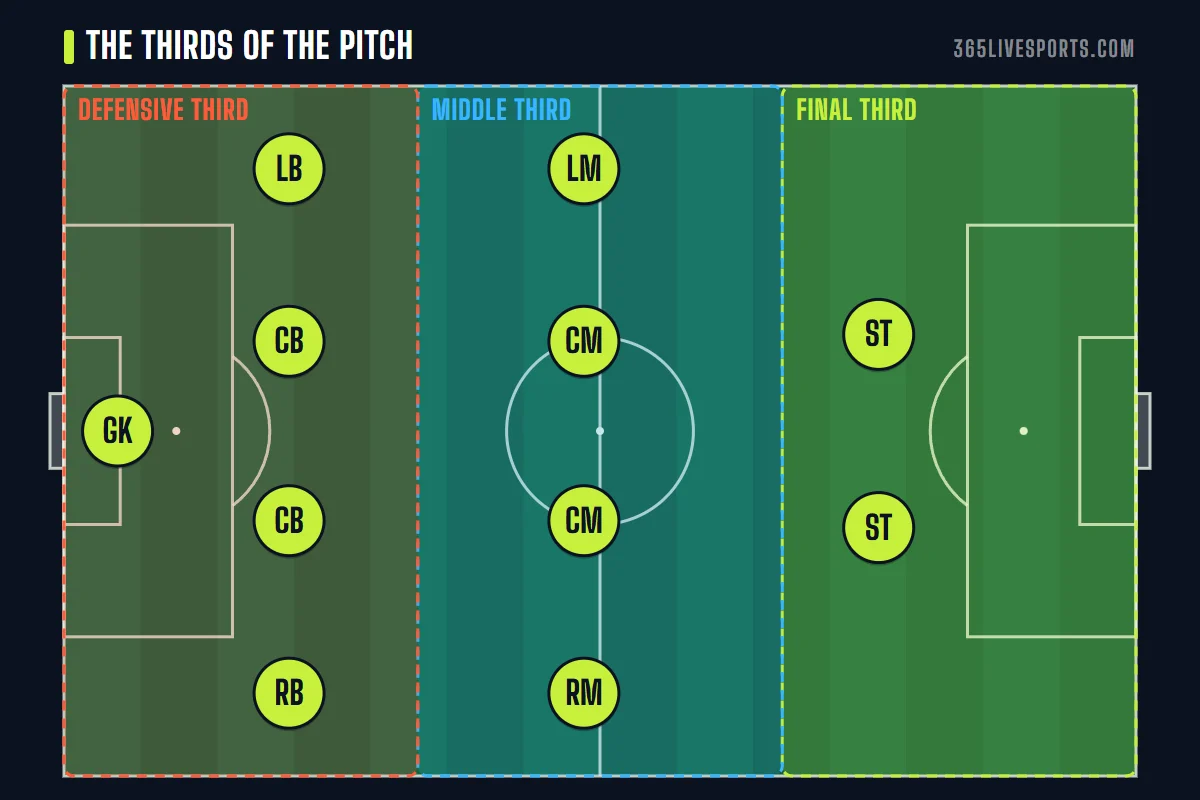
Most goals at grassroots level come from the two transitions, which is why the best youth coaches spend more time on them than on fancy build-up patterns. The thirds of the pitch give you a shared language for all four moments: "we press in the final third", "we stay compact in the middle third", "we never dribble in our defensive third".
Five ideas that explain most modern football tactics
Once you understand these five ideas, most tactics analysis you read or hear starts to make sense, and so do the diagrams on this site.
- Width and depth. With the ball, stretch the pitch: someone holds the touchline on each side and someone threatens to run in behind. That pulls defenders apart and opens gaps between them.
- Overloads. Put more of your players than theirs in one zone, for example three midfielders against two, or a full back and a winger against one defender. The free player is the one who breaks the line.
- Half spaces. The vertical channels between the wing and the middle are hard to defend because nobody is sure whose job it is. Midfielders and inverted wingers who receive there can shoot, cross or slip a pass behind.
- Compactness. Without the ball, squeeze the distances: roughly ten to fifteen yards separating the lines, and a similar gap between neighbors in each line, so the opponent has no easy pass through you.
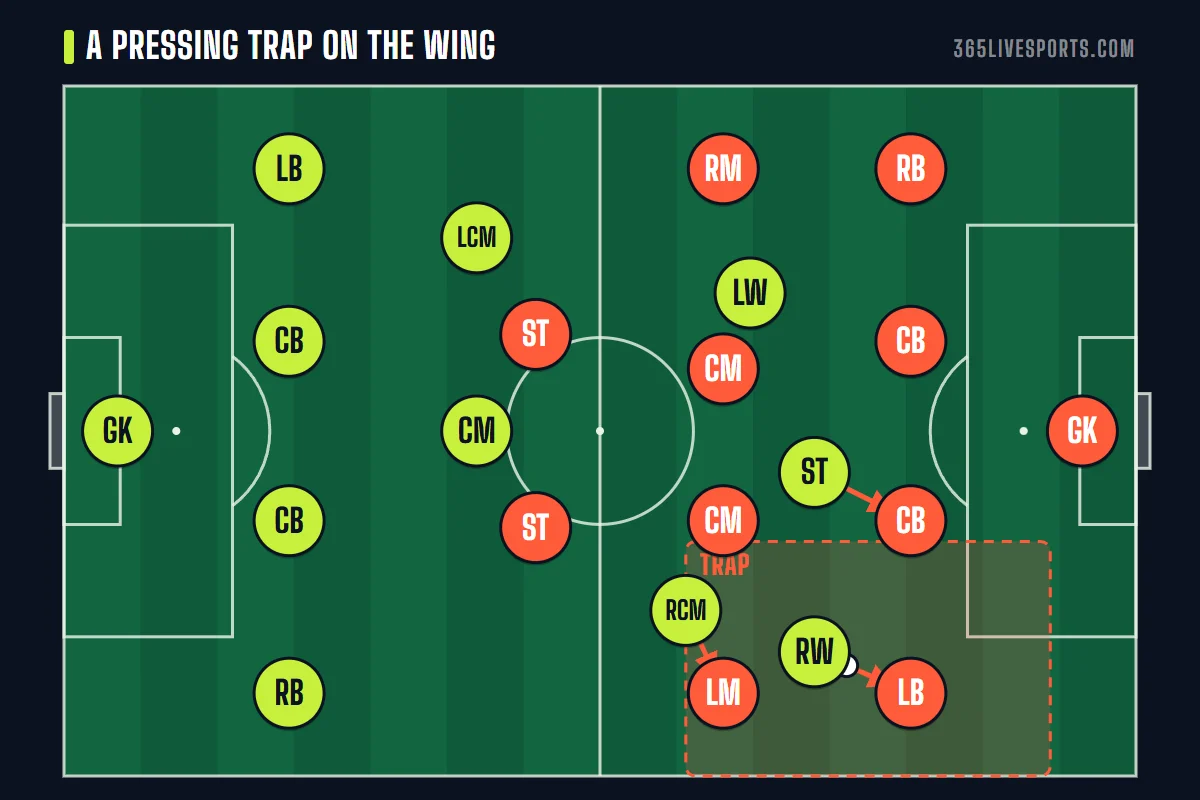
- Pressing and triggers. Decide when to jump at the ball together. A square ball out to the full back, a heavy first touch or a player facing his own goal are classic signals.
A popular modern variation on the first idea is the inverted full back: instead of overlapping, a full back steps into central midfield when his team has the ball. That adds a body in the middle to stop counterattacks and frees the winger to stay wide.
Formations: every shape explained
Start here if you want to know how a team lines up. Each page has a role table, the shape with and without the ball, variations, strengths, weaknesses and how to beat it, plus a board preloaded with that formation.
| Formation | In one line |
|---|---|
| All formations | Every shape side by side, how to read the numbers and which ones add up wrong |
| 4-3-3 | Three forwards, a midfield three; built for pressing high and keeping the ball |
| 4-2-3-1 | Two holding midfielders protect the back four, a number 10 links play |
| 4-4-2 | Two banks of four and a strike pair; simple, compact, easy to teach |
| 3-5-2 | Three center backs, wing backs and two strikers; strong through the middle |
| 3-4-3 | A back three with a front three; width from wing backs and wide forwards |
| 5-3-2 | Five defenders when the ball is lost; protects a lead or a weaker side |
| 4-3-2-1 | The narrow Christmas tree: two inside forwards behind one striker |
| 4-2-4 | Four forwards and only two midfielders; for chasing a goal late |
| 4-2-2-2 | The box midfield: two holders, two playmakers, two strikers |
| 4-1-2-1-2 | The narrow diamond; numbers in the center, width from full backs |
| 4-1-3-2 | One screening midfielder, three across and a front two |
| 4-3-1-2 | A flat midfield three with a playmaker behind two strikers |
| 4-2-1-3 | A double pivot under a 10 and a front three; a 4-3-3 cousin |
| 3-4-2-1 | Two attacking midfielders tucked behind a lone striker |
| 3-4-1-2 | Wing backs, one playmaker and a strike partnership |
| 3-1-4-2 | A single anchor in front of three center backs |
| 3-2-4-1 | The box-shaped build-up many possession sides use |
| 3-2-5 | Five attackers spread across the front line in possession |
| 3-3-4 | Four forwards and a back three; all-out attack |
| 5-2-3 | A back five that breaks with three runners |
| 2-3-5 pyramid | The early shape of organized football, with five forwards |
| Counter formations | How to set up against the shapes you meet most often |
Soccer positions and roles
A formation is only as good as the players who understand their jobs inside it. These pages explain each position and the specialist roles, with notes for coaches putting young players in the right spot.
| Position or role | What you will learn |
|---|---|
| Soccer positions | All 11 positions in one place, what each player does |
| Positions by number | What shirt numbers 1 to 11 usually mean |
| 11v11 positions | Full-sided roles for teams moving up from 9v9 |
| Youth positions | Where to play young players and why to rotate them |
| 7v7 formations | Shapes for six outfield players in U9 and U10 games |
| 9v9 formations | Shapes for eight outfield players in U11 and U12 games |
| Defense positions | Center backs, full backs, wing backs and the sweeper |
| Midfield positions | Holding, central, attacking and wide midfielders |
| Offense positions | Strikers, wingers and second strikers |
| Box-to-box midfielder | The runner who defends one box and arrives in the other |
| Regista | The deep-lying playmaker who sets the tempo |
| False nine | A center forward who drops into midfield to pull defenders out |
| Hardest positions | Which roles carry the most responsibility |
| Positions in Spanish | Position names for Spanish-speaking players and parents |
Tactics and playing styles
Two teams in the same formation can play completely different football. These guides cover the styles and defensive systems that decide how a shape behaves, and the board for planning your own.
| Style or tool | What it covers |
|---|---|
| Tiki-taka | Short passing, triangles and patient possession |
| Pressing | Winning the ball back high, with triggers and traps |
| Gegenpressing | Counter-pressing in the seconds after losing the ball |
| Low block | Defending deep and narrow to deny space behind |
| Offside trap | Stepping up together to catch forwards offside |
| Zonal marking | Defending spaces instead of following opponents |
| Tactics board | A drag and drop board to plan shapes and runs |
How to use this site to learn football tactics
- Find your shape. Open the page for the formation your team plays, or the one you keep seeing on TV, and read the role table.
- Learn the positions inside it. Follow the links to each position page, especially the one you play or the one you are struggling to fill.
- Add a style. Decide how your shape should behave: press high, sit in a low block, or keep the ball with short passing.
- Draw it. Use the tactics board to drag players into the in-possession and out-of-possession shapes, then screenshot it for your players.
- Plan for the opponent. Check the counter formations page before a game against a shape that gives you trouble.
Each diagram on the site follows the same code: your team in lime attacking to the right, the opponent in coral, dashed white arrows for runs, lime arrows for passes and coral arrows for pressing.
Attacking and defensive tactics in football
Attacking tactics in football fall into two families. Possession play moves the ball patiently through short passes until a gap opens; it needs players comfortable under pressure and lots of passing angles, the idea behind tiki-taka. Direct football tactics move the ball forward quickly, often with longer passes into a target striker or runs behind the back line, then attack the second ball. Neither is better. Direct play suits a fast front line, a heavy pitch or a team that is behind; possession suits technical players and a lead you want to protect.
Football defensive tactics also come in two families. A man-oriented defense gives each player an opponent to follow. A zonal defense gives each player a space to protect, and the team shifts together as the ball moves; most teams mix the two. The height of the block matters just as much: a high press tries to steal it close to the other team's goal, a mid block waits around halfway, a low block protects the penalty area. Teams that hold a high line often add an offside trap.
Tactics for small-sided and five-a-side football
Small games are where most players first meet tactics. In the US, the national federation's grassroots guidance starts the youngest children in tiny small-sided games, moves under-9 and under-10 teams to 7v7, under-11 and under-12 teams to 9v9, and brings in the full 11v11 game at under-13. Local leagues and clubs can and do change this, so ask your association before the season starts.
The same ideas scale down. In five a side football tactics, the two most common shapes are the diamond (one back, two sides, one pivot) and the box (two back, two forward); everybody attacks and everybody defends, and the rotations are the tactic. In 7v7 and 9v9, coaches use shapes like 2-3-1 and 3-2-3 that grow into the 11v11 formations later. Our 7v7 and 9v9 pages show each option on the pitch.
- Keep young players rotating through positions; specializing too early limits them.
- Teach one tactical idea per session, such as "make the pitch big when we have it".
- Praise the right decision even when the execution fails.
How football tactics evolved
The evolution of football tactics is a story of teams pulling players back from attack into defense and midfield. When the game first had written rules and organized clubs, teams lined up with five forwards in the 2-3-5 pyramid. The offside law changed, and sides added a third defender, which led to the W-M shape. Later, Brazilian sides popularized a back four in the 4-2-4, then pulled a winger back to make the 4-3-3. English and Soviet coaches then dropped both wingers into midfield and the 4-4-2 was born.
The modern game added the Netherlands' total football, where any player could fill any role, Italian catenaccio with its spare defender, Spanish passing football, and the intense counter-pressing first coached widely in Germany. Today the 4-3-3 is everywhere, with the double-pivot 4-2-3-1 running a close second and with back threes such as 3-4-3 used more than before. The direction of travel is clear: more pressing, more fluid positions, and fewer players who only attack or only defend.
Questions players and coaches ask
What is tactics in football?
Tactics in football are the agreed actions a team uses to control space, time and numbers during a match. They cover how the team attacks, how it defends, and what it does in the seconds after the ball changes hands. A formation is the starting shape; tactics are how that shape moves.
What are the main tactics in football?
The main tactics are pressing, defending in a block (high, mid or low), possession play, direct play and counterattacking, plus specific tools like the offside trap and zonal or man marking. Most teams combine several, for example pressing high for the first minutes and then dropping into a mid block.
What are the best tactics in football?
There is no single best tactic. The right plan depends on your players, the opponent and the score: a quick front line suits counterattacks, technical midfielders suit possession, a tired team may need a low block. The best teams can switch between two or three plans during one game.
What is the difference between strategy and tactics in football?
Strategy is the long-term plan, the style and identity a team wants across a season. Tactics are the match-day decisions that carry that plan out, such as where to press against this opponent or which full back pushes forward.
What are half spaces in football tactics?
Half spaces are the two vertical channels between the wide areas and the center of the pitch. They are hard to defend because full backs and center backs both feel responsible, so attacking midfielders and inside forwards try to receive the ball there.
How do I start learning football tactics?
Begin with one formation and learn what each position does in it, with and without the ball. Then watch a match and follow one player for ten minutes instead of the ball. Drawing what you saw on a tactics board makes the ideas stick fast.