
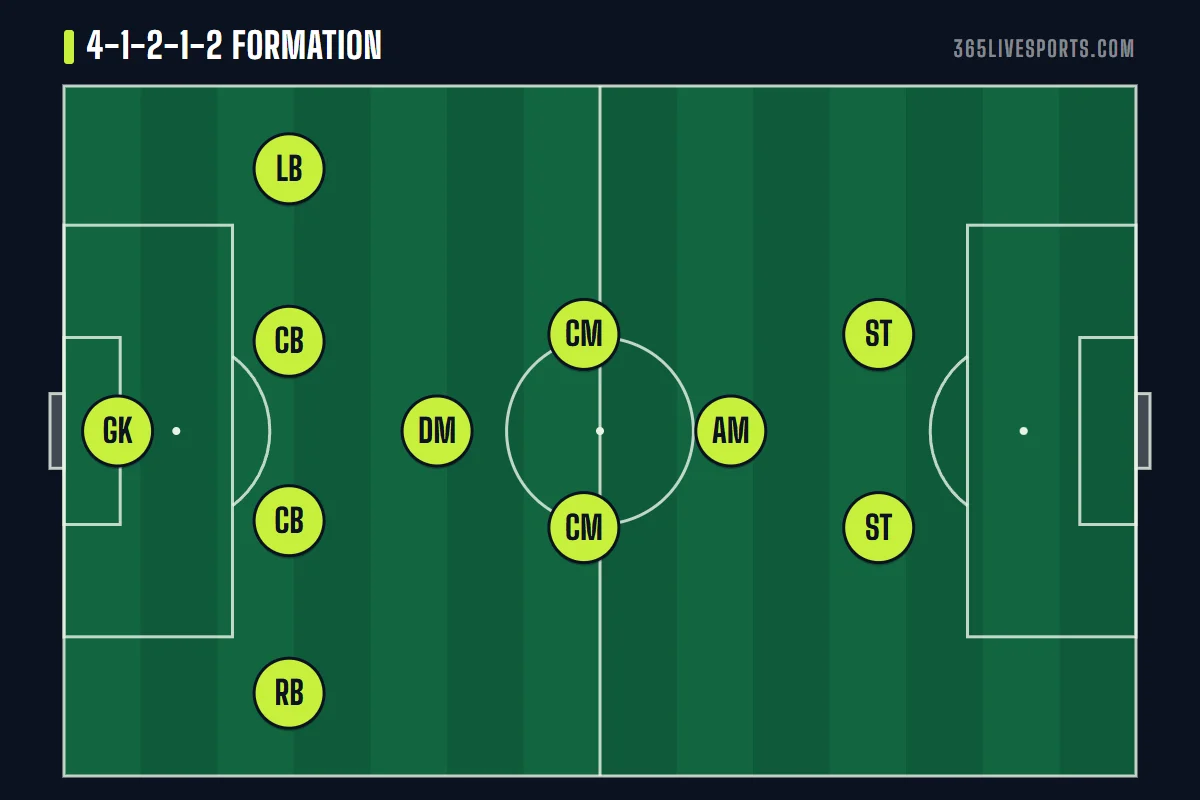
The 4-1-2-1-2 formation is the narrow 4-4-2 diamond: four defenders, then a midfield diamond with an anchor on the bottom point, a runner on each side point and a creator on the top point, with two strikers in front. Coaches choose it to win the center of the pitch and to give two forwards constant support from a number ten.
Football people use several names for this one shape: diamond, 4-4-2 diamond, narrow diamond. They all describe the same idea. What changes from team to team is how wide the two shuttlers stand, which is why you also hear about a wide and a narrow version. Below: what each player does, how the diamond attacks and defends, its well-known weak spot on the flanks, and a passing drill to teach it.
Quick facts
Shape
Back four, midfield diamond (holder, two shuttlers, ten), two strikersAlso called
4-4-2 diamond, narrow diamondBest for
Controlling the middle and feeding two strikersWeak spot
Wide areas in front of the full backsKey player
The holding midfielder at the base of the diamondMatchup
Wins the center against a flat 4-4-2; tested by a wide 4-3-3
The 4-1-2-1-2 formation in a picture
Each number is a line, read from your own goal. Four defenders. One holding midfielder sitting just ahead of the center backs. Two shuttling midfielders, one each side, often called the left and right central midfielders. One attacking midfielder, the ten, at the top of the diamond. Two strikers. Count them and you get ten outfielders plus the goalkeeper.
Join the four midfielders with a pen and you get a diamond, which is where the nickname comes from. Everybody is central except the full backs. Use the board above to slide the two shuttlers toward the touchlines and watch how the diamond flattens: that is the wide version, covered further down.
Roles inside the diamond
| Position | Attacking job | Defending job | Ideal profile |
|---|---|---|---|
| Holding midfielder (base) | Collects from the center backs, recycles, switches | Screens the back four, covers the full back's space | Calm, positionally disciplined, good passer |
| Shuttlers (left and right) | Support the full back outside, arrive late in the box | Slide wide to close down the opposition full back | Huge engine, two good feet |
| Ten (tip) | Receives between the lines, creates, shoots | Blocks the passing lane into their holding player | Creative, quick to turn, brave |
| Strikers | One stretches the line, one links | Press the center backs in pairs | A complementary duo: pace and hold-up play |
| Full backs | All the width, overlapping crosses | Defend wingers, often without a winger in front | Fit, quick, good crossers |
The base player is close to what our regista page describes when he is a passer, or a pure ball-winner when he is not.
Narrow vs wide 4-1-2-1-2 shapes
The 4-1-2-1-2 narrow formation keeps the two shuttlers close to the holder, within about 15 yards of each other. That makes the midfield very compact and hard to pass through, and gives plenty of short options. The flanks are left almost entirely to the full backs.
In the wide 4-1-2-1-2 version, the shuttlers start wider, roughly in line with the sides of the penalty area or beyond, closer to wide midfielders. It defends the flanks better and gives the full backs more help, but the gap between the shuttlers and the holder opens up, so opponents can play through the middle more easily.
| Version | Good at | Risk |
|---|---|---|
| Narrow | Central overloads, quick combinations, counter-pressing | Overlaps and switches on the flanks |
| Wide | Defending wingers, crossing positions | Holes on both flanks of the anchor |
How the diamond attacks
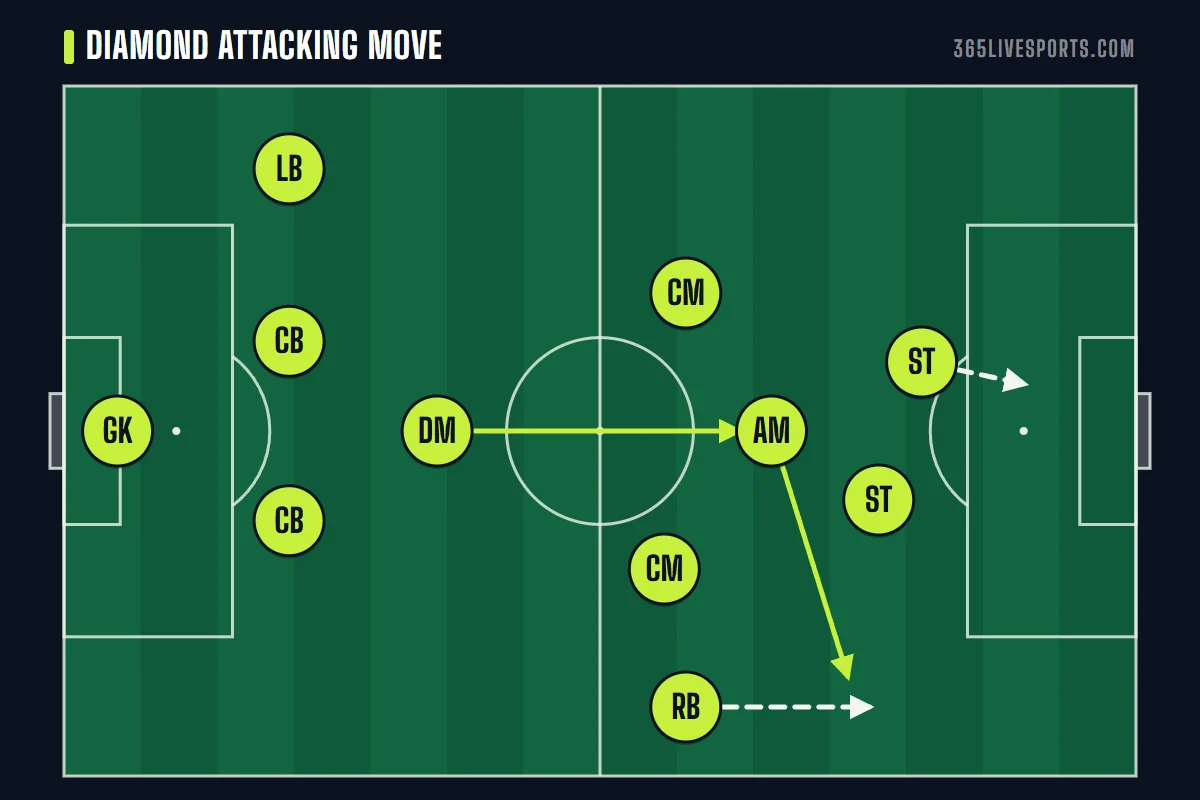
The diamond builds through the middle. The holder drops to receive, the shuttlers push up either side of the ten, and the strikers split across the width of the box. Now there are often five players around the opposition midfield, and the ten can usually find a pocket of space.
The most reliable move: a shuttler draws the opposition full back inside, the overlapping full back runs into the space he vacated, and the strikers attack the near and far posts with the ten arriving behind them. Football coaches sometimes describe this as making the field narrow on purpose so you can attack the width late.
Defending with four central midfielders
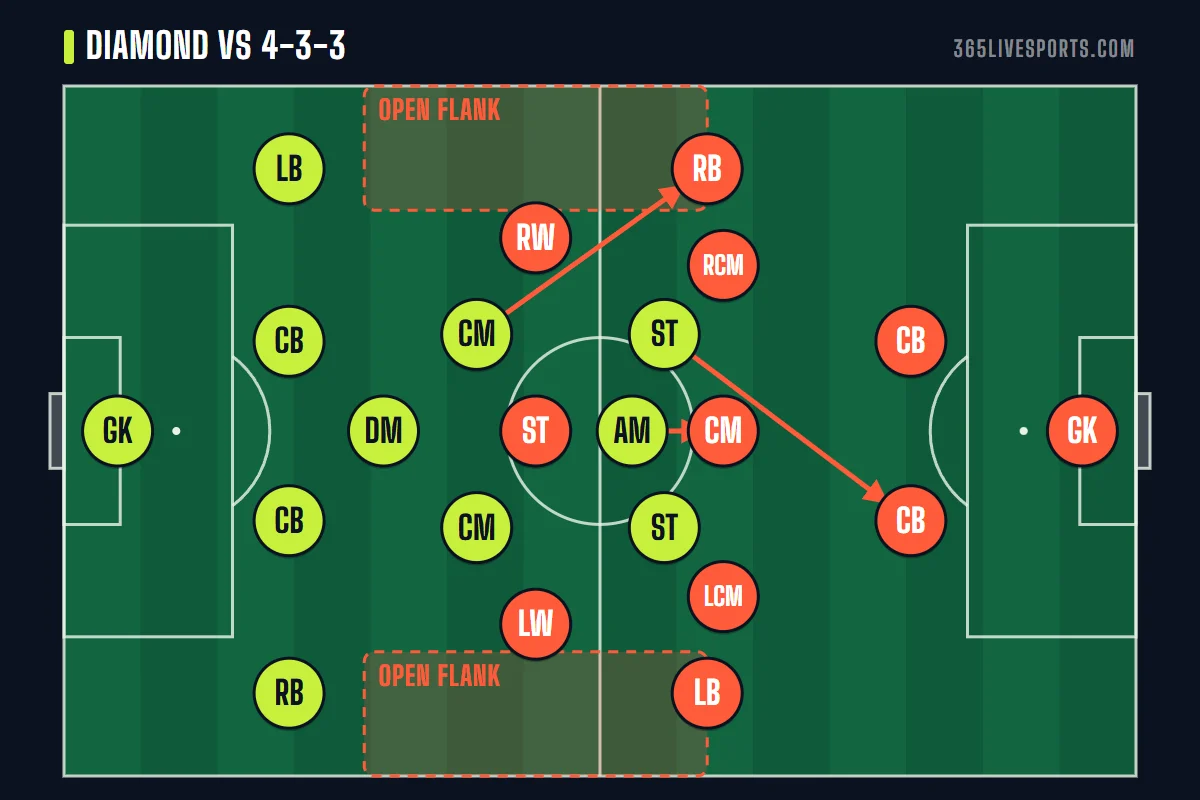
Without the ball the diamond usually holds its narrow midfield three, or flattens into two banks of four. The ten blocks the pass into the opposition holding midfielder, the two strikers screen the center backs, and the shuttlers slide out to the flanks to close down full backs. The holder guards the gap ahead of his defenders and slides with the ball.
The problem comes against a team with wingers and attacking full backs. When their full back gets forward, your shuttler must sprint a long way to close him, and if he is late, your own full back is facing two players. The picture below shows the opponent in a 4-3-3 with the danger zones in coral.
Is 4-1-2-1-2 a good formation for your team
It suits a squad with plenty of central midfielders and two strikers who like playing together. It struggles if the full backs are slow or defensive, because they provide all the width. Here is how it compares with nearby shapes:
- Facing opponents set up as a flat 4-4-2, your diamond has four central midfielders against two, a big edge in the middle.
- The 4-3-1-2 is the same family, written with the midfield three on one line.
- The 4-2-2-2 box swaps the single holder and single ten for two of each.
If the opponent pins your full backs with wingers, consider moving one striker wide and shifting to a 4-3-3 for a spell. Our counter formations guide lists the switches.
Diamond passing drill and youth advice
A classic way to teach the shape is a diamond passing pattern:
- Set four cones in a diamond, roughly a dozen yards apart (stretch it toward fifteen for older players), with a player on each and two at the base.
- The base passes to a side player, who sets it to the tip, who lays it back to the opposite side player, who returns it to the base.
- Each passer follows his pass to the next cone. Use two touches, then one.
- Add a defender in the middle once the pattern is smooth, so players must check their shoulder before receiving.
Young players in the US normally meet 11v11 at U13, after small-sided games for the little ones, seven a side for U9 and U10 and nine a side for U11 and U12; your own league's rules come first. With nine players, a 3-1-2-1-1 keeps a little diamond feel.
Questions players and coaches ask
Is 4-1-2-1-2 a good formation?
When your squad is built around central midfielders and a strike partnership, absolutely. Its weak point is width, so you need full backs who can attack and recover.
Narrow and wide 4-1-2-1-2: how do they differ?
In the narrow version the two shuttlers stay close to the holder, which makes the center very compact. In the wide version they start nearer the touchlines, which helps defend wingers but leaves gaps beside the holding midfielder.
Is 4-1-2-1-2 just another name for the 4-4-2 diamond?
Yes. The diamond 4-4-2 and this shape describe the same layout; the five-number label simply shows each line of the diamond separately.
How do you beat a diamond formation like 4-1-2-1-2?
Use width. Wingers and overlapping full backs create overloads against the full backs, and rapid changes of side force the shuttlers to run long distances across the pitch.
Who is the key player in the diamond?
Many coaches say the holder at the base, because he protects the back four on his own. Others would pick the ten, who links midfield to the two strikers and creates most of the chances.