
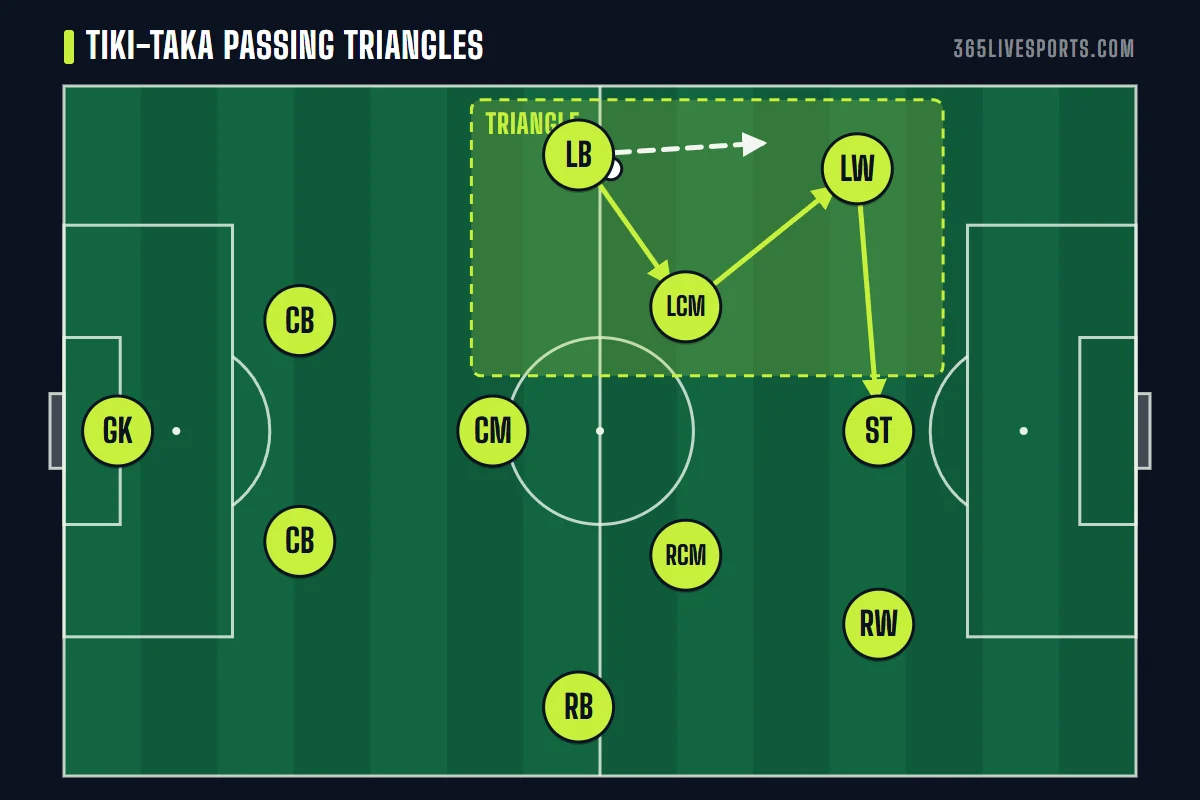
Tiki taka is a style of soccer built on short, quick passes, constant movement off the ball and keeping possession for long spells until a gap appears. It became famous through a Spanish club side and the Spain national team, who used it to dominate the ball against almost every opponent.
To a casual viewer it can look like passing for its own sake. To a coach it is a plan: move the ball fast enough that defenders are always a step late, keep players spread so there is always a free man, and win the ball back quickly when it is lost. This guide covers what the term means, where it came from, how the shape works with the ball, the roles involved, the best tiki taka formation, how to beat it and some drills you can run with your own team.
Quick facts
Style
Short passing, possession and positional playUsual shape
4-3-3 that becomes a 2-3-5 or 3-2-5 with the ballKey players
A passing pivot, two technical interior midfielders, often a false nineWithout the ball
Immediate pressing to win it back high up the pitchWeak spot
Space behind a high defensive line on fast countersRelated ideas
The Netherlands' total football, rondos, gegenpressing
What is tiki taka in football?
At its simplest, tiki taka football means the team keeps the ball with lots of short passes, usually one or two touches each, while players keep moving to offer new angles. The opponent chases, gets tired and slowly pulls out of shape. When a defender steps out of line, the ball goes through the gap.
The building block is the triangle. If the player on the ball always has two teammates at different angles, a defender can only block one pass at a time. Link enough triangles together and the ball can travel the length of the pitch without a long kick.
Tiki taka meaning and where the name came from
The words do not mean anything specific in Spanish. They imitate a sound, the tapping of a ball passed quickly back and forth, a bit like "tick-tock". Some writers also link it to a clicking toy of two balls on a string sold under a similar name. The phrase was popularized by a Spanish TV commentator who used it on air during a national team match, and it caught on from there. Some writers say it had been around before that in Spanish football, sometimes as a mocking word for passing that goes nowhere.
So who invented tiki taka? No single person. The style grew out of the Netherlands' total football ideas, which were brought to a famous Spanish club by a Dutch coach and built into its youth academy. Later coaches at that club and in the national team refined it into the version people now call tiki-taka. Many people call that Dutch coach the father of the idea, though he did not use the name himself.
How it works on the pitch
Teams that play this way follow a handful of principles:
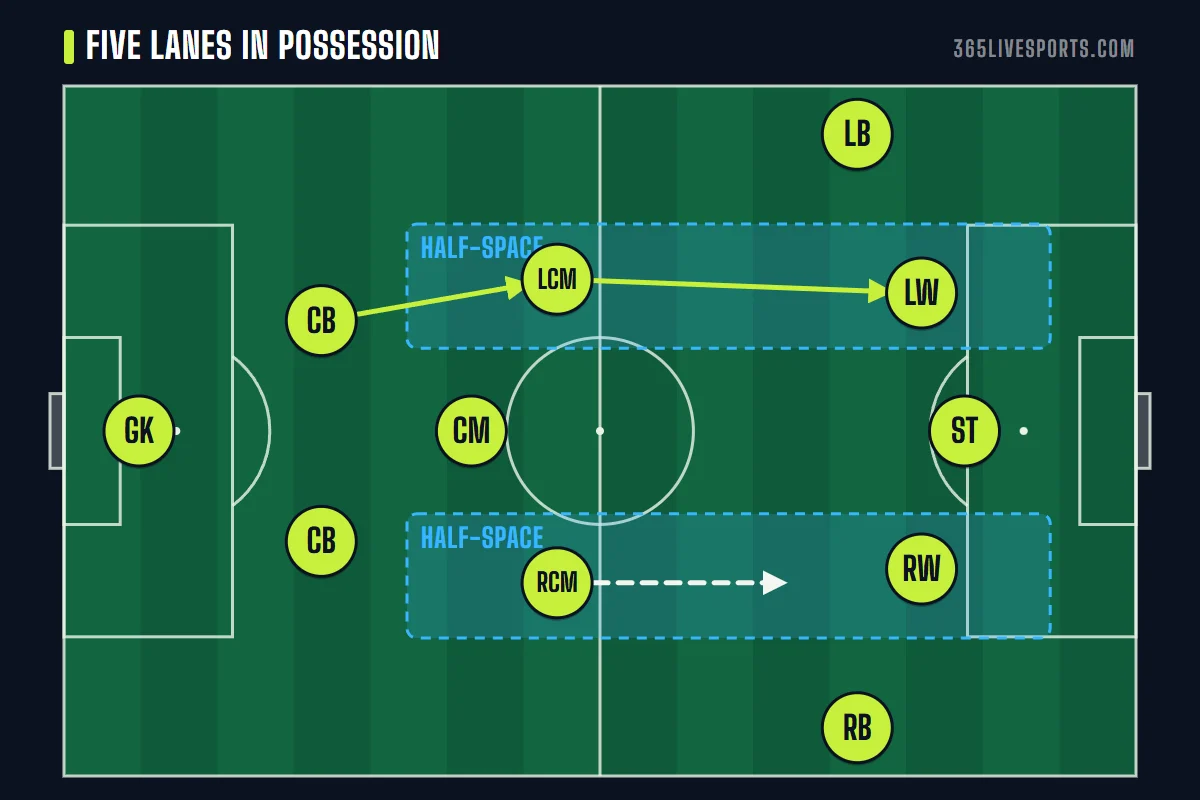
- Width and depth: imagine the pitch cut into five vertical lanes. Players avoid standing in the same lane as a teammate at the same height, so the shape always offers passing angles.
- Half-spaces: the channels between the center and the touchlines are where the interior midfielders and wingers receive, because defenders find them hardest to cover.
- The third man: A passes to B, who lays it off first time to C, who was already running. The defender watching A and B never sees C coming.
- Patience: a pass backward is fine if it moves the opponent. Teams may pass 20 or 30 times before attacking the box.
- Win it back fast: once possession goes, the nearest players press at once. See the gegenpressing guide for how that counter-press works.
The diagram shows the typical in-possession shape: a pair of center backs, a midfield three and five players spread across the front line.
Roles in the system
| Player | When we have it | When they have it |
|---|---|---|
| Goalkeeper | Acts as an extra passer in build-up | Sweeps behind a high line |
| Center backs | Split wide, carry the ball into midfield | Defend big spaces, often one on one |
| Full backs | Give width high up, or tuck inside next to the pivot | Recover fast on counters |
| Pivot (6) | Takes the ball off the defenders and switches play | Screens the middle, stops counters early |
| Interior midfielders (8s) | Find pockets in the half-spaces, combine, get into the box | Lead the counter-press |
| Wingers | Stretch the defense or attack the half-space | Press full backs |
| Center forward | Often a false nine who drops to make an extra midfielder | Presses the center backs |
The pivot is usually a passer in the mold of a regista, and much of the system depends on him being calm under pressure.
Best formation for tiki taka
Coaches usually pick the 4-3-3 because it creates triangles naturally: full back, interior midfielder and winger on each side, with the pivot linking both. A 3-4-3 works too, with the wing backs giving width and the back three adding a passer in build-up.
The formation on the team sheet matters less than the shape with the ball, which often becomes a 2-3-5 or 3-2-5. Try it yourself on the tactics board: move the full backs high and wide, bring one midfielder deep, and count how many passing angles each player has.
Tiki-taka vs total football and gegenpressing
People often compare the style with its parent and with its rival.
| Tiki-taka | Total football | Gegenpressing | |
|---|---|---|---|
| Main aim | Control the game through the ball | Any player can fill any role as positions rotate | Regain possession the instant it is lost |
| Passing | Short, patient, many passes | Mixed, with lots of movement | Fast and direct after regaining |
| Rotation of positions | Some, within a set structure | Very high | Moderate |
| Where it came from | Spain, from Dutch roots | The Netherlands | Germany |
In practice, modern teams borrow from all three. Even possession sides press hard, and pressing sides need to keep the ball once they win it.
How to beat tiki-taka
Opponents have found a few reliable answers over the years:
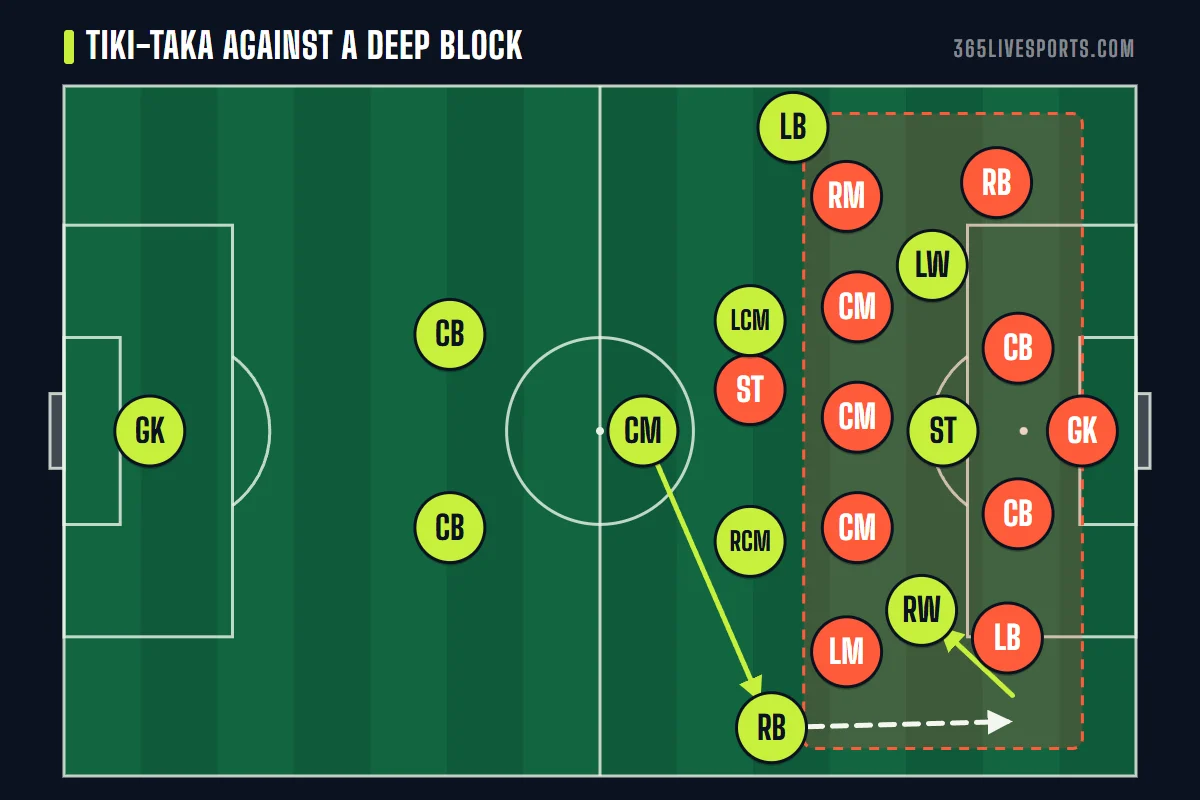
- Sit deep and narrow. A compact low block leaves little space between the lines and forces the ball wide.
- Mark the pivot. Put a forward on the deepest midfielder so the center backs have no easy pass into midfield.
- Press the trigger. Let the ball go to a full back near the touchline, then close him down hard with the touchline as an extra defender.
- Counter quickly. When you win it, go forward in two or three passes before the high line can recover.
The answer from the possession side is speed and switches: move the ball side to side quickly so the deep block has to shift, then attack the side where it is late.
Tiki taka soccer drills
Two practices cover most of what a youth or amateur team needs.
Rondo 5v2
- Mark a circle or a square of about 12 yards across. Put five passers around the edge and two chasers inside it.
- The passers are limited to two touches each. Ten passes in a row earns a point.
- Whoever gives the ball away becomes a chaser, and the chaser who won it moves out to the edge.
Positional game 4v4 plus 3
- Play in a 30 by 25 yard area. Two teams of four plus three neutral players who always play with the team on the ball.
- One neutral stands at each end and one in the middle, so the team in possession has a 7v4 overload.
- A point for each pass from one end player to the other through the middle player.
Strengths and risks of the style
The strengths are clear: the team controls the tempo, the opponent spends most of the game chasing, and defending is easier because the other side rarely has the ball. Young players who learn it become comfortable in tight spaces.
The risks are just as real. A misplaced pass in your own half can lead straight to a goal, and the high line leaves space for fast forwards. Possession without penetration also becomes slow and predictable, which is why the term "vertical" tiki-taka is sometimes used for teams that pass the same way but look forward much sooner.
Questions players and coaches ask
What does tiki taka mean in soccer?
It describes a style based on short, quick passes and constant movement to keep possession. The words themselves imitate the sound of the ball being tapped between players rather than having a dictionary meaning.
Who invented tiki taka?
Nobody invented it alone. It grew from the Netherlands' total football ideas brought to a famous Spanish club by a Dutch coach, then was refined by later coaches at club and national team level. The name itself was popularized by a Spanish TV commentator.
Which formation suits tiki taka best?
Most teams pick the 4-3-3 because it builds triangles on both sides with a pivot in the middle. The 3-4-3 is a good alternative. The shape with the ball, often a 2-3-5, matters more than the starting numbers.
What is the difference between tiki taka and total football?
Total football is about players swapping positions freely so any of them can attack or defend. Tiki-taka keeps a clearer structure and focuses on short passing and possession. The second grew partly out of the first.
Is tiki taka still used?
The pure version, with very long passing sequences, is less common now because teams press better. But its ideas, such as building from the back, positional play and quick counter-pressing, are used by many modern teams.
Can youth teams play tiki taka?
Yes, and the rondo and positional games are some of the best practices for young players. Keep the pitch size and the opponent's press in mind, and let players use longer passes when the short option is covered.