
The soccer midfield positions are the defensive midfielder (CDM), who shields the back line, the central midfielder (CM), who links the team end to end, the attacking midfielder (CAM), who creates chances, and the wide midfielders (LM and RM) on the flanks. Most teams field three to five of them, and their balance decides who controls the game.
Coaches say games are won in midfield because this is where possession changes hands most often. A midfielder touches the ball more than anyone else, faces pressure from every direction and has to defend and attack within seconds. If you like being involved all the time, this is your area of the field.
Quick facts
Holding role
CDM or DM, the 6: protects the defenseLinking role
CM, the 8: works between both boxesCreative role
CAM or AM, the 10: final pass and goalsWide roles
LM and RM: width and tracking backUsual count
Three to five midfieldersCore skill
Scanning before receiving the ball
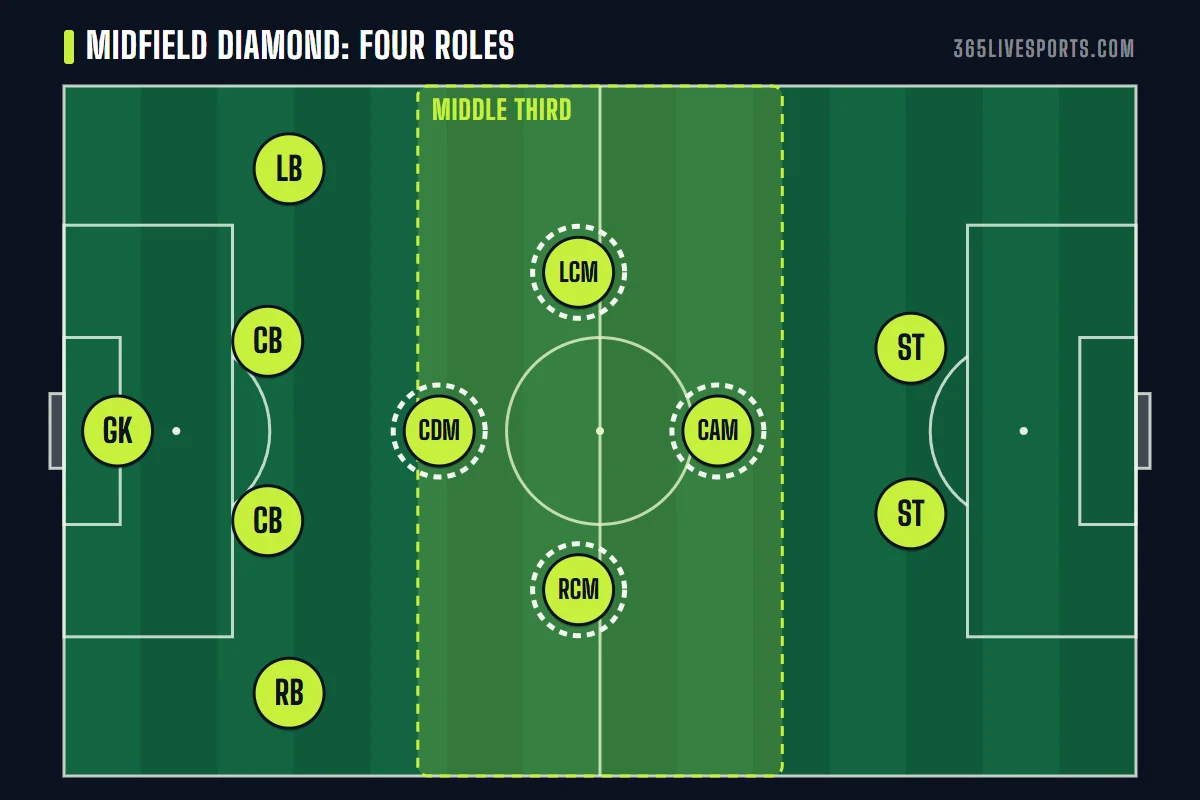
Soccer midfield positions: four jobs in the middle third
The diagram shows a midfield diamond, which happens to contain every central role at once: a holder at the base, two central midfielders on the sides and an attacking midfielder at the tip. Formations with a flat midfield, such as the 4-4-2, swap the diamond's top and bottom for wide midfielders.
The midfield has three big jobs whatever the shape: win the ball back, move it safely from defense to attack, and create chances. Each role leans toward one of these, but every midfielder does a bit of all three.
Defensive midfielder (CDM or DM)
The defensive midfielder, often called the holding midfielder, the anchor or simply the 6, operates a few yards ahead of the central defenders.
Off the ball: parks in the line between the ball and the opposing striker, stops counterattacks early and slides across to fill gaps when a full back goes forward. The best ones rarely need to tackle because they are already standing where the pass was meant to go.
On the ball: collects from the defenders and gets the team moving, often with simple two-touch passes. Some holders slot into the defensive line during build-up, turning a back four into three plus two.
A holding midfielder with excellent passing range is a regista, the deep-lying playmaker. A pair of holders next to each other is known as a double pivot, a hallmark of any 4-2-3-1 shape.
Central midfielder (CM)
The central midfielder, the 8, links defense and attack. This player covers more ground than almost anyone on the field.
Off the ball: presses opposing midfielders, recovers to help the holder and tracks runners from deep.
On the ball: takes the ball on the half-turn, plays forward when possible, supports wide players and arrives in the penalty area for cut-backs and rebounds.
When this role does heavy work at both ends, people call it a box-to-box midfielder. Italian coaching also uses the word mezzala (half-winger) for a central midfielder who drifts wide into the channel between full back and center back, which is common in a 4-3-3.
Attacking midfielder: the CAM
The attacking midfielder, the 10, plays behind the striker in the gap behind the rival midfield. This is where defenders hate to step out, because leaving the line opens space behind them.
On the ball: turns, slips the killer ball, tries shots from range and combines quickly with the forwards. Off the ball: screens the rival 6 with a curved run, forcing their build-up out to the flanks.
Many modern teams use two attacking midfielders in the half-spaces, the zones between the middle and the wings, instead of one central 10.
Wide midfielders (LM and RM)
Wide midfielders play on the flanks of a flat midfield, as in the 4-4-2. They are a little deeper than wingers and do more defending.
On the ball: hold the touchline to stretch the opponent, deliver crosses and link up with the full back behind them. Off the ball: tuck in level with the central midfielders and slide across as a unit.
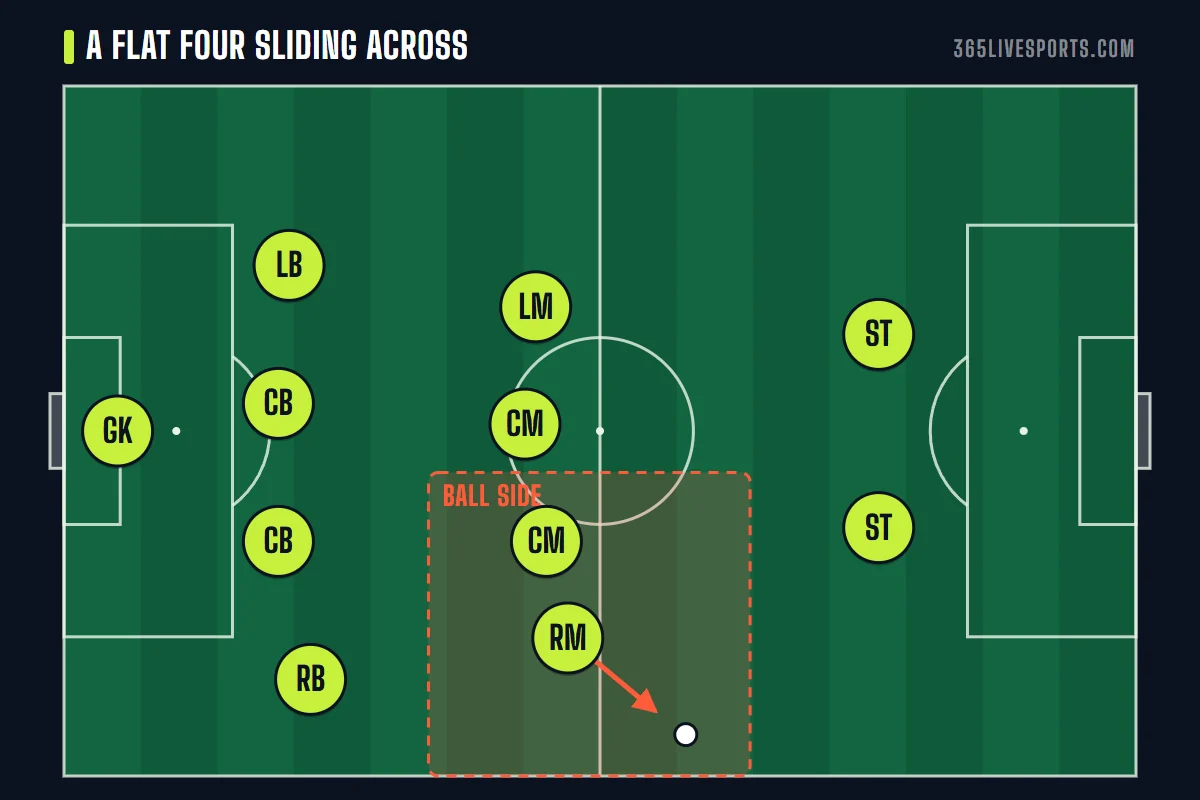
The second diagram shows a flat four sliding toward the ball on the right. The right midfielder presses, the center midfielders shift across, and the left midfielder tucks almost into the middle. Leaving the far touchline open is fine; the ball takes a long time to get there.
Midfield roles compared
| Role | Number | Zone | Main strength | Common weakness to work on |
|---|---|---|---|---|
| Defensive midfielder | 6 | Ahead of the back line | Positioning, interceptions | Playing too safe, never passing forward |
| Central midfielder | 8 | Center circle to both boxes | Stamina, linking play | Drifting out of position when tired |
| Attacking midfielder | 10 | Between the opponent's lines | Creativity, final pass | Not helping out of possession |
| Wide midfielder | 7 or 11 | Touchline, middle third | Width, crossing, work rate | Stranded upfield after a turnover |
Which midfield positions soccer formations use
- Single pivot (one holder, two 8s), found in the 4-3-3: strong in the center, but the holder can be overrun if the 8s push too high.
- Double pivot (two holders), the 4-2-3-1 way: very safe in transition, with a 10 and two wide players ahead.
- Flat four, the classic 4-4-2 setup: easy to teach and great width, but only two players in the center.
- Diamond, used by a 4-1-2-1-2: four central players dominate possession, while full backs must supply all the width.
- Five across, typical of a 3-5-2: wing-backs give width and three center midfielders control the middle.
Compare all the shapes on our formations guide.
Midfield mistakes, fixes and a rondo drill
| Mistake | Fix |
|---|---|
| Receiving square-on with no idea what is behind | Check the shoulder twice before the ball arrives, open the hips to receive |
| Both central midfielders going forward at once | Agree a rule: when one goes, the other stays |
| Hiding behind opponents | Move into the passing line between two defenders |
| Chasing the ball across the whole field | Press when it is in your zone, cover your zone when it is not |
The classic midfield practice is the rondo, a keep-ball game:
- Mark a square about 10 by 10 yards for younger players, smaller for older ones.
- Place four or five passers on the edges with one or two chasers inside.
- Passers are limited to one or two touches each. When a chaser steals the ball, the passer at fault becomes the new chaser.
- Coach the habits: scan before receiving, play into the open side, move after every pass.
For the full picture of every line, go back to the main soccer positions guide.
Questions players and coaches ask
What are the midfield positions in soccer?
Defensive midfielder (CDM), central midfielder (CM), attacking midfielder (CAM) and the wide midfielders (LM and RM). Variants include the box-to-box midfielder and the regista, a deep playmaker.
How many midfielders are on a soccer team?
Usually three to five, depending on the formation. A 4-4-2 has four, a 4-3-3 has three and a 3-5-2 has five, counting the wing-backs.
How do a CDM, a CM and a CAM differ?
The CDM sits deepest and protects the defense, the CM links both ends of the field, and the CAM plays closest to the striker and creates chances. The letters go from defensive to attacking.
What is the hardest midfield position?
Many coaches say central midfield, because the player faces pressure from all sides and must defend and attack. A holding midfielder also carries heavy responsibility, since mistakes there lead straight to chances.
What makes a good soccer midfielder?
Constant scanning, a clean first touch, passing with both feet, stamina and discipline in position. Good midfielders always know where the next pass is going before the ball arrives.