
What is pressing in football? It is a team closing down the opponent who has the ball, together and on a signal, to force a mistake and win possession back instead of waiting for them to come forward. One player chasing alone is not a press; a press is several players moving at once so that every nearby pass is covered.
Teams press at different heights and with different intensity. Some hunt it deep in the other team's half, others wait at halfway, and some barely press at all. This page explains the three heights, the triggers coaches use, how a high press is organized, what the PPDA statistic tells you, and a practice you can use with a youth or amateur team.
Quick facts
Definition
Coordinated pressure on the ball carrier and his passing optionsThree heights
High press, mid press (mid block), low blockTriggers
Back passes, passes to the touchline, a heavy touch, a player facing his own goalKey measure
PPDA: passes allowed per defensive action, lower means more intenseMain risk
Space behind the defense if the press is beatenRelated
Counter-pressing right after losing the ball
What is pressing in football, without the jargon?
Think of pressing as defending forward. Instead of retreating and protecting the goal, players step toward the ball to take time and space away from the opponent. The aims are to win the ball, to force a long kick that your defenders can head away, or at least to push the opponent toward an area where you have more players.
Three things separate a real press from random chasing: timing (everyone goes on the same signal), angles (the presser runs in a curve to block one pass while attacking the ball) and support (teammates behind move up so the next pass is also covered).
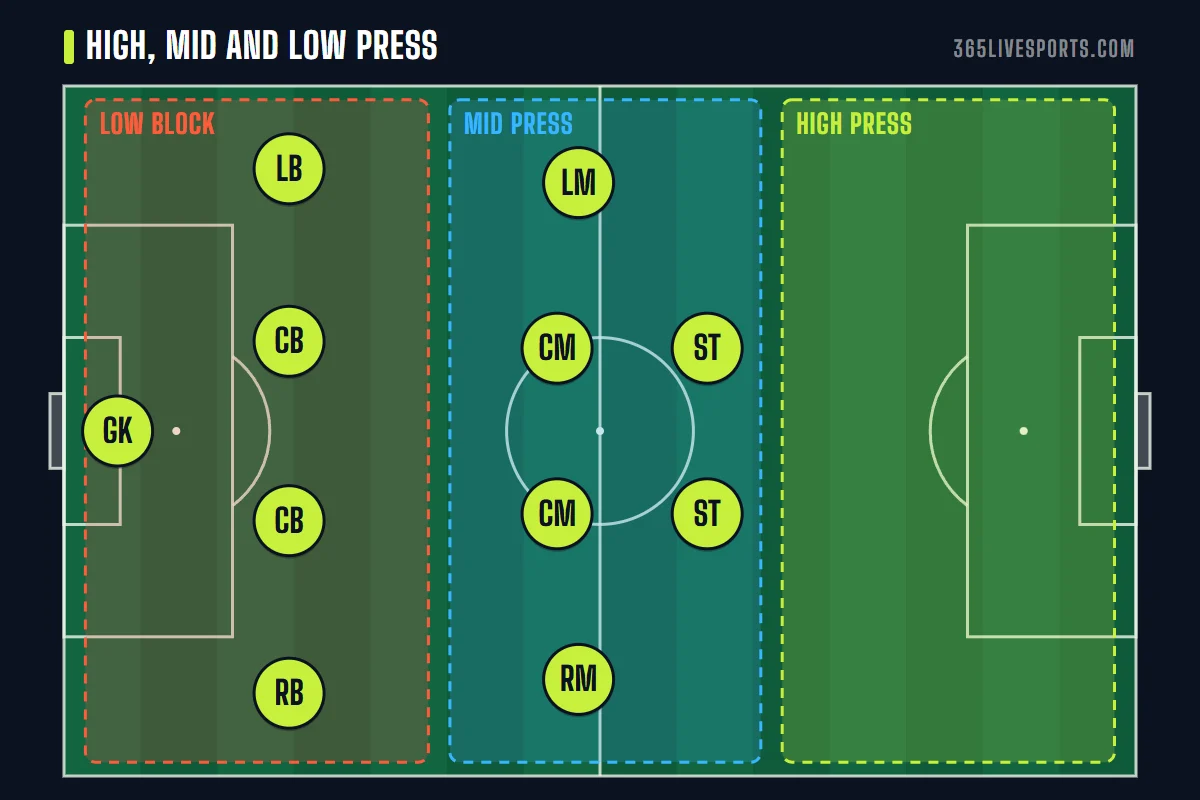
High press, mid press and low block
| Height | Where the first line starts | Aim | Main risk |
|---|---|---|---|
| High press | Near the opponent's penalty area | Win the ball close to goal, stop build-up from the back | Long ball over the press into the space behind |
| Mid press (mid block) | Around the halfway line | Let center backs have it, then press in midfield | Opponent gets time to pick a pass from deep |
| Low block | Around the edge of your own box | Protect the goal, deny space behind, counter-attack | Long spells without the ball, shots from distance |
Most teams use all three during a match. They might press high from goal kicks, sit in a mid block during open play and drop into a low block when protecting a lead. The deep option has its own guide: what a low block is and how to break it.
Pressing triggers: when to go
A trigger is a moment that tells the whole team "press now". Good triggers are situations where the opponent's options shrink. The most common ones:
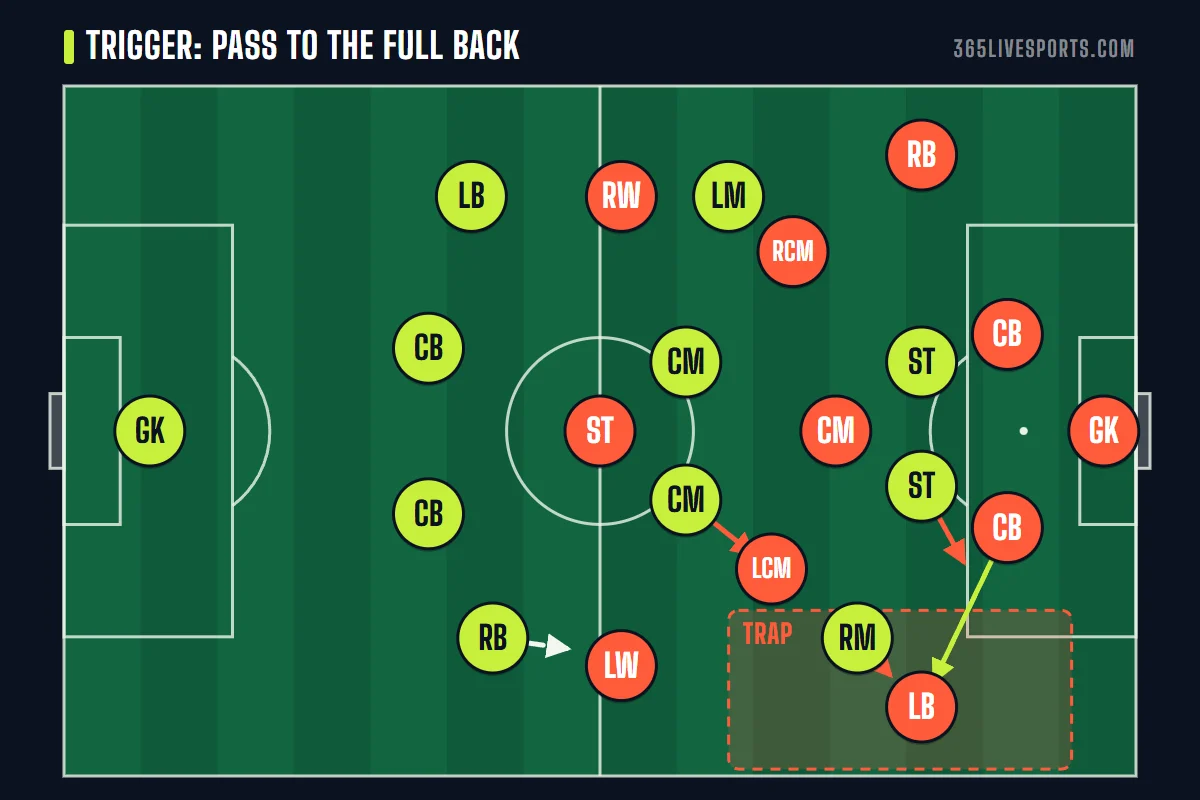
- Pass to the full back. The touchline acts like an extra defender, so the receiver has only two directions to go.
- Back pass. When a midfielder passes back to a defender or the goalkeeper, the whole team can step up together.
- Receiving facing his own goal. A player with his back to you cannot see the press coming.
- A heavy or bouncing first touch. The ball is loose for a moment, and the nearest presser attacks it.
- A slow sideways pass between center backs. It gives time to close the gap while the ball travels.
The diagram shows the classic trigger: the center back passes wide, the wide midfielder presses the full back, a striker bends his approach so the return ball to the center back is shut off, and a central midfielder steps onto the nearest opponent.
How a high press is organized
- Show them one way. The first presser angles his run to push the ball toward the touchline, not the middle.
- Use the cover shadow. A forward stands between the ball and an opponent so that the pass to that player is blocked by his body.
- Press in pairs and threes. One player goes to the ball, the next two cut the nearest passes.
- Squeeze from the back. The defensive line pushes up so the team stays compact, roughly 30 to 35 yards between the last defender and the front runners.
- Know when to stop. If the opponent plays through, the team drops back together rather than chasing one by one.
PPDA: how pressing intensity is measured
PPDA stands for passes allowed per defensive action. It counts the opponent's passes in their own build-up area and divides that number by the pressing team's tackles, interceptions, challenges and fouls in the same area. The result tells you how many passes the opponent was allowed before the pressing team tried to stop them.
A worked example: the opponent completes 120 passes in their build-up area, and your team makes 12 defensive actions there. 120 divided by 12 gives a PPDA of 10. If you made 20 defensive actions instead, the PPDA would be 6. Lower means more intense pressing.
PPDA has limits. A team that sits deep on purpose will have a high number even if it defends well, and it says nothing about where the ball was won. Use it as one clue among several, alongside where turnovers happen and how many shots follow them.
Pressing after losing the ball
Everything above is about pressing an opponent who has settled possession, for example from a goal kick. There is a second type: pressing in the seconds right after your own team loses the ball, before the opponent can organize. That is called counter-pressing, or by its German name. The gegenpressing guide covers the five-second window, the rest defense and how the two kinds of press fit together.
Many possession teams, including those playing the short passing style described on the tiki-taka page, rely on counter-pressing more than on a set high press.
Common pressing mistakes
| Mistake | Result | Fix |
|---|---|---|
| Forwards press, midfield stays deep | Huge gap, one pass beats the press | The whole team moves up on the trigger |
| Running straight at the ball | Opponent passes around the presser | Curved runs that block one pass |
| Back line stays deep | Space between midfield and defense | Defenders step up as the press goes in |
| Pressing without a trigger | Players arrive at different times | Agree one or two clear signals |
A pressing session for your team
This practice works for roughly 14 players on half a pitch.
- Set up a back four and a goalkeeper (the team in possession) against four pressers: two strikers and two wide midfielders.
- The back four tries to pass the ball through two small gates placed on the halfway line.
- The pressers may only start when the coach's chosen trigger happens, for example a pass to a full back.
- A point goes to the pressers if they win it and finish on the big goal within eight seconds.
- Progress by adding two central midfielders on each side, so the pressers must also deal with passes into midfield.
Ask players after each round: who went first, who blocked which pass, and did the back line step up? Moving pieces on the tactics board before the session helps players see the shape.
Questions players and coaches ask
What does pressing mean in football?
Pressing means putting coordinated pressure on the opponent who has the ball, and on his nearby teammates, to win possession back. It is done by several players at once, usually after a clear signal.
What is a high press in soccer?
A high press means pressing near the opponent's goal, often from their goal kicks and center back passes. It aims to win the ball close to goal, but it leaves space behind the defense if the opponent escapes.
What is the PPDA definition in football?
PPDA means passes allowed per defensive action: the opponent's passes in their own build-up area divided by the pressing team's tackles, interceptions, challenges and fouls there. A lower number means more intense pressing.
What is a pressing trigger?
A pressing trigger is a moment that tells players to press together, such as a pass to the full back, a back pass, a poor first touch or an opponent who takes the ball while turned away from play.
Which formation is best for high pressing?
Shapes with two or three forwards, for example a 4-4-2 or a 4-3-3, make it easier to press center backs. The formation matters less than the whole team moving together and the back line stepping up.
Should youth teams press high?
Simple pressing on one trigger is great for young players because it teaches them to defend as a group. Very intense full-pitch pressing is tiring, so keep it to short periods and focus on angles and timing.