

The 3-3-4 formation lines up three center backs, a flat midfield three and four forwards, normally two wingers hugging the touchlines and two strikers between them. Few shapes in soccer are more aggressive, and you will rarely see a team start a match in it. You will see it when a side is chasing a goal, in youth football where a coach wants lots of players near the ball, and as a passing phase of wing-back systems. This guide shows the roles, how the shape behaves in possession and out of it, the gaps opponents aim at, and how to close them.
Quick facts
Shape
3 center backs, 3 central midfielders, 2 wingers and 2 strikers (10 outfield players)Back line
Three, with no full backs; the wide center backs cover the channelsBest for
Chasing a late goal, pinning a back four, high pressingWeak spot
The flanks behind the wingers and the space beside the midfield threeKey player
The middle midfielder, who screens three defenders almost aloneTough matchup
A 4-3-3 with overlapping full backs
What the 3-3-4 formation looks like
Picture three horizontal bands of almost equal width. At the back, three center backs stand roughly a dozen yards from each other, with the middle one slightly deeper so he can sweep behind the other two. In front of them, three midfielders spread across the center circle. Up top, the four forwards split the field into four lanes: the wingers wide on each touchline and the two strikers in the gaps between the opposing center backs and full backs.
Move the circles on the tactics board above and you will notice the problem straight away: nobody owns the flanks between your own penalty box and the halfway line. Everything about coaching this shape comes back to who covers that ground.
Where the 3-3-4 soccer formation actually shows up
Few coaches pick a 3 3 4 formation on the team sheet, but the shape appears more often than people think:
- Chasing a goal. Down by one with ten minutes left, a coach takes off a full back, pushes the other one into midfield and adds a forward. The result is a 3-3-4 in all but name.
- Youth soccer. At 11v11 for younger teenagers, some coaches use four forwards because the opponents struggle to play out under pressure. It rewards bravery, though it can teach bad defensive habits if it is the only shape a team knows.
- Wing-back systems in full attack. When a 3-4-3 pushes both wing-backs level with its front three, the picture looks like a 3-3-4 for a few seconds. One central midfielder stays, the other joins the line.
Player roles in the 3 3 4 formation
Each line has a different job, and the middle midfielder carries the most responsibility. The table lists what each player does in both phases.
| Player | Job when we attack | Job when they attack |
|---|---|---|
| Goalkeeper | Plays short to the three center backs; sweeps behind a high line | Starts 15 to 20 yards off the line to clear balls over the top |
| Wide center backs | Step into the channel and carry the ball forward | Slide wide to stop crosses when the winger is beaten |
| Middle center back | Organizes the line, keeps a cover position | Marks the striker, calls the step up |
| Holding midfielder | Receives on the half turn, switches play | Screens the center, never chases to the wing |
| Two outer midfielders | Arrive late on the edge of the box | Shuttle wide to help the center backs |
| Wingers | Pull the defense wide, take on the full back one on one | Track the opposing full back to the halfway line |
| Two strikers | One pins the center backs, one drops to link | Press the center backs and block the pass into midfield |
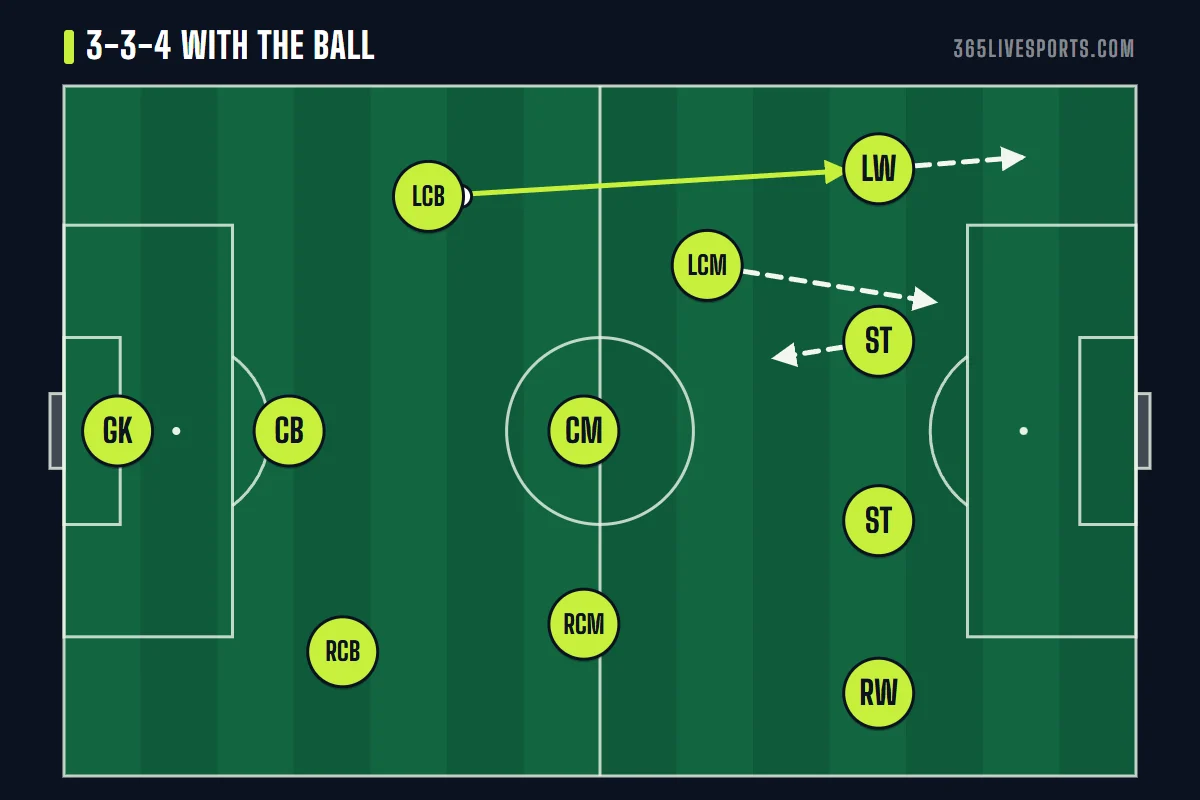
Attacking with four forwards
The point of the shape is simple arithmetic. Four forwards against a back four means every defender has a direct opponent and nobody is free to cover. If one of your attackers wins a duel, there is no spare man behind it.
To make that work, the wide center backs step forward with the ball into the space a full back would normally use, which drags the opposing wide midfielder toward them and opens a lane to the winger. The strikers split: one stays on the shoulder of the last defender, the other drops into the pocket in front of the defense to receive. The outer midfielders then run beyond that dropping striker.
Crosses are the main source of goals. With two strikers and a far-side winger attacking the box, you have three targets plus a midfielder arriving at the penalty spot.
Defending in a 3-3-4 formation in football
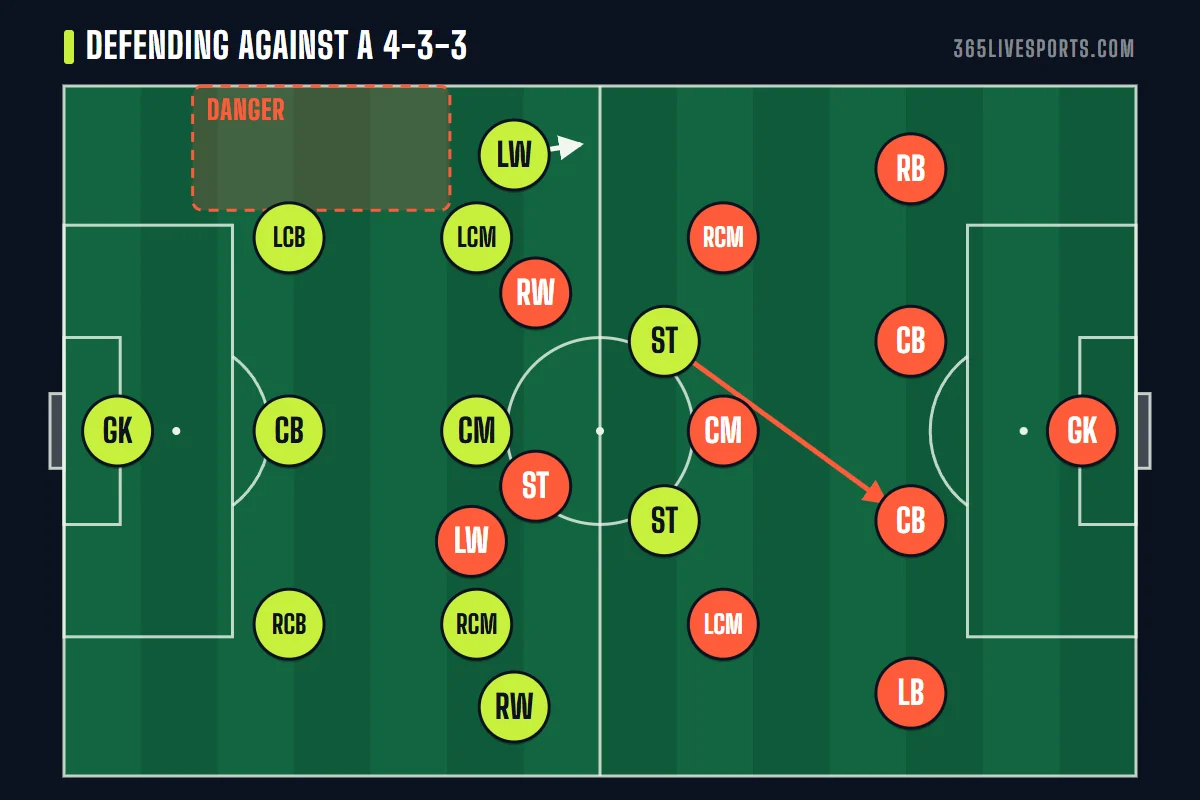
No team can defend for long with four players up front, so the shape changes the moment the ball is lost. The usual answer is that both wingers retreat to midfield height, turning the team into a 3-5-2. If the opponent pushes deeper still, the wingers keep going and become wing-backs in a 5-3-2.
The strikers have the other half of the job. They press the two center backs from the outside in, so the ball goes to a full back, and then the nearest winger jumps out to close that full back down. That trigger only works if the winger is already back at midfield height when the pass is played.
Strengths and weaknesses
| Strengths | Weaknesses |
|---|---|
| Four forwards pin a back four and stop full backs from joining the attack | The flanks behind the wingers are empty when the ball is lost |
| Many bodies in the box for crosses and rebounds | A single holding midfielder can be overrun by a midfield three |
| A high press with four players can force long, hopeful clearances | Three center backs face wingers and overlapping full backs at the same time |
| Easy to switch into from a back four late in a game | Tiring: the wingers must cover the whole touchline |
How it gets beaten, and what to change
A good opponent will switch the ball quickly to the side your winger has left, then overlap with its full back. Against a 4-3-3, that leaves your wide center back facing two attackers almost every time. You can respond in three steps:
- Tell the far winger to drop first, before the ball is switched, so the team defends in a 3-5-2 rather than a 3-3-4.
- Ask the outer midfielder on the ball side to slide over and double up with the wide center back.
- If the problem keeps repeating, change shape: move one forward into midfield and play 3-4-3 or 3-5-2 until the game settles.
The other route for opponents is through the middle, playing around your lone holding midfielder. A midfield diamond or a 4-2-3-1 with a busy number 10 will look for that pocket. Pull one striker back to sit on their deepest midfielder when you defend.
Who should use it, plus a practice idea
Use the 3-3-4 soccer formation for short spells: the last fifteen minutes when you need a goal, or against a weak side that cannot pass out from the back. A team with quick, hard-working wingers and a calm, positionally sharp holding midfielder has the best chance of making it hold together.
For a broader view of where this shape sits among the others, compare it with the full list of formations.
Questions players and coaches ask
What is a 3-3-4 formation in soccer?
It is a shape with three center backs, three central midfielders and four forwards, usually two wingers and two strikers. It is built for attacking and is mostly used for short periods, such as chasing a goal.
Should youth teams try the 3-3-4 soccer formation?
It can be fun for a game or two because lots of players get near the goal. Over a season it can teach wingers to skip defending, so rotate players through it and teach a more balanced shape as the main plan.
How do you defend in a 3 3 4 formation?
The two wingers drop back to midfield to make a 3-5-2, and further to make a 5-3-2 if the opponent keeps the ball. The strikers press the center backs and push the play wide.
What formation beats the 3-3-4?
A 4-3-3 with attacking full backs causes the most trouble, because it creates two against one on your wide center backs. A shape with a number 10 can also overload your lone holding midfielder.
How does a 3-3-4 differ from a 3-4-3?
A 3-4-3 has four midfielders, including two wing-backs, and three forwards. The 3-3-4 moves one of those midfielders into the front line, so it gains an attacker and loses wide defensive cover.
Can you play the 3-3-4 formation in football at a high level?
Rarely as a starting shape. Senior teams mostly reach it during a game, when a coach goes all in for an equalizer or when wing-backs push up in a three-at-the-back system.