
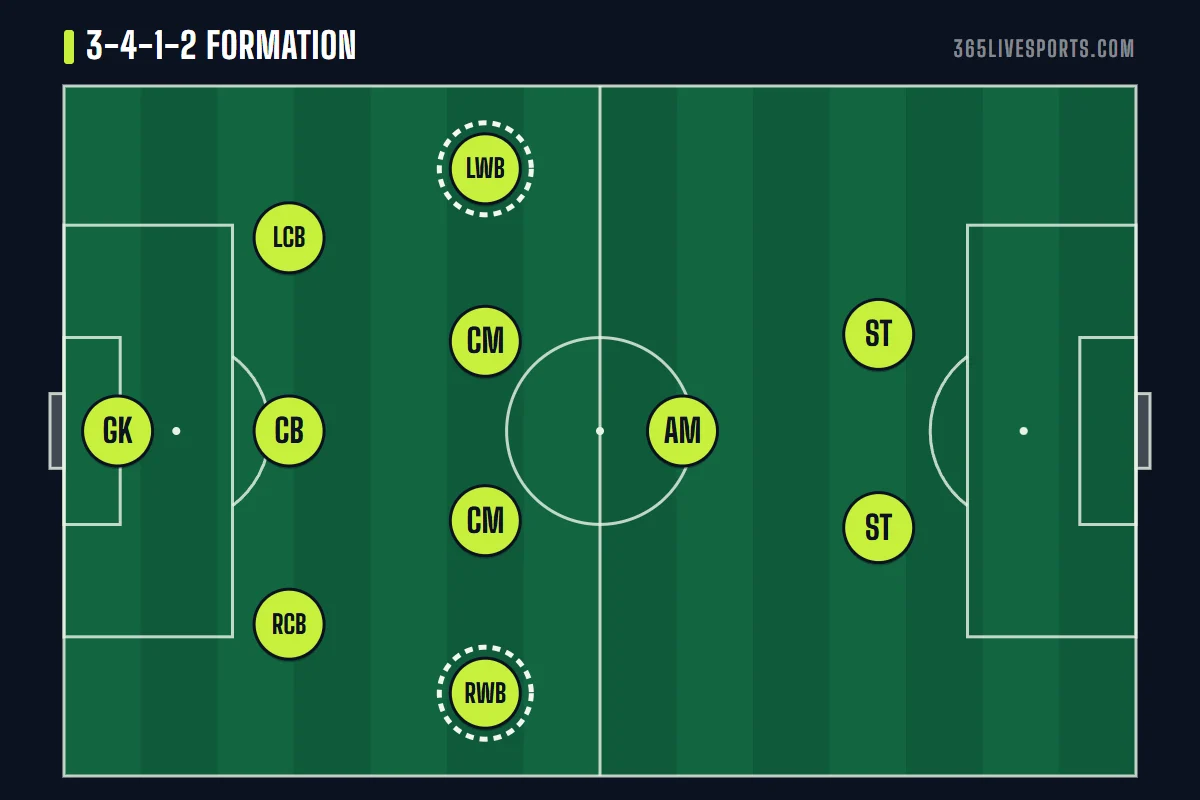
A 3-4-1-2 formation has three center backs, a midfield four made of two wing-backs and two central midfielders, a single attacking midfielder and a pair of strikers up front. You can read it as a 3-5-2 that swaps a third central midfielder for a true number 10. The team gets a playmaker and a strike pair through the middle, while the wing-backs give it width on both flanks. The cost is a thinner central midfield, so the shape needs hard runners in the middle and wing-backs who can last ninety minutes.
Quick facts
Shape
3 center backs, 2 wing-backs, 2 central midfielders, 1 number 10, 2 strikersWidth
Only the wing-backs start wideDefends as
A 5-2-1-2 or 5-3-2 with the 10 dropping inBest for
A team with a creative 10 and two strikers who like to play togetherWeak spot
Either side of the two central midfieldersTricky matchup
A 4-3-3 that overloads midfield and pins the wing-backs
How the 3-4-1-2 formation lines up
From the back: three center backs spread roughly as wide as the eighteen-yard box. A line of four sits in front of them, with wing-backs on each touchline and two central midfielders in the middle, roughly 15 yards apart. The 10 is alone in the space just behind the strikers, while the strike partners hover near the opponent's center backs.
Notice the hole between the wing-backs and the central pair. On the interactive tactics board higher up this page, you can drag a wing-back inside to see how quickly that hole closes, and how quickly the flank opens instead.
Player by player
| Player | Where | Key tasks |
|---|---|---|
| Left and right center backs | Wide of the box | Defend the channels, dribble out into midfield |
| Middle center back | Central, slightly deeper | Cover, organize, win headers |
| Wing-backs | Touchline, whole length | Provide width and crosses; drop into a back five |
| Two central midfielders | Center circle | One holds, one supports; both screen the 10's gaps |
| Number 10 | Between the lines | Create chances, link to strikers, press the opposing 6 |
| Two strikers | Near the center backs | One runs in behind, one comes short or wide |
New to the wing-back job? Our page on soccer defense positions explains how it differs from a full back.
Attacking in the 3-4-1-2 soccer formation
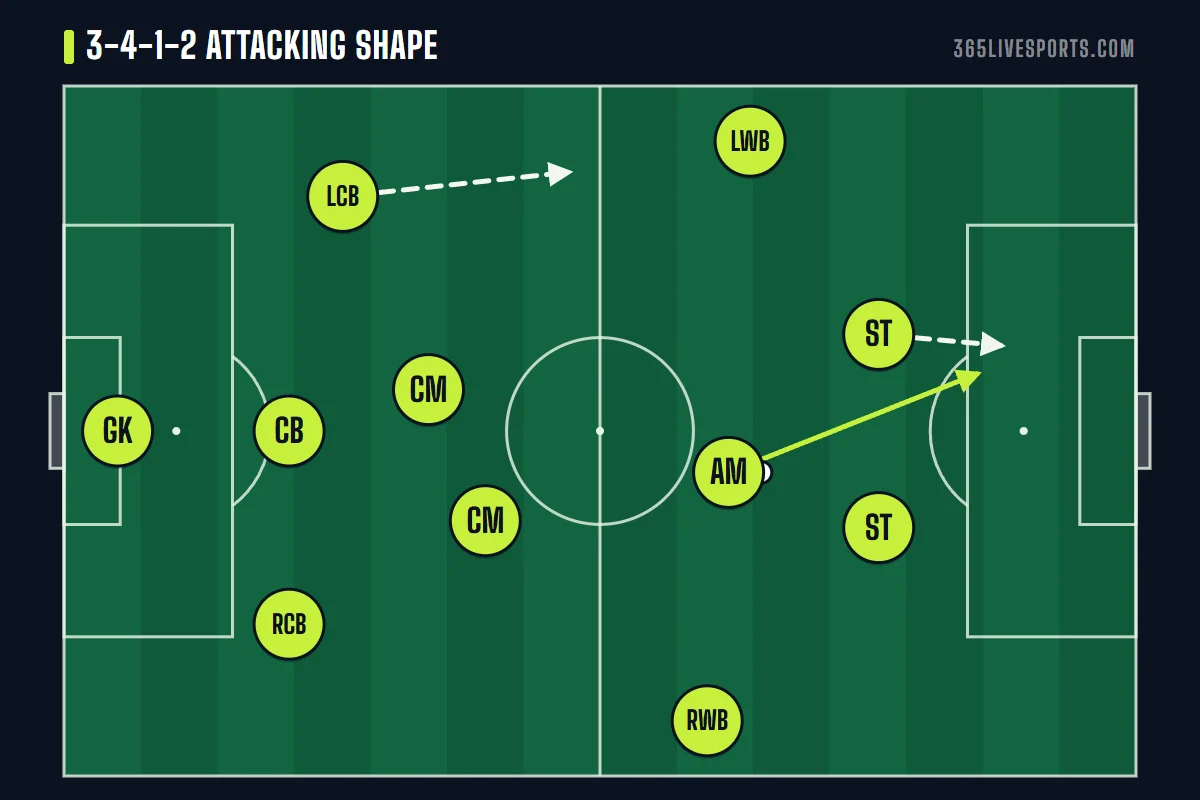
With the ball, the wing-backs push as high as the 10, the wide center backs move out toward the touchline and one central midfielder drops to collect from the defense. That makes a 3-1-4-2 or even a 3-1-3-3 picture where five players attack the back line.
Look for three patterns. The first is the switch: the opponent slides toward one wing-back, so you swing the ball to the other. The second is the 10 receiving between the lines, then sliding a pass between the center backs for a striker. The third is the overlap of a wide center back on the outside of his wing-back, which creates two against one on the flank.
Defending: five at the back and a 10 who drops
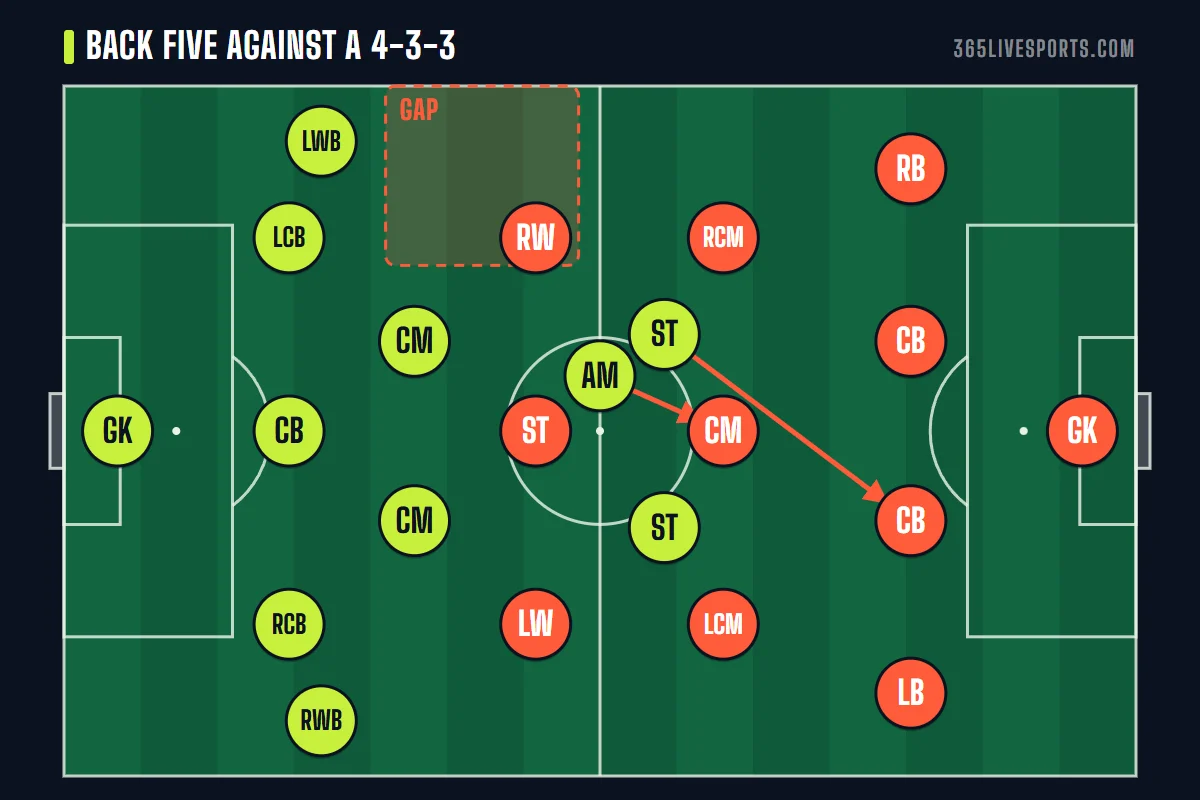
Without the ball, both wing-backs drop to make a back five. The two central midfielders stay compact, and the 10 drops beside them to form a midfield three, giving a 5-3-2 block. Up front, the pair presses the two center backs and try to keep the ball out of the middle.
If the 10 is lazy, it becomes a 5-2-1-2 with two tired central midfielders covering the full width. Make the 10's defensive job clear before the match: mark the opponent's deepest midfielder and drop level with the midfield when the ball goes wide.
Matchups for the 3 4 1 2 formation
| Against | The problem | What to change |
|---|---|---|
| 4-3-3 | Three midfielders against your two, wingers pin your wing-backs | The 10 drops to make three; a wide center back steps up on their 8 |
| 4-4-2 | Mostly good: your back three outnumber their two strikers | Free the spare center back to carry the ball into midfield |
| 4-2-3-1 | Their number 10 lurks between your two midfielders | Middle center back steps out to meet him |
| 3-5-2 | Mirror match, many one on one duels | Win the second balls; the side with the better 10 usually wins |
Strengths, weaknesses and the usual fix
The strengths are easy to list. Two strikers and a 10 give you three central attackers. Three center backs comfortably handle a front two. And the wing-backs allow you to defend with five and attack with five.
The weaknesses all come from the middle being thin. The two central midfielders must cover a lot of ground, so a team with a midfield three can circulate the ball around them. A wing-back caught upfield leaves a huge space for a winger to run into.
The usual fix is a midfield adjustment rather than a new formation: tell the 10 to drop level with the midfield or switch to a 3-5-2 for a spell.
Who it suits and a session to try
The 3-4-1-2 suits a squad with good center backs, two strikers you want on the field together and a true playmaker. At youth level it is a good way to give a creative player a free role while teaching others the demands of a back three.
See the full set of shapes on our football formations hub.
Questions players and coaches ask
What is a 3 4 1 2 formation?
A back three, a wing-back on each side, a central pair, a number 10 and two strikers. The wing-backs provide all of the width, and the 10 links the midfield to the strike pair.
Is a 3-4-1-2 just a 3-5-2?
Close, but not the same. A 3-5-2 normally has three central midfielders, while the 3-4-1-2 turns one of them into an attacking midfielder who plays just behind the strikers.
How does the 3-4-1-2 soccer formation defend?
The wing-backs drop into a back five and the 10 drops into midfield, which makes a 5-3-2. The two strikers press the opponent's center backs.
What beats the football formation 3-4-1-2?
A 4-3-3 with active full backs and a strong midfield three. It outnumbers the two central midfielders and pins the wing-backs back with wingers.
What kind of players do you need for a 3-4-1-2 formation?
Three solid center backs, two very fit wing-backs, two hard-working central midfielders, a creative 10 and two strikers who understand each other's runs.