
This football tactics board is a free online pitch you can use on a phone, tablet or laptop: pick a formation, drag the players where you want them, add an opponent and draw runs and passes. Think of it as a football tactics maker that works like the magnetic whiteboard in a locker room, without the lost magnets.
Below the board you will find how to use each part, how coaches use a tactics board for team talks and at half-time, and some exercises that turn it into a teaching tool for players.
Quick facts
Cost
Free, in the browser, nothing to install.Shapes
Every formation covered on this site, from 4-3-3 to the 2-3-5 pyramid, plus youth shapes.Opponent
Add a second team in a different shape to plan a matchup.Drawing
Arrows for runs and passes to show movement.Best use
Pre-match talks, half-time fixes and teaching positions.
How to use the football tactics board
- Pick a shape. Choose your formation from the list. Eleven players appear on the pitch with role labels such as GK, CB, DM and ST, set in the starting positions used on our formation pages.
- Drag players. Touch or click a player and move the disc. Use this to show how the team looks in possession (full backs high, a midfielder dropping) and without it (wingers back in line with the midfield).
- Add an opponent. Add the second team and set it in the shape you expect. Now you can see who is free, where you are outnumbered and who should mark whom.
- Draw runs and passes. Add arrows for a player's run and for the path of the ball. Keep it to three or four arrows per picture so players can follow it.
- Share it. Take a screenshot on your phone and send it to your team chat, or put the device in the middle of the huddle.
Every formation page on this site opens the same board, already set to that shape, so you can start from a 4-3-3 or 4-4-2 page and adjust from there.
Reading a board: colors and arrows
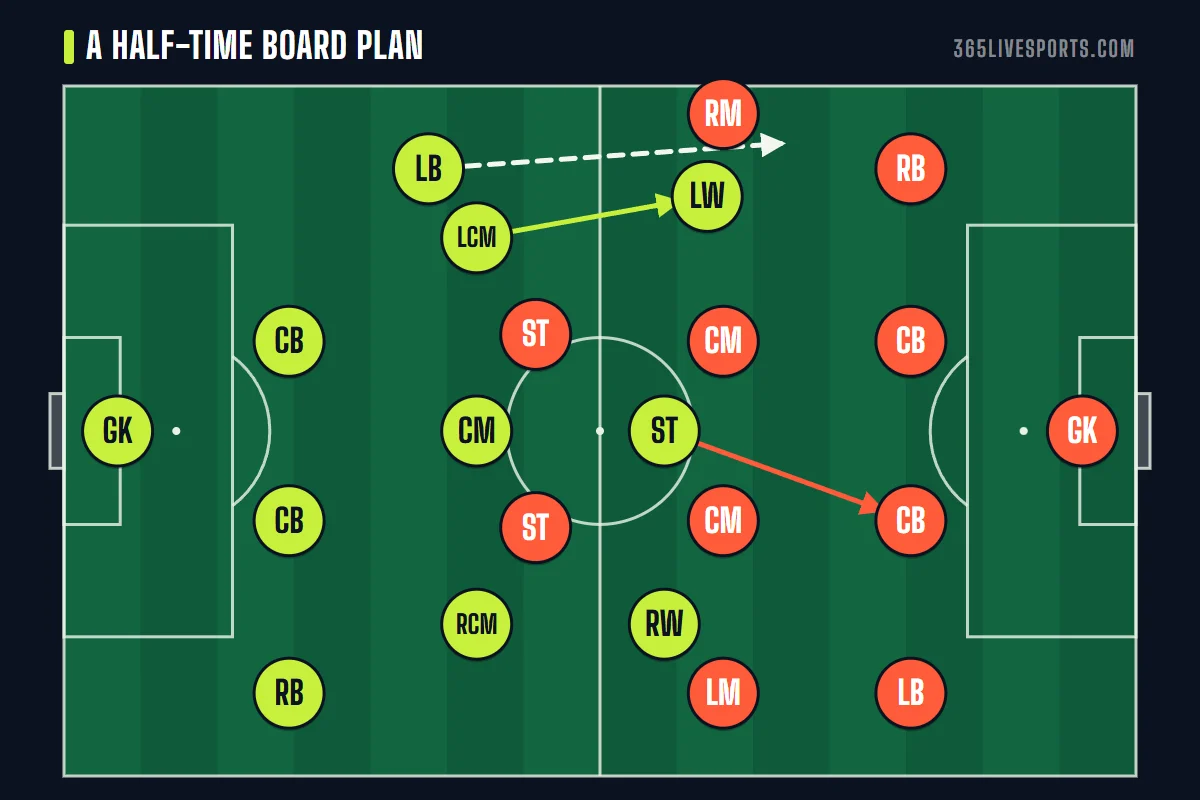
The diagrams on this site use one simple code, and it helps to draw your boards the same way so players learn to read them at a glance: your team attacking in one direction, the opponent in a contrasting color, a dashed line for a player's run without the ball, a solid arrow for a pass, and a different color for a press.
- Runs show where a player goes: an overlap, a run in behind, a winger tracking back.
- Passes show where the ball goes: the switch of play, the pass into the striker.
- Pressing arrows show who jumps at whom when the trigger happens.
The picture below is a typical half-time board: one pass, one run and one press, each with a clear owner.
How coaches use a tactics board for team talks and half-time
Before kick-off, a coach uses the board to set the starting shape and two or three key ideas: who presses first, where we attack, what happens at set pieces. Players remember a picture far better than a list of instructions, especially young ones.
At half-time the board becomes a diagnosis tool. You have about ten minutes, and the players are tired and emotional, so be brief:
- Show one problem. Put the opponent in the shape they really played, not the one on their team sheet, and point at the free player who hurt you.
- Show one fix. Move a single player (the striker dropping onto their holding midfielder, a winger tucking in) and draw the new job.
- Ask one player to repeat it. If the player with the new job can explain it back, the message landed.
Online football tactics board vs magnetic tactics board
| Online board | Magnetic or dry-erase board | |
|---|---|---|
| Setup time | Pick a formation and the players appear | Place every magnet by hand |
| Opponent shape | One click | Second set of magnets |
| Sharing | Screenshot to the team chat | Photo of the board |
| Weather | Phone screens can be hard to read in sun | Works anywhere, rain or shine |
| Group size | Best for small groups or sent to phones | Whole squad can see one big board |
Many coaches use both: the online board to plan at home and send to players, a magnetic board on the bench on match day.
Exercises for a football coach tactics board
- Rebuild a goal. Watch a goal from a match, then rebuild it on the board player by player. Which pass broke the line? Who made the run nobody tracked?
- Find the free player. Put your formation against your next opponent's and count players in each line. Where is the spare one, on both sides?
- Press triggers. Draw the opponent's center back on the ball and ask a player to drag your front three into the right pressing positions. Then move the ball to the full back and repeat.
- Position quiz. Move one player out of position and ask the team what is wrong. Great for youth sessions on a rainy day.
- Set pieces. Plan corner and free kick routines: who blocks, who runs near post, who stays back.
- Compare two shapes. Switch between a back four and a back three and discuss what changes for the wide players.
For ideas on what to draw, start with the pressing guide, the low block and the full formations list.
Tips for a clear football tactics whiteboard
- One idea per board. If you need a second idea, make a second board.
- Show the starting position and the end position; skip the steps in between.
- Label the player who must act, not everybody.
- For youth players, use the board for questions more than answers: "where should our left back be now?"
Questions players and coaches ask
Is this online football tactics board free?
Yes. The board runs in your browser on this page, with nothing to install and no sign-up. Open it on a phone, tablet or computer.
Can I use the tactics board on my phone?
Yes. Players can be dragged with a finger, and the page is built for phone screens. For a group talk, a tablet or laptop is easier for everyone to see.
Can I add an opponent to the board?
Yes. Add the second team, set it in the opponent's shape, then move both teams to plan the matchup and see where you have spare players.
How do I share a board with my team?
Take a screenshot once the players and arrows are set, then send it to your team chat or print it for the locker room. It is the quickest way to get a plan into players' hands before a game.
What is a football tactics board used for?
Coaches use it to show formations, explain each player's job, plan against an opponent, fix problems at half-time and design set pieces. Players use it to learn positions and to understand what they watch.