
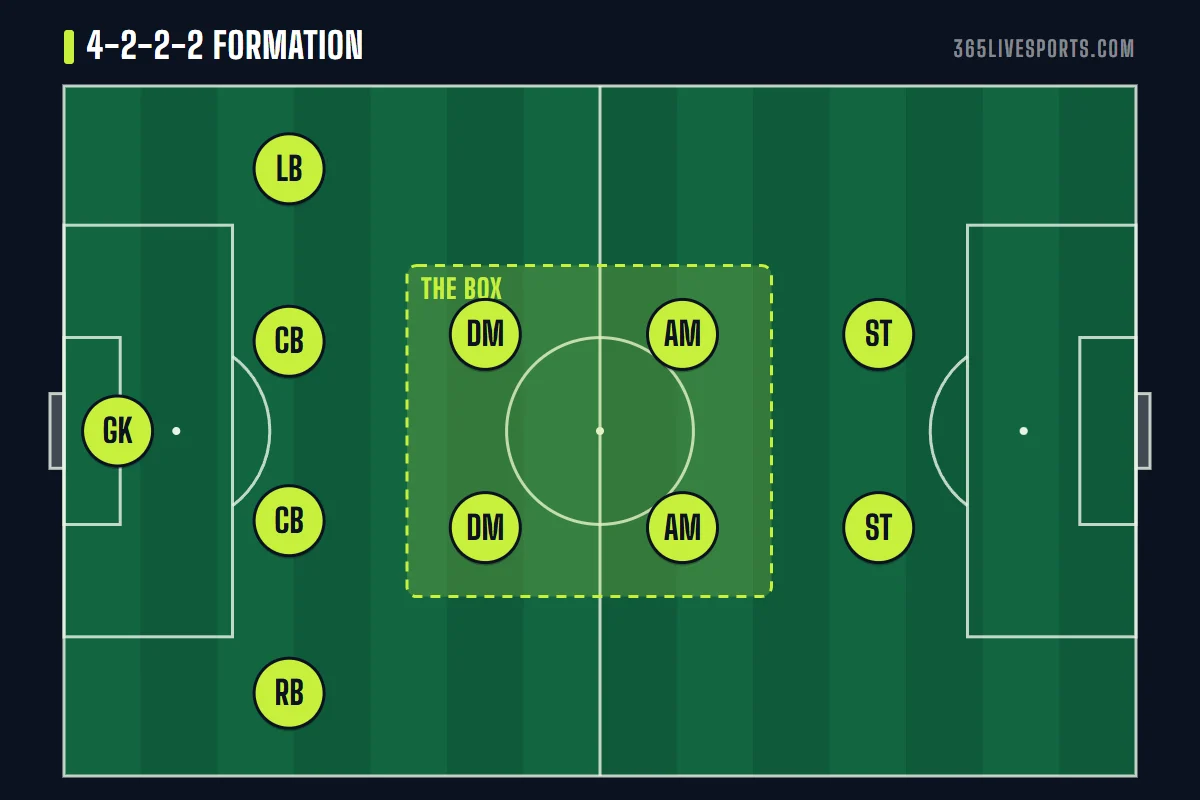
The 4-2-2-2 formation places two holding midfielders and two attacking midfielders in a square in front of a back four, with two strikers on top, so the whole middle of the team forms a box. There are no wingers at all; width belongs to the full backs.
It is a shape with two very different personalities. Brazilian teams made it famous as an expressive, creative system, sometimes called the magic square. Later, high-pressing coaches from German-speaking countries rebuilt it as a narrow trap that wins the ball back in central areas and attacks the goal within seconds. This guide explains both versions, every role, and how to stop opponents exploiting the empty flanks.
Quick facts
Shape
Back four, two holders, two narrow tens, two strikersNickname
Box midfield, magic squareWidth
Full backs only; no wingersBest for
Pressing teams and sides with two creative inside playersWeak spot
Flanks, where opponents can create 2v1s on the full backsMatchup
Thrives against a single holding midfielder; suffers against wide 4-3-3 sides
4-2-2-2 formation diagram and basic layout
Draw a square in the center circle. The bottom two corners are the holding midfielders, often numbers 6 and 8; the top two corners are the attacking midfielders, often a 10 and a second creative player. In front of the square stand two strikers, and behind it a normal back four with a keeper.
Every number in the formation is a pair: four at the back, then 2, 2 and 2. That symmetry is useful for coaching, because each player has a partner to talk to and a mirror on the other side of the pitch. Shift the box a few yards to one side on the tactics board you see up top and notice how the far full back suddenly carries the whole flank on his own.
Positions and responsibilities in the box
| Role | Ball in our possession | Ball with the opponent |
|---|---|---|
| Center backs | Play into the holders or straight into the strikers' feet | Defend narrow, step up quickly behind a press |
| Full backs | Provide all width, overlap the tens | Defend the whole flank; get help from the near ten |
| Two holding midfielders | Circulate, switch play, one may drop between center backs | Guard the space ahead of the defense, win second balls |
| Two attacking midfielders | Receive in the half-spaces, turn, combine with strikers | Press inside, then drift wide to help the full back |
| Two strikers | One drops, one runs; both attack crosses | Press the center backs and screen the opposition 6 |
If you are new to the names, our soccer positions page explains holding midfielders, tens and strikers in plain words.
Attacking from a box midfield
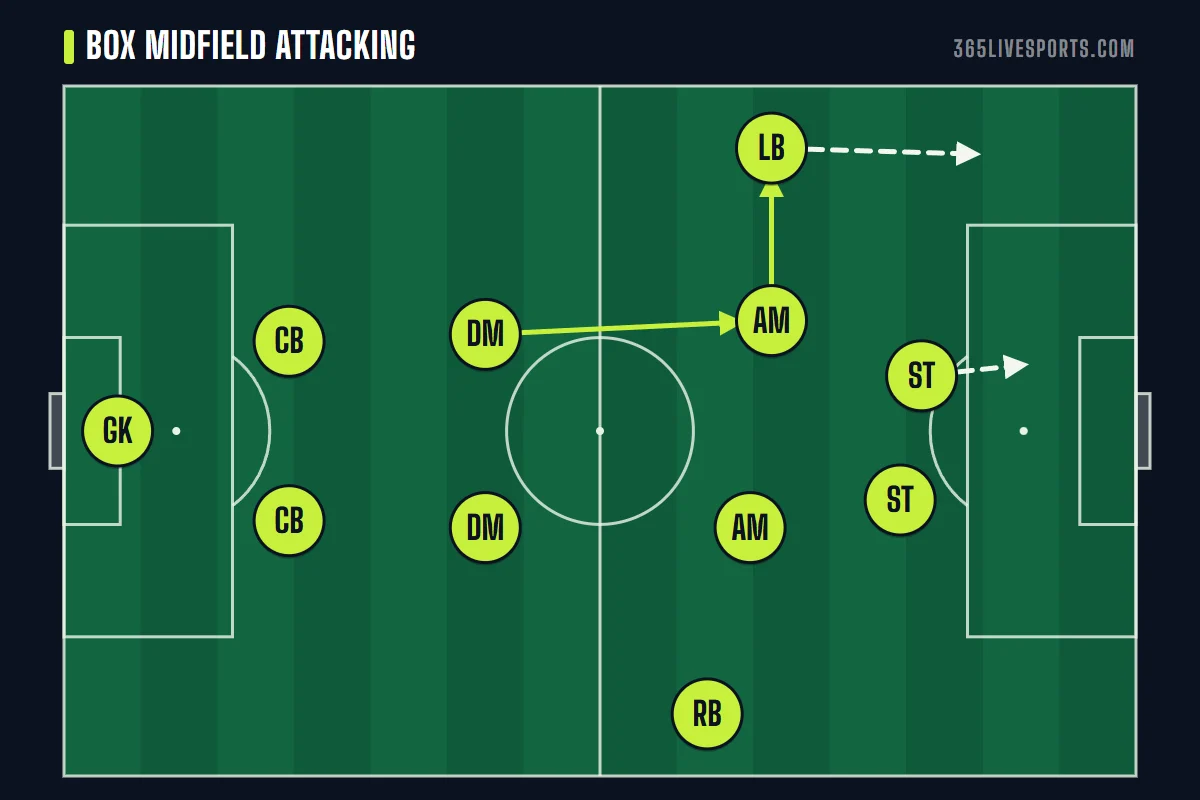
The 4-2-2-2 creates a central overload. With two tens and two strikers so close together, the opposition center backs and holding midfielder face four attackers in a small area. Quick combinations, one-twos and third-man runs are the main weapons.
The full backs time their runs off the tens. When a ten drifts inside, the touchline in front of the full back opens, and he can arrive at speed to cross or cut the ball back. The strikers split: one heads for the near post while his partner holds at the far post or the penalty spot.
- Keep the four attackers within roughly 20 yards of each other.
- The holder on the ball side supports; the other stays as cover.
- Switch play through the holders when the middle gets crowded.
Using the 4-2-2-2 as a pressing trap
In the pressing version, the narrowness is a weapon. The team lets the opponent pass wide to its full back, then closes the trap: the striker on that side curves his run to block the pass back inside, the ten jumps onto the opposition full back, the near holder steps onto their central midfielder, and the full back squeezes their winger. The touchline becomes an extra defender.
The trigger is simple to teach: the ball travelling to their full back. Players read the pass while it is still rolling and sprint to their marks before the receiver can look up. More on triggers and counter-pressing is in our gegenpressing guide.

4-2-2-2 formation weakness and how to protect it
The obvious danger is the flank. A side that pairs a winger with an overlapping full back down one flank can outnumber your full back, especially if the near ten is slow to help. A second issue is the switch: one raking cross-field pass finds a full back with nobody in front of him.
| Problem | Fix |
|---|---|
| 2v1 against your full back | The near ten tracks the overlapping full back; the holder slides to cover the inside |
| Long switches to the far side | Far full back stays narrower and deeper; strikers press the passer's body shape to block the diagonal |
| Opponent bypasses the press with long balls | Center backs drop five yards earlier and holders win the second ball |
| Tens get lost in traffic | One ten pulls wide for a few minutes to stretch the defense |
Box midfield versus other two-striker shapes
A flat 4-4-2 has the same back four and strike pair but puts two midfielders out wide. That gives natural width and an easier time defending the flanks, at the cost of central numbers. Closest of all is the narrow diamond, or 4-1-2-1-2: it also has no wingers, but it uses a single holder, two shuttlers and one ten instead of a square. The box is better for pressing in pairs; the diamond has a clearer playmaker.
A box midfield drill and youth notes
This practice teaches the box to move as one unit:
- Mark a 40 by 30 yard area. Put four players in a square (two holders, two tens) against three defenders inside it.
- Two full backs stand on the long sides as outside players; they can receive but only for two touches.
- The box scores a point for ten passes or for a pass through to a striker standing at one end. The defenders score by winning the ball and passing it out.
- After every point, rotate the defenders in.
For young players, keep in mind the US pathway: tiny-sided games for the youngest, 7v7 for U9 and U10 teams, 9v9 for U11 and U12 teams and full-size football at U13, while each league or club may set different rules. In 9v9 a 3-2-1-2 or a 2-2-2-2 can teach the same box ideas.
Questions players and coaches ask
Is 4-2-2-2 a good formation?
Yes for teams that want to press hard and dominate the center, and for teams with two creative inside players. It is less suitable if your full backs cannot cover the whole flank, because the shape has no wingers.
What is the main 4-2-2-2 formation weakness?
Its flanks. Opponents who pair a winger with an attacking full back down one touchline can overload your full back, and long switches find empty space on the far side.
Why is the 4-2-2-2 called the box midfield?
The four midfielders form a square: two holders at the bottom corners and a pair of tens at the top corners. Brazilian teams who used it with great freedom gave it the nickname magic square.
Which teams play a 4-2-2-2 formation?
It is associated with Brazilian football and, more recently, with high-pressing teams in central Europe. Many sides also use it as a pressing shape from a 4-4-2 when they do not have the ball.
How can a team break down a 4-2-2-2?
Play around it. Use wingers and overlapping full backs to create 2v1s on the flanks, switch the ball quickly from side to side, and avoid passing into the crowded middle where the trap is set.
How is a 4-2-2-2 different from a 4-4-2?
Both have four defenders and two strikers. In a 4-4-2 the two outside midfielders play wide, while in a 4-2-2-2 they play narrow as attacking midfielders, making the team stronger in the center but weaker on the flanks.