
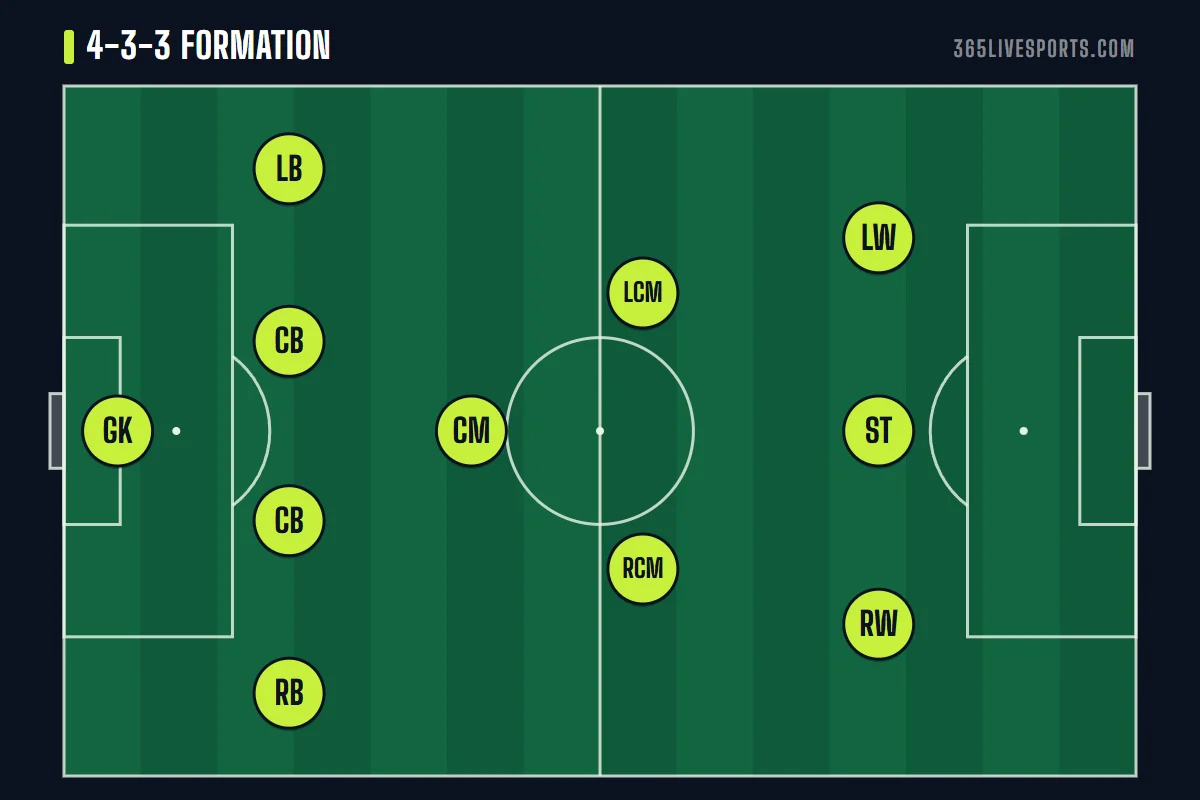
The 4-3-3 formation puts four defenders across the back, three central midfielders across the middle, then three forwards up top: a winger on each side of a central striker, with the goalkeeper behind them all. Most coaches set the midfield as one holding player and two more advanced "eights", which is why the 4-1-2-3 formation you see on some team sheets is really the same thing.
It is the most popular shape in the modern game for good reasons. It spreads players across the full width, it builds natural triangles all over the field, and its front three can press a back four man for man. It also asks a lot: the holding midfielder has a huge zone to protect and the wingers must work both ways. This guide covers every role, both phases, the main variations and the habits that make the shape work for an amateur or youth team.
Quick facts
Shape
Four at the back, three in midfield, three forwards; often written 4-1-2-3.Back line
Two center backs and two full backs who push on to support the wingers.Best for
Pressing high, keeping the ball and attacking with width.Weak spot
The space either side of the lone holding midfielder.Key player
The number 6, who screens the defense and starts every attack.Tricky matchup
A 4-2-3-1 or a 3-5-2 that puts extra bodies around the six.
4-3-3 formation numbers and positions
Read these numbers as tradition, not law: they change from country to country and from one club to the next. In many countries the 4 is the holding midfielder instead of a center back, and plenty of teams give the left-sided eight a 10.
| No. | Position | Attacking duty | Defending duty |
|---|---|---|---|
| 1 | Goalkeeper | Extra passer in build-up; plays out short or long | Commands the box, sweeps behind a high line |
| 2 and 3 | Right and left back | Run outside the winger, or step inside to add a midfielder | Close down the opposing winger; stay narrow when the ball is far side |
| 4 and 5 | Center backs | Drift to the corners of the box to receive from the keeper; carry the ball into midfield when unpressed | Hold the line, win headers, cover each other |
| 6 | Holding midfielder | Drops beside or between the two center backs to receive; moves the ball from flank to flank | Sits in the passing lane to the opposing striker and guards the pocket where strikers like to drop |
| 8 and 10 | Central midfielders (eights) | Find pockets inside the wingers, link play, arrive late in the box | Press the opposing midfielders, cover the full back's space |
| 7 and 11 | Right and left wingers | Keep the opposing full back wide, take a defender on 1v1, cut inside to shoot | Press the center back or full back, track runners back |
| 9 | Striker | Pins both center backs, runs in behind, finishes | First presser; curves the run to cut off one side |
Move the counters on the interactive pitch up top to see how the roles connect: draw a line from each player to the three teammates closest to them and you will see the triangles that make the 4-3-3 easy to pass through.
The 4-3-3 attacking formation: build-up to final third
The shape with the ball is where the 4-3-3 earns its reputation as an attacking formation. The aim is to get one of the eights or a winger facing goal between the opponent's lines.
- Goal kick or keeper's ball: the center backs split to the edges of the box, the full backs step up to around the halfway point of their own half, and the six shows centrally. That gives the keeper a diamond of options.
- Beat the first line: if the opponent presses with two forwards, the six drops between the center backs to make three against two. If they press with one, a center back simply carries the ball forward.
- Find the eights: the two eights hover in the half spaces, just off the shoulder of the opposing midfielders. A pass into either of them, received on the half turn, is the moment the attack speeds up.
- Use the width: the wingers hold the touchline so the opposing full backs cannot squeeze in. When the winger receives, the full back or eight runs past to make a 2v1.
- Fill the box: on a cross, the nine goes to the near post, the far-side winger to the back post, and one eight arrives at the penalty spot. The other eight and the six hold the edge of the area for second balls.
Attacking with five across the front line is the modern habit: wingers wide, eights in the half spaces, striker central. Behind them, the two center backs and the six (plus sometimes one full back) guard against the counterattack. Coaches call that rest defense, and without it a 4-3-3 concedes on the break.

Defending in a 4-3-3: high press or 4-5-1 block
Without the ball the 4-3-3 can do two very different things, and your players must know which one is on.
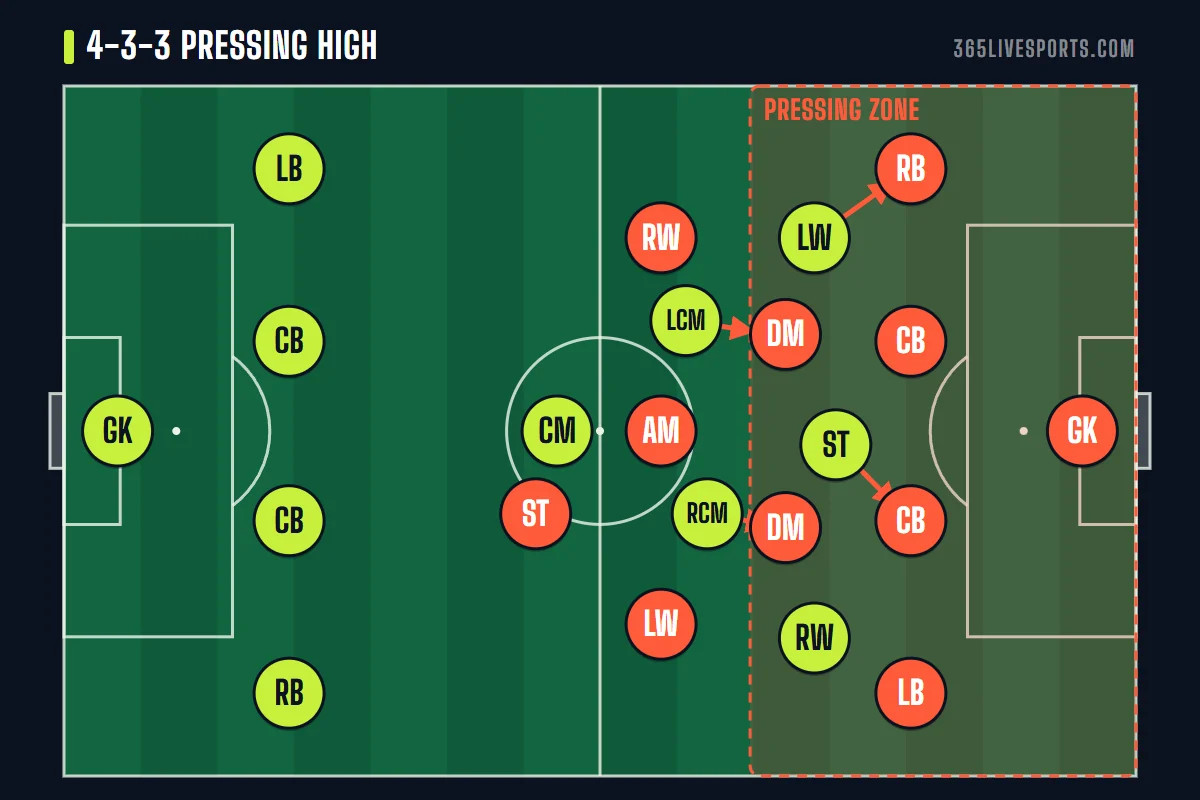
The high press. The striker and two wingers go at the opponent's back four. The striker curves the run to cut one center back off from the other, the wingers stand between center back and full back so either pass can be pressed, and the eights push onto the opposing midfielders. The best trigger for youth teams is simple: press when the center back passes to the full back, because the touchline then becomes an extra defender. Read our pressing guide for more triggers.
The 4-5-1 mid block. When the press is beaten, or to rest, the wingers drop level with the eights and the shape becomes four defenders and five midfielders with the striker screening the six. The rule here is distance: keep the gap from the back four up to the midfield line at 10 to 15 yards, so nobody can receive in it.
Variations: one holder, two holders or a false nine
The three numbers hide several quite different teams. Choose the version that suits your midfielders.
| Version | Midfield setup | Use it when |
|---|---|---|
| 4-1-2-3 (holding six) | One deep midfielder, two eights ahead | Your six reads danger well and your eights love to get forward |
| Double pivot: the 4-2-1-3 | Two deep midfielders, one attacking midfielder | You need more protection, or the opponent plays a number 10 |
| Flat three | Three midfielders across one line | Youth teams learning to share the work evenly |
| 4-3-3 with a false nine | Striker drops into midfield | Your wingers are your best scorers and the center backs are tall but slow |
| Inverted full backs | A full back steps into midfield in possession | You lose too many counterattacks through the middle |
Wingers also change the feel. Right-footed players on the right stay wide and cross. Left-footers on the right (inverted wingers) cut inside to shoot and leave the flank for the full back to overlap.
Strengths and weaknesses of the 4-3-3 formation
| Strengths | Weaknesses |
|---|---|
| Natural triangles everywhere make short passing easy | One holding player can be overrun by two attacking midfielders |
| Front three can press a back four player for player | Wingers who do not track back leave the full backs 2v1 |
| Width from wingers stretches compact defenses | Lone striker can be isolated against two center backs |
| Three central midfielders beat a two-man midfield | Gaps open in the channel beside each center back once the full backs push on |
| Easy to switch to 4-5-1 or a 3-2-5 in possession | Very tiring for the eights, who must defend and attack the box |
How to beat a 4-3-3
If you face this shape, aim at three places. First, the zones either side of the six: put two players there (a 4-2-3-1's number 10 and a winger tucking in, or the twin tens of a 3-4-2-1 shape) and the six cannot cover both. Second, the space behind the full backs, which opens every time they push on; a quick switch of play followed by a run in behind hurts them. Third, play two strikers against the two center backs so they have no spare man.
Against its press, go long over the front three or use your goalkeeper as an extra passer so you have one more player than they can press. The matchups are laid out in full on our counter formations page.
Coaching tips and a practice for the 4-3-3
- Teach the six to scan. Before every pass arrives, the holder should look over both shoulders. Count the checks in a session and praise them.
- Give the eights a rule. One eight goes, one stays. If the left eight arrives in the box, the right eight holds the edge.
- Fix the winger's starting spot. Wingers who drift inside early crowd the middle; ask them to keep a foot on the touchline until the ball reaches the half space.
- Agree the press signal. One word from the striker, shouted when the trigger happens, gets all three forwards moving together.
Practice idea: 7 v 6 build-up. Play on half a pitch. Your keeper, back four and six try to pass through two halfway gates; the opponent's front three and three midfielders defend and counter into a big goal. Score two points for a pass into an eight who turns and dribbles through a gate. Rotate the six often, because it is the hardest role to learn.
Should young teams learn the 4-3-3 soccer formation?
It is one of the best shapes to grow into, because every player has clear neighbors and the roles map onto the smaller games. A 2-3-1 in seven-a-side and a 3-2-3 in the nine-a-side game both turn into the 4-3-3 when a team reaches the full 11v11 game, usually from under-13 in the US system; your league may differ. See our 9v9 formations and youth positions guides for the stepping stones.
Keep it simple for young teams: a flat midfield three, wingers who always go back to their own half when the ball is lost, and full backs who only attack one at a time. Add the holding six and the high press once the basics are automatic.
Questions players and coaches ask
What is a 4-3-3 formation in football?
Four defenders, three central midfielders and three forwards (a winger either side of a striker) make up the shape. With the goalkeeper that makes 11 players. Most teams play one of the midfielders as a holding player, so it is also written 4-1-2-3.
What are the numbers in a 4-3-3 formation?
The classic numbers are 1 for the goalkeeper, 2 and 3 for the full backs, 4 and 5 for the center backs, 6 for the holding midfielder, 8 and 10 for the two central midfielders, 7 and 11 for the wingers and 9 for the striker. Teams and countries do not all follow this numbering.
Is the 4-3-3 an attacking formation?
Yes, it is one of the more attacking shapes because three forwards stay high and the full backs join in. With wingers dropping back it can also defend as a solid 4-5-1, so it is really a balanced shape that leans toward attack.
4-3-3 vs 4-2-3-1: what actually changes?
The 4-3-3 usually has one holding midfielder and two eights, with wingers who play as forwards. A 4-2-3-1 uses two holding midfielders, a number 10 and wide players who sit slightly deeper. The 4-3-3 presses higher; the 4-2-3-1 keeps an extra body screening the defense.
What is a 4-3-3 with a false 9?
It is a 4-3-3 where the central striker drops into midfield instead of staying up against the center backs. That creates a spare player in midfield and leaves space for the wingers to run into behind the defense.
Does 4-1-2-3 mean something other than 4-3-3?
No. Same shape, written in more detail. The 1 shows the single holding midfielder and the 2 shows the two eights in front of him. Most coaches who say 4-3-3 mean exactly this setup.