

The 3-4-3 formation puts three center backs in front of the goalkeeper, a line of four across midfield (two wing-backs on the outside, two central midfielders inside) and three forwards up top. It is a bold, front-heavy soccer shape: five players can attack the last line at once, yet it folds back into a five-man defense when the ball is lost.
I have coached it with adult amateurs and with older youth teams, and the honest summary is simple. It rewards fit wing-backs and brave center backs, and it punishes a team that forgets who covers the space behind those wing-backs. This football guide walks through every position, how the shape moves in and out of possession, the diamond variant and how opponents try to break it.
Quick facts
Shape
3 center backs, 4 midfielders (2 wing-backs, 2 central), 3 forwardsBack line
Three at the back that becomes five when the wing-backs dropBest for
Teams with very fit wing-backs and quick wide forwardsWeak spot
The channel behind each wing-back, and a two-man midfield against a threeKey player
The wing-backs: they cover the whole touchline aloneTough matchup
A 4-3-3 that pins the wing-backs and wins the midfield 3v2
What the 3-4-3 formation looks like on the pitch
Read it from the back, the way every formation number is read: 3 defenders, 4 midfielders, 3 forwards, which adds up to the 10 outfield players, with the goalkeeper as the eleventh. Some coaching books write it as 1-3-4-3 to include the keeper, so if you see the 1-3-4-3 soccer formation on a youth handout, it is the same thing.
The middle center back is the organizer. The two outside center backs stand wider than in a back four, roughly level with the edges of the penalty box. The wing-backs start on the halfway line and own a whole flank each. Inside them, two central midfielders form a pair, one usually a bit deeper. Up front, a central striker is flanked by two wide forwards who often drift inside into the gaps between the opposition full back and center back.
Drag the players on the board above to see how the gaps change when one wing-back pushes on and the other holds.
3-4-3 formation positions, numbers and jobs
Shirt numbers vary by country and by team, so treat the numbers below as the classic pattern, not a rule. The full explanation of shirt numbers lives on our positions by number page.
| Position | Typical number | With the ball | Without the ball |
|---|---|---|---|
| Goalkeeper | 1 | Third center back in build-up, splits the two outside defenders | Sweeps behind a high line |
| Left and right center backs | 4 or 5, 2 or 3 | Carry the ball into midfield, pass into the wide forward's feet | Step out to the wide channel when the wing-back is beaten |
| Middle center back | 5 or 6 | Starts build-up, switches play | Holds the line, marks the striker, talks |
| Wing-backs | 2 and 3 | Give all the width, cross, overlap | Drop into a back five |
| Central midfielders | 6 and 8 | One screens, one joins attacks | Protect the zone in front of the center backs |
| Wide forwards | 7 and 11 | Attack the half-spaces, run in behind | Press the opposition full backs or drop to make a 5-4-1 |
| Striker | 9 | Pins both center backs, finishes | Screens passes into the holding midfielder |
If your squad has more natural number tens than wingers, the closely related 3-4-2-1 swaps the wide forwards for two narrow attacking midfielders.
Building attacks from three at the back
The 3-4-3 is at its best with the ball. Against a front two, the three center backs give a natural 3v2 at the start of play, so one of them is always free to carry forward. The wing-backs push high and wide, which forces the opposition wingers to choose between tracking them and pressing the center backs.
In the final third the shape often becomes a 3-2-5: the two wing-backs and the front three form a line of five across the pitch, while the two central midfielders and three defenders hold the rest-defense. That line of five stretches a back four past its comfort zone, because four defenders cannot mark five lanes.
- Width: wing-backs stay on the chalk until the ball arrives on their side.
- Half-spaces: wide forwards come inside to receive between the lines.
- Depth: the striker threatens to run in behind so the defensive line cannot step up.
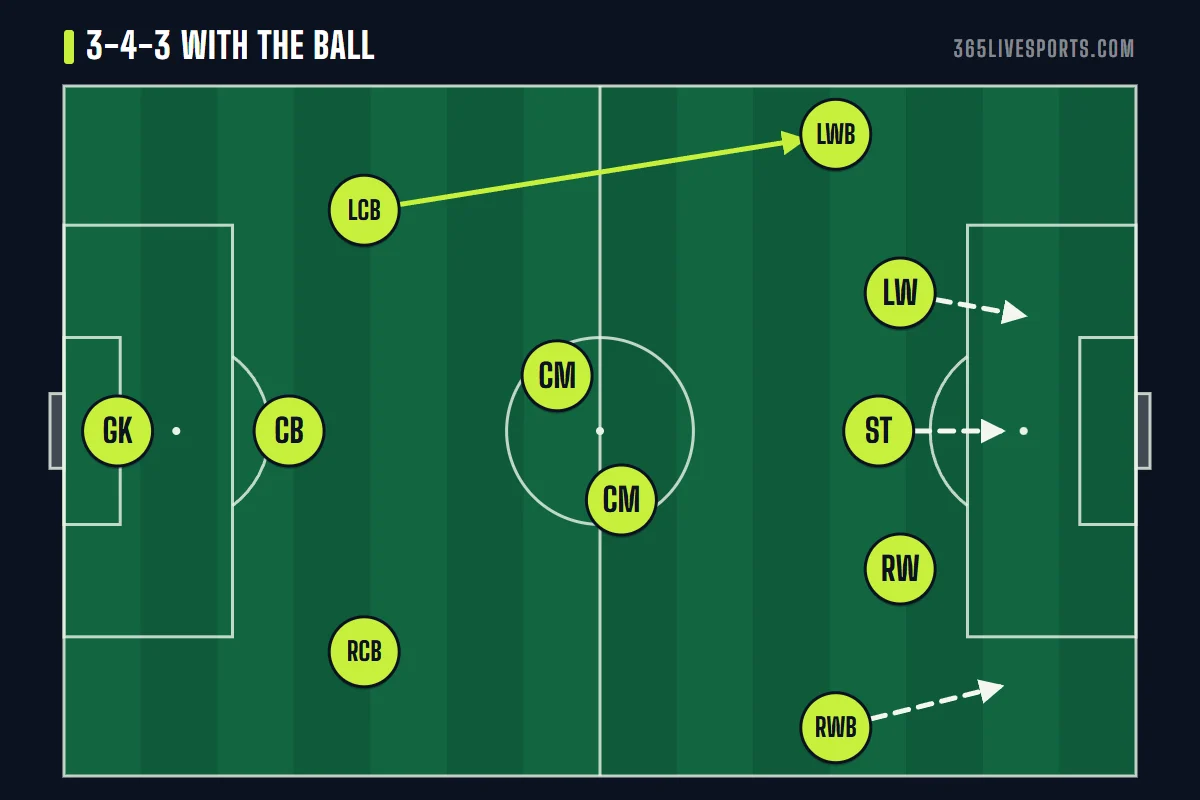
Without the ball: from 3-4-3 to 5-4-1
When possession is lost high up the pitch, the front three press straight away. The striker curves his run to cut off the pass between the center backs, and each wide forward jumps onto the full back on his side. If the press is broken, the team retreats into a 5-4-1 or a 5-2-3 depending on how fit the wide forwards are.
The trigger I use with amateur teams is easy to remember: when their center back passes to their full back, our wide forward presses and our wing-back steps up to the opposition winger. Everyone else shuffles across. When the opponent goes long instead, the three center backs drop and the wing-backs tuck in.
The danger zone is shown in coral below. If the wing-back has pushed on and the wide forward does not track, the outside center back must step into that channel, which drags the back line apart. Our pressing guide covers triggers in more detail.

Strengths and the 3-4-3 formation weakness
| Strengths | Weaknesses |
|---|---|
| Five attackers can reach the box at once | Space behind the wing-backs on the counter |
| Three center backs cover each other against two strikers | Only two central midfielders against a midfield three |
| Natural width without asking wingers to defend deep | Wing-backs need huge stamina; tired legs break the shape |
| Easy switch to a 5-4-1 when protecting a lead | Outside center backs dragged wide lose the box |
The biggest weakness is midfield numbers. Opponents set up in 4-3-3, or with a double pivot and a number ten, will happily crowd three bodies around your two central midfielders and pass through the middle. The second one is time: the wing-back who has just crossed the ball needs a few seconds to recover, and smart teams counter into exactly that space.
The 3-4-3 diamond and the flat 3-4-3
What most people draw is the flat 3-4-3: four midfielders in a line. The 3-4-3 diamond formation is a different animal. It keeps three at the back and three forwards, but the midfield four becomes a diamond: a holding midfielder at the base, two shuttlers on the sides and a playmaker at the tip, behind the striker. Wide play then comes from the two wingers, not wing-backs.
The diamond version grew out of Dutch total football coaching and later spread to a famous Spanish club side. It demands center backs who are comfortable defending wide open spaces, and it suits a passing team, so it pairs naturally with the ideas on our tiki-taka page. For most amateur teams the flat version is easier, because the wing-backs give a clear answer to the question of who defends the flank.
How opponents beat it, and what to change
Expect three common plans from the other bench, each with a fix you can make at halftime.
- They overload your midfield pair. Drop one wide forward into a 3-5-2 shape, or ask the middle center back to step into midfield when the ball is in front of him.
- They hit long balls behind your wing-backs. Keep the far-side wing-back level with the center backs so you defend with four when the ball is on the other side.
- They press your three center backs with three forwards. Use the goalkeeper as a fourth player in build-up and let one central midfielder drop between the center backs.
For full counter plans, see the best formation against each shape.
Coaching the 3-4-3 with youth and amateur teams
A full 3-4-3 needs 11v11. US youth soccer generally uses small-sided games for the youngest age groups, 7v7 around U9 and U10, 9v9 around U11 and U12, and the full game from U13, though every league and club sets its own format. In 9v9 the nearest relative is a 3-3-2 with outside midfielders acting as wing-backs; our 9v9 formations page has diagrams.
A practice I like for wing-backs is a simple channel game:
- Mark two channels about 10 yards wide along each touchline of a half pitch.
- Play 6v6 in the middle, plus one wing-back per team in each channel who cannot be tackled.
- A goal only counts if the ball went through a channel first. Switch the wing-backs every four minutes so they get recovery time.
After a few weeks, add a rule that a wing-back must sprint back inside the channel within five seconds of losing the ball. That habit is the difference between a shape that works and one that leaks.
Questions players and coaches ask
Is 3-4-3 a good formation?
Yes, if you have two very fit wing-backs and center backs who can defend in wide areas. It creates a lot of attacking width and numbers, but it can be outnumbered in central midfield. Teams without those players usually do better with a back four.
What is the main 3-4-3 formation weakness?
The space behind the wing-backs is the classic problem, along with having only two central midfielders. Opponents counter into the channels and try to overload the middle with three midfielders.
What is the 1-3-4-3 soccer formation?
It is the same 3-4-3 with the goalkeeper written in front as the 1. Many youth coaching documents include the goalkeeper this way so players remember the keeper is part of the team shape.
What is the difference between the 3-4-3 diamond and the flat 3-4-3?
In the flat version the four midfielders sit in a line, with wing-backs on the outside. In the diamond version the midfield is a diamond of holding midfielder, two shuttlers and a playmaker, and the width comes from two wingers instead.
What are the 3-4-3 formation numbers?
A common pattern is 1 in goal, 4, 5 and 6 or 2, 5 and 3 across the back, 2 and 3 or 7 and 11 as wing-backs, 6 and 8 in midfield, and 7, 9 and 11 up front. Numbering differs between countries and teams, so there is no single correct list.
Which teams use the 3-4-3 formation?
Plenty of professional sides have used it, often switching between it and a 3-4-2-1 during matches. At grassroots level it is most common with older teenage and adult teams, because it needs the full 11v11 game and a lot of running from the wing-backs.