
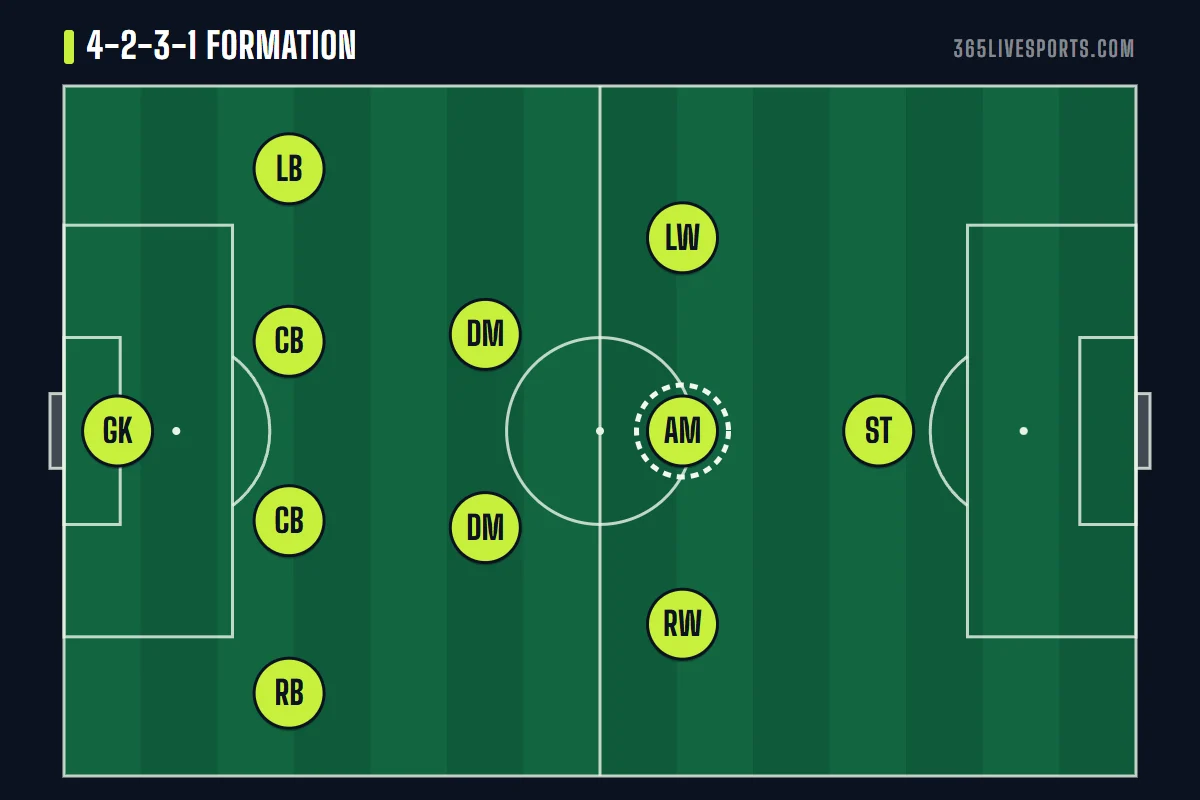
The 4-2-3-1 formation stacks four lines ahead of the keeper: a back four, then the double pivot of two holding midfielders, then a band of three attacking midfielders with a number 10 in the middle, and one striker on top. Read it as 4-2-3-1 from the back, or 1-4-2-3-1 if your coaching course counts the keeper.
Coaches love it because it is hard to get through. Six players sit behind the ball even when the full backs push on, and the attacking band of three can still flood forward. The price is that the striker is often alone and the shape can turn passive if the wide players do not join the attack. Below you will find every role, the attacking and defending pictures, the wide and narrow versions, and how to coach it at your level.
Quick facts
Shape
Back four, double pivot, attacking three, lone striker.Double pivot
Two holding midfielders who rarely abandon the zone ahead of the center backs at the same time.Best for
Balance: a strong number 10 with plenty of cover behind.Weak spot
An isolated striker and space for opposing full backs if the wide men stay high.Key player
The number 10, who links midfield to the striker.Defends as
A 4-4-1-1 or 4-4-2 when the ball is lost.
4-2-3-1 formation positions and numbers
Here is the usual number for each spot. Numbering traditions differ between countries and clubs, so do not be surprised to see the pivots wearing 4 and 8, or the wide players swapped.
| No. | Role | Ball in our feet | Ball with the opponent |
|---|---|---|---|
| 1 | Goalkeeper | Starts attacks; a short pass to a center back or pivot | Organizes the back four, deals with crosses |
| 2, 3 | Full backs | Go round the outside or the inside of the wide midfielder, deliver crosses | Defend 1v1 on the flank, tuck in when the ball is opposite |
| 4, 5 | Center backs | Pass into the pivots, step out with the ball when given room | Mark the striker, attack every cross |
| 6, 8 | Double pivot | The deeper of the two collects from the center backs; his partner steps up toward the 10 | Screen the center backs, never both leave the zone |
| 7, 11 | Wide attacking midfielders | Dribble, cross or cut inside to shoot | Drop alongside the pivots to make a midfield four |
| 10 | Attacking midfielder | Turns between the lines, slides the last pass through, or shoots from distance | Marks the opposing holding midfielder; first help for the striker's press |
| 9 | Striker | Holds the ball up, runs in behind, finishes | Screens the pass into midfield, presses the center backs |
The tactics board higher up is preloaded with this shape. Slide the two pivots apart and back together to see how much ground they cover between them.
4-2-3-1 formation attacking: pivots, the 10 and the full backs
The attacking plan starts with the pivots. One of them drops toward the center backs to pull the opposing forward with him; the other stays higher and looks for the 10. When the 10 receives facing forward between the opponent's midfield and defense, the whole front four goes.
The wide players decide how the attack looks. In the classic wide 4-2-3-1 they hug the touchline, beat their full back and cross for the striker. In the more common modern version they drift inside into the half spaces, which lets the full backs overlap and creates a crowd of four players near the penalty arc: two wide attackers, the 10 and the striker.
- The striker's job: pin the center backs and make one run in behind every time a pivot gets the ball facing forward.
- Rest defense: with both full backs high, both center backs plus the deeper pivot stay home. That three-player base is what makes this formation safe.
- Switches of play: when the ball is stuck on one side, a quick pass back through a pivot to the far full back is often the best attack.

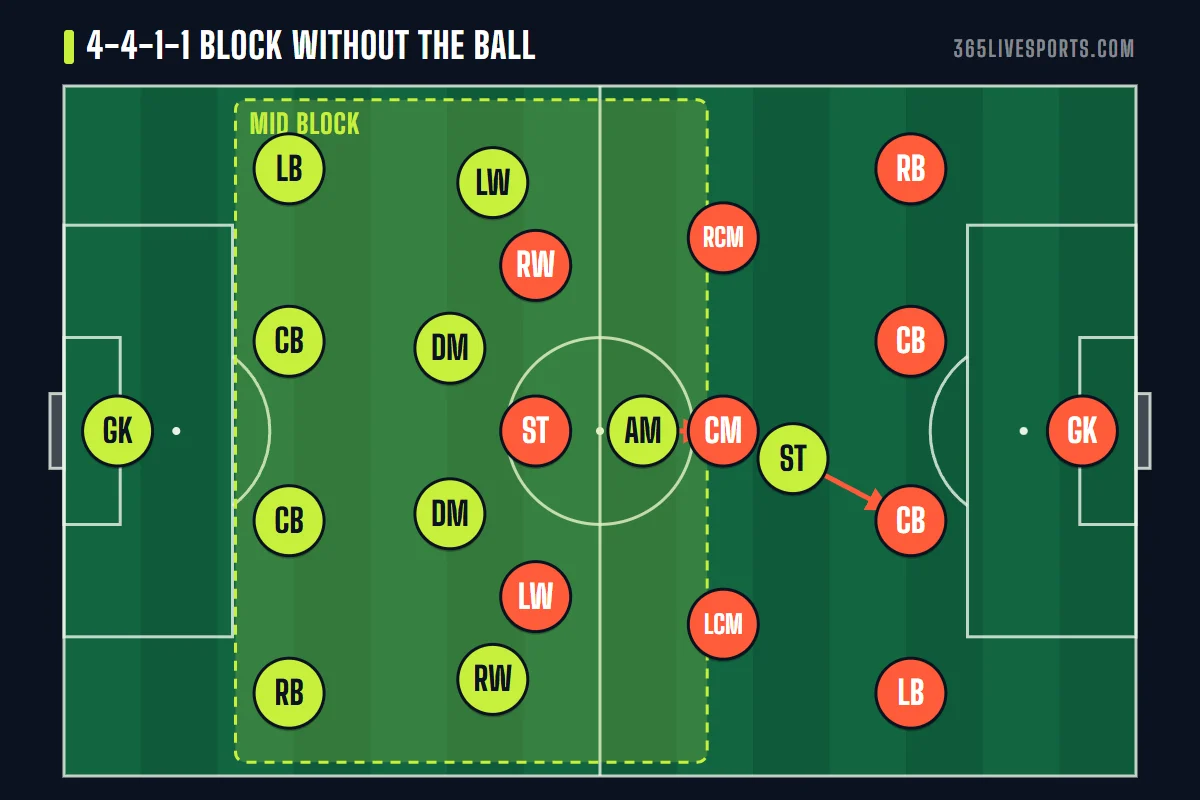
4-2-3-1 formation defending: the 4-4-1-1 block
Once possession is lost, the shape folds into two lines of four with the 10 just behind the striker, a 4-4-1-1. Some teams push the 10 up beside the striker to make a 4-4-2 press. Either way the job list is short and clear:
- The striker blocks one side. He stands between the center backs and curves toward one of them so the ball goes where you want it.
- The 10 marks the opposing six. If their holding midfielder can receive and turn, every press fails. Stay touch-tight on him.
- The wide men drop level with the pivots. They protect the full backs from 2v1s and press the opposing full back once the ball is played out to the flank.
- The pivots stay together. Ten yards apart, one stride ahead of the center backs. Neither one chases into the opposing half.
- The back four steps up with the midfield. If the midfield line is high, the defenders follow so there is no room between them.
Wide or narrow: versions of the 4-2-3-1
| Version | What changes | Good when |
|---|---|---|
| 4-2-3-1 wide | Wingers stay on the touchline and cross | You have a tall striker and quick, direct wide players |
| 4-2-3-1 narrow | Wide players play as inside forwards; full backs give all the width | Your full backs are strong runners and your wide men like to shoot |
| 4-4-1-1 | Wide players sit deeper, the 10 plays as a second striker | You need to defend a lead or face a stronger side |
| 4-3-3 hybrid | One pivot pushes up beside the 10 in possession | You want more bodies near the box without changing the team sheet |
A very narrow version becomes the box midfield of the 4-2-2-2, and a version with two inside forwards behind the striker turns into the 4-3-2-1 "Christmas tree". If you want a second striker instead of a 10, compare it with the 4-4-2.
Strengths and the main 4-2-3-1 formation weakness
| Strength | Weakness |
|---|---|
| Two holding midfielders give steady cover against counterattacks | The lone striker can be starved of service and outnumbered |
| The 10 has a free role between the lines | If the 10 is marked out of the game, the attack loses its link |
| Folds quickly into a 4-4-1-1, or a 4-4-2 press, when the ball is lost | Can become passive, with too many players behind the ball |
| Wide players can attack 1v1 against full backs | Opposing full backs get free if the wide men do not track |
| Flexible: wide, narrow or hybrid without changing personnel | A midfield three with a free player can overload the pivots |
Is 4-2-3-1 a good formation? For most amateur and youth teams, yes: it is forgiving defensively and gives a creative player a clear role. It fails when you lack a striker who can hold the ball alone.
Beating a 4-2-3-1: three plans
Three plans work well against this shape. The first is to take away the 10: a holding midfielder who follows him everywhere, or two center backs ready to step out, cuts the formation in half. The second is to outnumber the pivots: a midfield three with two attacking eights puts the double pivot in a 3v2 and someone is always free. The third is to attack the full backs when the wide midfielders are slow to get back; quick switches to an overlapping full back or a winger find the 2v1.
A holder-based 4-3-3 that sits its six on the 10, or a 3-5-2 that matches the midfield and adds a spare center back against the lone striker, are the shapes most coaches reach for. See our full counter formations guide.
Coaching points and a practice
- Pivot pairing: pick one natural defender and one passer, and agree that when one steps forward the other holds. Shout "stay" or "go" to make it audible.
- The 10's body shape: train him to receive side-on, already half turned, so he can play forward with his first or second touch.
- Wide players' recovery: give them a target, such as "back level with the pivots within five seconds of a turnover".
- Striker's patience: a lone striker who drops too often leaves nobody in the box. Ask him to come short only when the 10 has gone past him.
Practice: 6 v 4 through the middle. In an area about 40 yards long and 30 wide, two center backs and two pivots play to a 10 and a striker at the far end while four defenders try to block. A goal counts only if the 10 touches the ball. It trains the pivots to find the gap and the 10 to move into it.
Is the 4-2-3-1 right for young players?
For teams new to the full game, yes, with a couple of tweaks. Under the US federation's guidance most players step up to 11v11 around under-13, after the 7v7 and 9v9 years; your league may run different ages. The 3-2-3 used in many nine-a-side games already has the two holding players and the three attackers, so the jump is small. See our 9v9 shapes and the youth positions guide.
For youth players, rotate the 10 role. It teaches scanning and receiving under pressure better than any other spot on the field, and every midfielder should try it.
Questions players and coaches ask
What is a 4-2-3-1 formation in soccer?
Four defenders, two holding midfielders, a band of three creators and one striker line up in front of the goalkeeper. The middle of the attacking three is the number 10, who links play to the striker.
Is 4-2-3-1 a good formation?
Yes. Few shapes in football are as balanced. The two holding midfielders protect the defense, the 10 has freedom, and it defends easily as a 4-4-1-1. It struggles if the striker is isolated or the wide players will not defend.
What are the 4-2-3-1 formation numbers?
A common numbering is 1 goalkeeper; 2 and 3 full backs; 4 and 5 center backs; 6 and 8 holding midfielders; 7 and 11 wide attackers; 10 attacking midfielder; 9 striker. Clubs and countries number differently, so treat it as a guide.
What does 1-4-2-3-1 mean?
Same shape, keeper listed first. Some coaching courses write it that way to remind players that build-up starts with the goalkeeper's feet.
Is the 4-2-3-1 a defensive formation?
It is balanced rather than defensive. Two holding midfielders make it safe, but with full backs overlapping and four attacking players it can be very aggressive. Pulling the wide players back into a 4-4-1-1 makes it more defensive.
What is the weakness of a 4-2-3-1 formation?
The main weaknesses are an isolated striker, dependence on the 10, and space for opposing full backs when the wide midfielders do not track back. A midfield three can also outnumber the two pivots.