
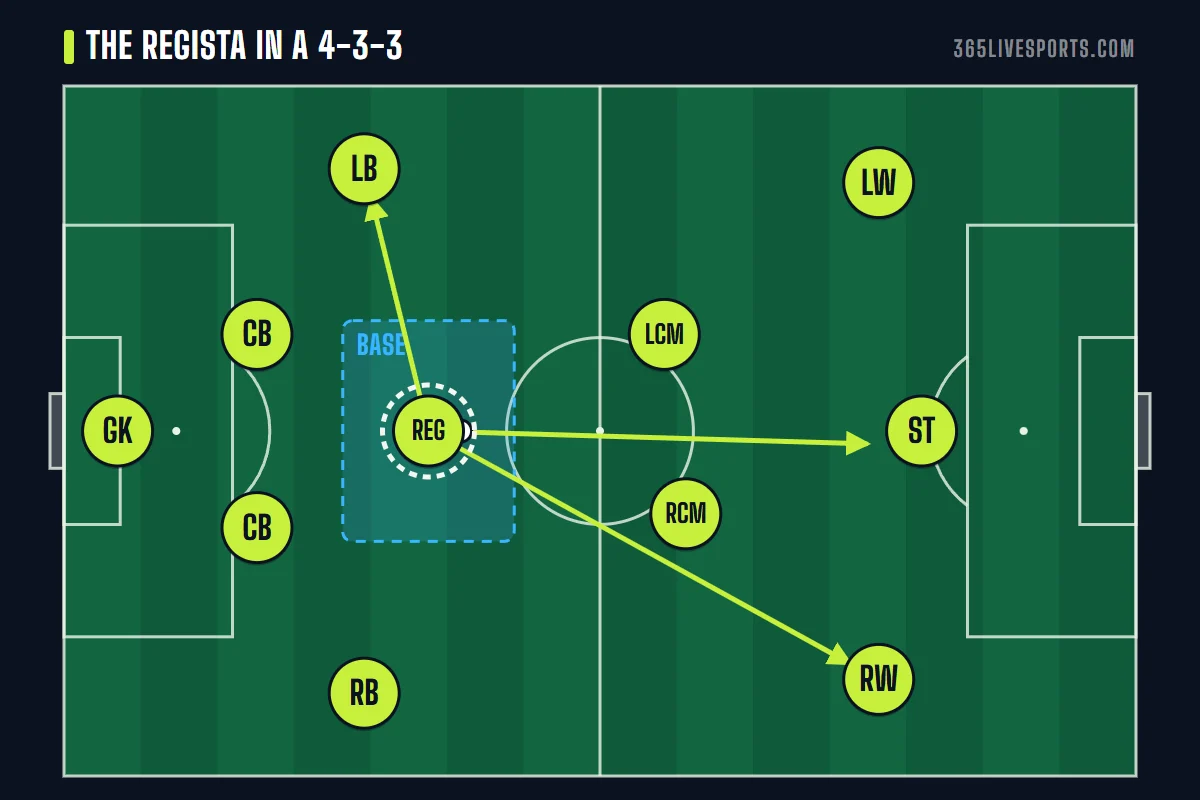
The regista is a deep-lying playmaker in soccer: a midfielder who sits just in front of his own center backs and sets the rhythm of the team with his passing, rather than with tackles or runs. The word is Italian for "director", the person who runs a film or a stage show, and that is the idea: everything the team builds goes through him.
On the field he is often the calmest player, and he may cover less ground than anyone except the goalkeeper. Many coaches would call the regista soccer's quietest match-winner. What he does instead is see the whole pitch, receive under pressure and choose the pass that moves the team forward. This page explains the role, how it differs from a classic holding midfielder, which shapes suit it and how you stop one if you are the opponent.
Quick facts
Meaning
Italian for director: the player who directs playPosition
Deepest central midfielder, in front of the back lineMain weapon
Passing range, short and long, plus vision under pressureShirt number
Often 4, 6 or 8 depending on the country and teamNeeds beside him
Energetic midfielders who press and win the ball backHow to stop him
A forward who marks him or stands in his passing lane
Regista meaning: the director in front of the defense
The regista football tradition is strongest in Italy, where the word has long described the player who organizes a side from deep. In the modern game you will also hear "deep-lying playmaker" or simply "the pivot". The position is the same as a holding midfielder, number 6 in many countries, but the priorities are reversed: the regista is there mainly to pass, and his defending is about positioning rather than tackling.
A simple test for fans: when the center back has the ball, who does he look for first? If one midfielder always shows for it, takes it on the half-turn and plays forward, that is your regista.
What the regista does with the ball
His menu of passes is what defines the role. In rough order of how often a coach wants each one:
- The tempo pass: a simple pass to a full back or a midfielder to keep the ball and move the opponent around.
- The switch: a raking ball out to the winger on the far side when the opponent has shifted to one side.
- The line-breaker: a firm pass along the ground between two opposing midfielders into the striker or an attacking midfielder.
- The ball over the top: lifted behind a high back line for a runner who has timed his move.
All of these depend on what he does before the ball arrives. A good regista checks over both shoulders two or three times as the pass comes, so he already knows the next move. Coaches call this scanning, and it is the habit to build first in any young player you see in this role.
Regista vs deep-lying playmaker vs holding midfielder
The three labels overlap a lot, and people use them loosely. Here is a practical way to separate them.
| Role | Main job | Defending style | Typical pass |
|---|---|---|---|
| Regista | Directs all of the team's build-up, often with freedom to drift | Light: positions himself, rarely chases | Long switches and passes over the top |
| Deep-lying playmaker | Starts attacks from deep, a broader term used in many countries | Moderate: screens and intercepts | Line-breaking passes into midfield |
| Holding midfielder | Protects the back four first, passes simply | Heavy: tackles, covers, breaks up play | Short and safe to the nearest teammate |
In short, every regista is a deep-lying playmaker, but not every holding midfielder is a regista. For the more athletic central role, see the box-to-box midfielder page.
Where he stands when the team builds up
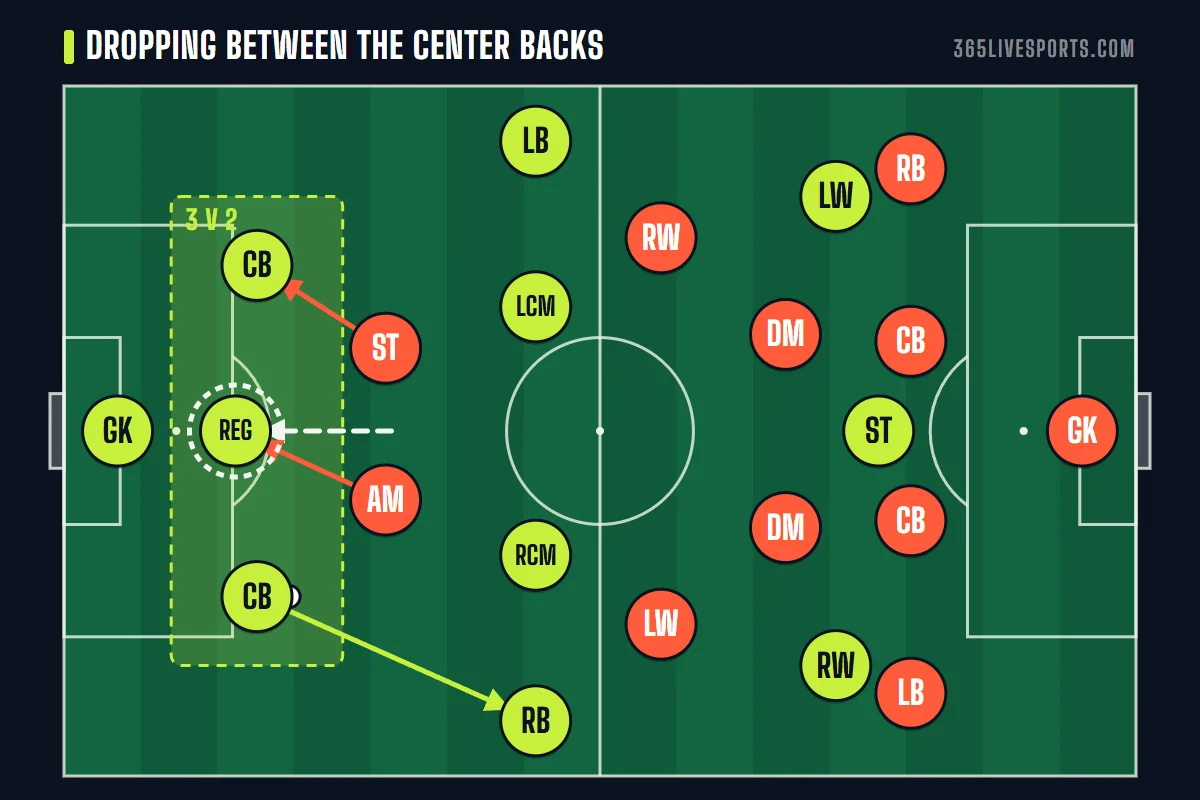
When the opponent presses with two players, a regista often drops between the two center backs. The center backs split toward the touchlines, the full backs push up, and suddenly three defenders are facing two pressers. One of the three is always free to carry the ball or pass forward.
When the opponent presses with one striker, he stays just ahead of them instead, so the line stays two plus one. The rule a coach can give is simple: "count their forwards, then make sure we have one more player at the back."
Formations that suit the role
- 4-3-3: the single 6 with two 8s ahead is the most natural home. The 8s handle most of the running.
- 4-1-4-1: similar, with the four ahead of him forming a screen when defending.
- 3-5-2: the central player of the three midfielders, with three center backs giving extra cover behind him.
- 4-3-1-2 diamond: the base of the diamond, protected by two shuttling midfielders on either side.
A flat 4-4-2 is harder, because with only two central midfielders the partner must do almost all the defensive running. The midfield positions guide shows how each central role fits into these shapes.
Protecting a regista
The role has an obvious cost: the player is chosen for his passing, so he may be slower and lighter than a traditional destroyer. Teams protect him in three ways:
- Pick two hard-working central midfielders beside or ahead of him to press and cover ground.
- Keep the back line compact so he does not have to defend big spaces behind him.
- Ask the striker and wide forwards to press high, so the opponent rarely plays through the middle where he sits.
How opponents shut down the regista
Because so much goes through one player, opponents plan for him. The usual answers are a forward or number 10 who stays close and follows him everywhere, or a striker who stands in the passing lane between the center back and the regista, a technique called a cover shadow. You can read more about it on the pressing page.
The counter to that counter: drop him between the center backs as shown above, invite a center back to stride out with the ball, or move a second playmaker deeper so there are two to mark. A goalkeeper who passes well also helps, since the team then has an extra player in the build-up.
Practice: the director's rondo
A rondo is a keep-ball game with attackers around the outside and defenders in the middle. Adapt it for a regista like this:
- Mark a square of about 15 by 15 yards. Four players stand on the sides, one regista in the middle, two defenders inside.
- The outside players may only pass to each other through the regista or with one-touch passes along the edge.
- Every time the regista receives and plays out on two touches or fewer, his team gets a point.
- Add a rule that he must call out a teammate's name or look over his shoulder before each reception, which builds the scanning habit.
Rotate players into the middle so others learn what it is like to receive under pressure from two sides.
Questions players and coaches ask
What does regista mean?
Regista is the Italian word for a director, as in the director of a film or play. In soccer it describes the deep-lying midfielder who directs the team's passing from in front of the defense.
Is a regista the same as a number 6?
They play in the same zone, but not always the same way. A classic number 6 is mainly a defensive screen, while a regista is chosen for passing and vision and defends by positioning.
What skills does a regista need in football?
Passing range, a good first touch under pressure, the habit of scanning before receiving, and calm decision making. Pace and tackling help but matter less than in most midfield roles.
Which formation is best for a regista?
You will most often find him at the base of a 4-3-3, protected by two energetic 8s. The diamond 4-3-1-2 and the 3-5-2 also suit the role well because they give him protection.
Can a regista play in youth soccer?
Yes, and it is a good role for a thoughtful player who is not the fastest. Coaches should make sure he still learns to defend, because at youth level games are often end to end and he will face lots of one-on-one moments.