

In a 3-1-4-2 formation, three center backs protect the goal, one holding midfielder screens them, the wing-backs plus a pair of central midfielders form a band of four further up, and two strikers lead the attack. It is a close relative of the 3-5-2, with one key difference: the two central midfielders play higher, nearly level with the wing-backs, so the holder is alone at the base. That makes the shape more aggressive and puts a heavy load on one player. This guide covers the setup, each role, how it attacks and defends, and what to do when the space beside the anchor is attacked.
Quick facts
Shape
3 center backs, 1 holding midfielder, 2 wing-backs, 2 central midfielders, 2 strikersDefends as
A 5-3-2, with the 8s dropping beside the holderBest for
Pressing high and getting runners into the boxKey player
The holding midfielder, the only screen in front of the back threeWeak spot
The pockets left and right of the holderGood against
A 4-4-2, where the back three outnumber two strikers
The 3-1-4-2 formation: shape and spacing
Set up the team from the back. The three center backs stand about 10 yards apart across the box. The holder stands 8 to 10 yards ahead of the middle center back. Then comes the line of four: wing-backs on the touchlines with the two 8s in the inside channels, about 20 yards apart. The front pair stay within a short pass of one another.
The board above loads this layout. Move the two central midfielders down beside the holder and you have a 3-5-2; push them up and you see the 3-1-4-2 as it really plays.
How it compares with its neighbors
| Formation | Central midfield | Feel |
|---|---|---|
| 3-1-4-2 | One holder, two 8s pushed high | Aggressive, lots of runners |
| 3-5-2 | Three central midfielders roughly level | Balanced, compact |
| 3-4-1-2 | Two central midfielders and a 10 | Creative, built around one playmaker |
The players are the same in all three. The difference lies in how high the central midfielders stand and the instructions they get. Many coaches switch between them during a match without making a single substitution.
The anchor: the hardest job in the 3 1 4 2 formation
The holding midfielder has three jobs: receive from the center backs and turn, guard the area right in front of his back three, and cover the gaps left when the wing-backs and 8s attack. He rarely goes past the halfway line.
He needs to scan constantly, because the opponent will place a player on either side of him. Good holders are rarely the fastest players, but they read danger early and position themselves before the pass is played. The regista page covers the passing version of this role.
Roles for the other nine players
- Wide center backs: defend the channels, dribble forward into midfield if nobody presses them, and cover behind the wing-backs.
- Middle center back: leads the line, wins aerial duels and covers both partners.
- Wing-backs: provide all the width, cross, then sprint home so the defense becomes five.
- The two 8s: attack the inside channels, arrive in the box, press the opponent's midfielders and drop beside the holder when defending.
- Strikers: one stretches the defense with runs in behind, the other links with the 8s; both press the center backs.
Attacking in the 3-1-4-2 soccer formation
Most moves send five runners at the back line: the two strikers, one 8 arriving in the box and the two wing-backs. The other 8 hangs back around the arc, ready for cut-backs and second balls. The holder and the back three stay behind to stop counters.
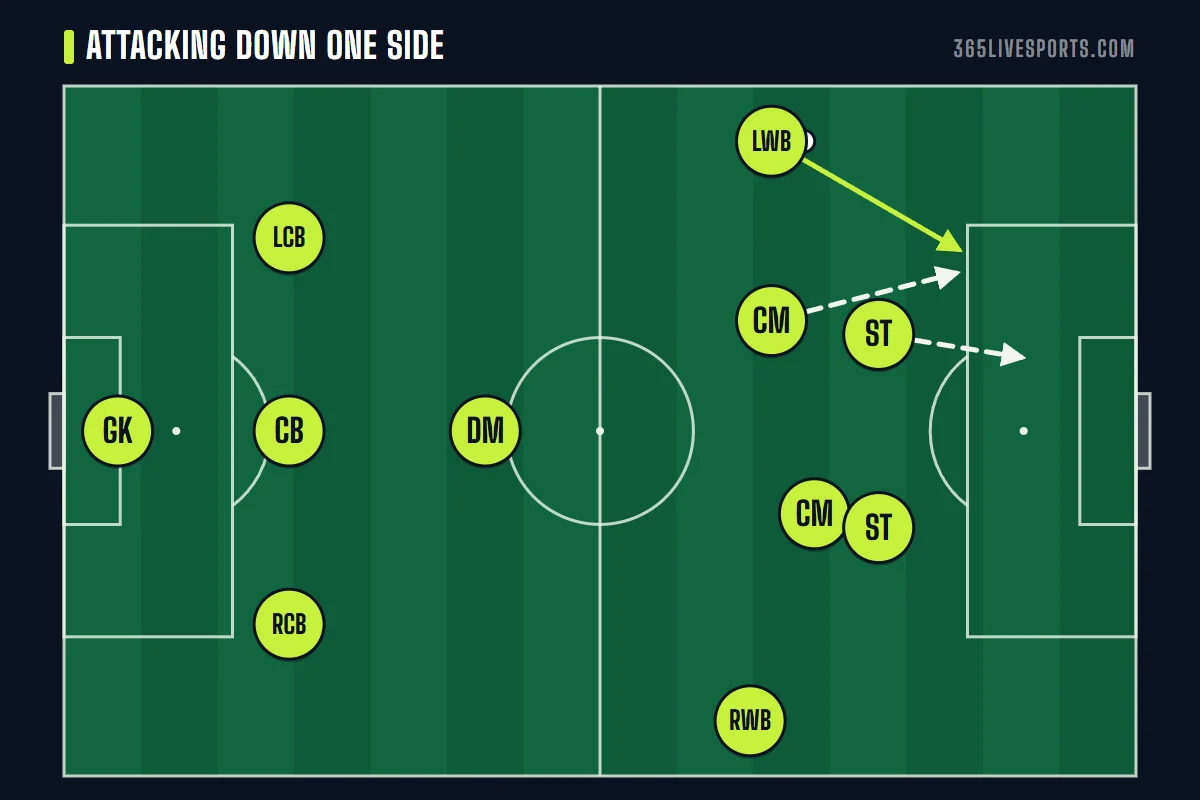
A favorite pattern runs down one side. The wide center back passes to the wing-back, the 8 on that side runs into the channel behind the full back, and the nearest striker moves toward the near post. The wing-back can cross early, play the 8 in, or recycle to the holder and switch play.
Defending as a back five and midfield three
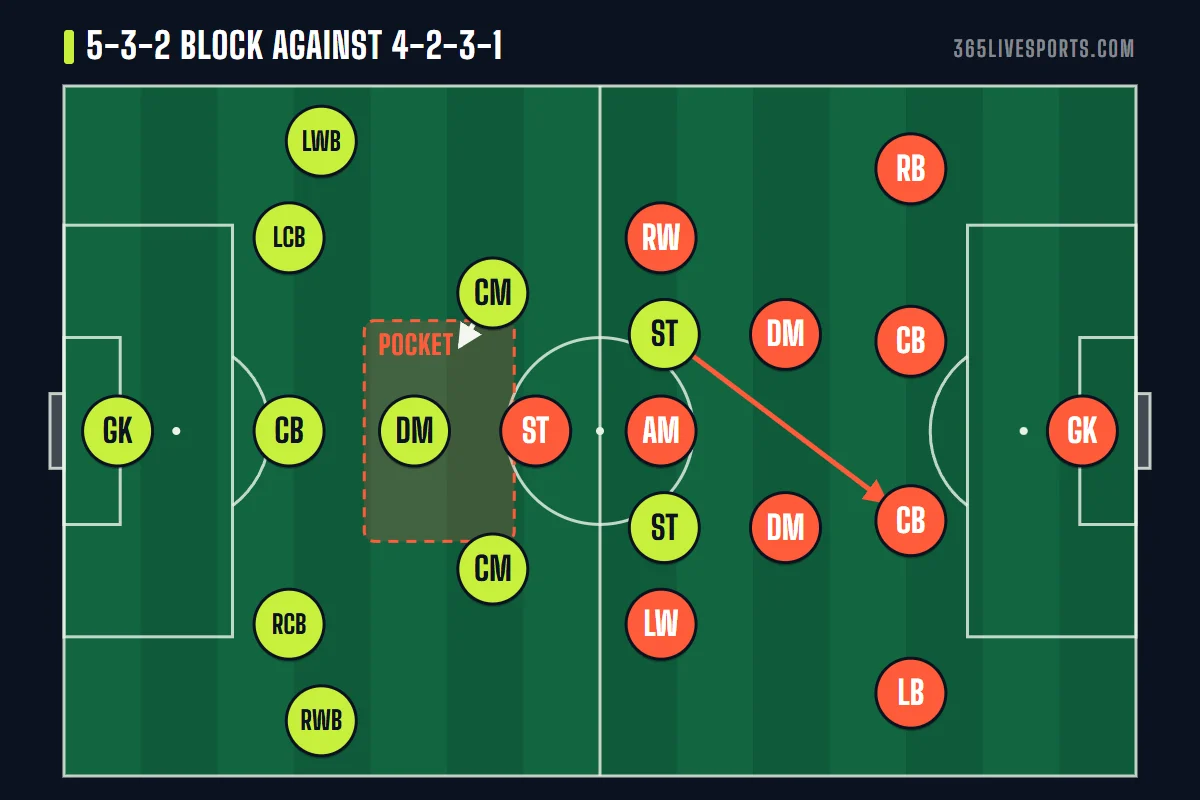
When the opponent has possession, the wing-backs retreat into the back line and the 8s drop beside the holder. That makes a compact 5-3-2. Up front, the pair angles its pressing runs from outside in, steering the ball into the middle, where the three midfielders can win it.
The danger comes against a 4-2-3-1, whose number 10 stands right next to your holder, and their wingers pin your wing-backs. If your 8s are slow to drop, the holder faces two players at once.
Weak spots, and how to fix them
The obvious target is the space next to the holder. The second is the flank behind a wing-back who has gone forward. A clever opponent combines them: a winger pulls your wing-back wide, and a midfielder runs into the gap.
- Teach the 8s a simple rule: when the ball is behind you, sprint back to the holder's line before doing anything else.
- Allow the nearest wide center back to jump out and meet any opponent who receives in the pocket.
- If the opponent's 10 keeps finding space, drop one 8 permanently and play a straight 3-5-2.
- Against two wide forwards, keep the far wing-back deeper so you always have four defenders.
Who should use it, and a session to build it
This shape suits teams with an intelligent holding midfielder, two energetic box-to-box players and wing-backs who can run all day. It is a good option against a 4-4-2, where your three center backs outnumber their two strikers.
For more on the midfield runners this shape needs, read about the box-to-box midfielder.
Questions players and coaches ask
What is a 3 1 4 2 formation?
Three center backs, one holder, a band of four (wing-backs plus two central midfielders) and two strikers. Out of possession it usually turns into a 5-3-2.
Is a 3-1-4-2 the same as a 3-5-2?
They use the same players, but the 3-1-4-2 pushes two central midfielders higher and leaves one holder alone at the base. A 3-5-2 keeps the three central midfielders closer to level.
Where is the 3-1-4-2 soccer formation weakest?
The pockets beside the holder, plus the flanks when the wing-backs push up. A team with a 10 and two wingers can attack both.
Which player matters most in a 3 1 4 2 soccer formation?
The holding midfielder. He is the only player screening the back three when the 8s and wing-backs attack, so his positioning decides how safe the team is.
Does the 3-1-4-2 formation suit youth soccer?
It can work for older youth teams that already understand a back three. Give different players turns as holder and wing-back, because those roles teach the most.