
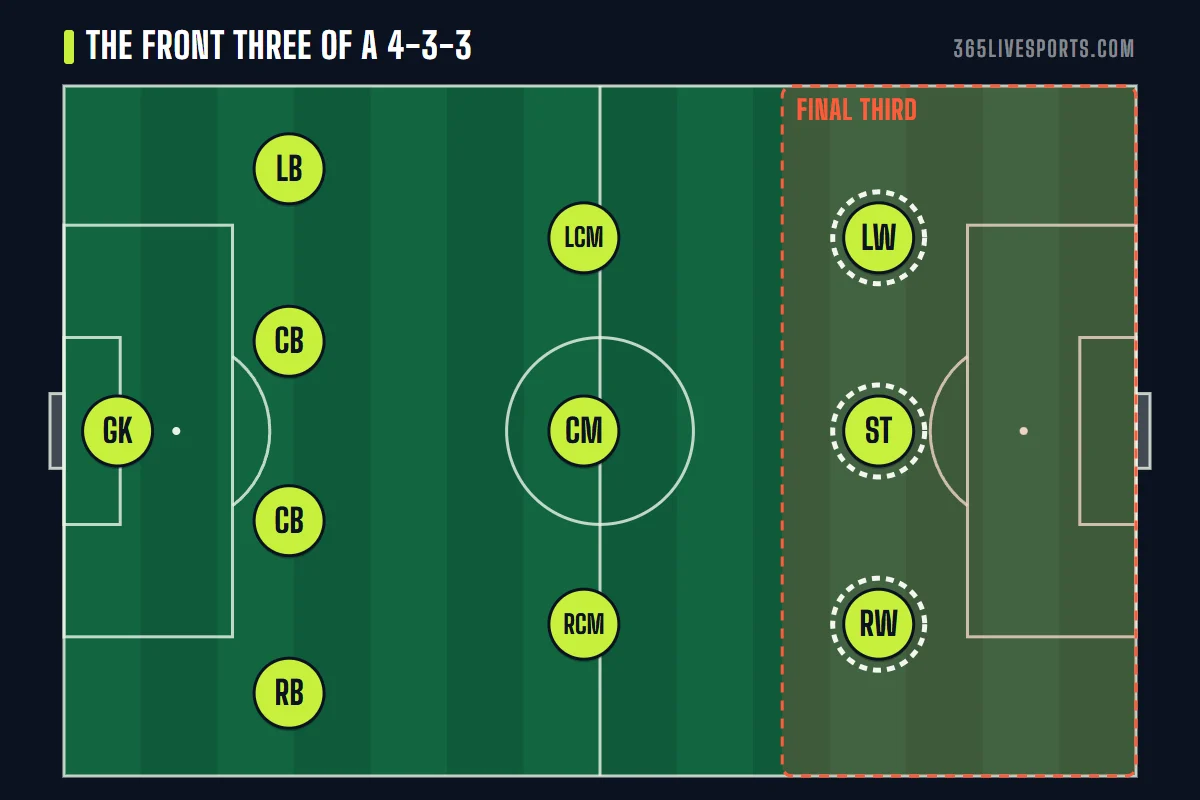
The main soccer offense positions are the striker or center forward, the second striker, the left and right wingers and the attacking midfielder behind them; together they create and finish most of a team's chances. Depending on the formation, a team plays with one, two or three forwards, and full backs and central midfielders join in when the moment is right.
Kids want to play up front because that is where the goals are. What they discover quickly is that attacking well depends on movement more than on shooting. The best forwards I have coached at amateur level were not always the most skillful; they were the ones who arrived in the right place a split second before the defender.
Quick facts
Forwards
Striker (ST), center forward (CF), second striker (SS)Wide attackers
Left winger (LW), right winger (RW)Creator
Attacking midfielder (CAM), the classic 10Classic shirts
7 and 11 on the wings, 9 up front, 10 behindKey skill
Movement off the ball, timed to beat the offside lineDefensive duty
Lead the press on the opponent's back line
Soccer offense positions: the attacking unit
Think of the attack as a unit of three to five players rather than one hero. In the 4-3-3 shown in the diagram, the attacking trio is a striker in the middle and a winger on each side. Behind them, one of the central midfielders pushes forward to join, and the full backs overlap when the ball is wide.
Formations change the mix. A 4-4-2 has two strikers and wide midfielders instead of wingers. A 4-2-3-1 has one striker supported by three attacking midfielders. A 3-5-2 pairs two strikers with wing-backs who supply the width.
Striker and center forward
The striker (ST), also called the center forward (CF) or simply the 9, is the main goal threat. With the ball, the job is to score and to make the defense deal with you. Without it, the striker is the first defender, angling runs to cut the field in half for the opposing center back.
Target forward
Strong and good in the air. Receives with the back to goal, holds off a defender and lays the ball off to midfielders running past. Valuable for teams that play direct.
Poacher
Lives in the penalty area and finishes chances with one touch. Rarely involved in build-up, but always in the right place for rebounds and cut-backs.
Runner in behind
Quick and always level with the deepest defender, ready to spin. Stretches the back line so midfielders have more room in front of it.
Pressing forward
Works hard without the ball, chasing center backs and goalkeepers into mistakes. Ideal for a high-pressing team; see pressing in football.
Most good strikers mix two or three of these types. A young striker should learn all of them, then lean toward the one that fits their body and instincts.
Second striker and false nine
The second striker (SS) plays just behind or alongside the main forward. Part creator, part finisher, this player drifts into the pockets between the opposing midfield and defense, links play and arrives late in the box. When a side plays two up top with a big target forward, the second striker is the one who feeds off the knockdowns.
The false nine is a lone striker who does not stay up front. By dropping deep into midfield, the false nine pulls a center back out of the defensive line or leaves the defenders with nobody to mark, and wingers or midfielders run into the space left behind. It suits technical teams who keep the ball well.
Wingers: traditional and inverted
Wingers (LW, RW) attack from the sides, traditionally wearing 7 and 11. They come in two main types:
- Traditional winger: plays on the side of the stronger foot (a right-footer on the right). Hugs the touchline, beats the full back on the outside and crosses. Great for teams with a strong target forward.
- Inverted winger: plays on the opposite side (a right-footer on the left). Comes infield to shoot with the favored foot or slip a pass through, while the full back overlaps outside.
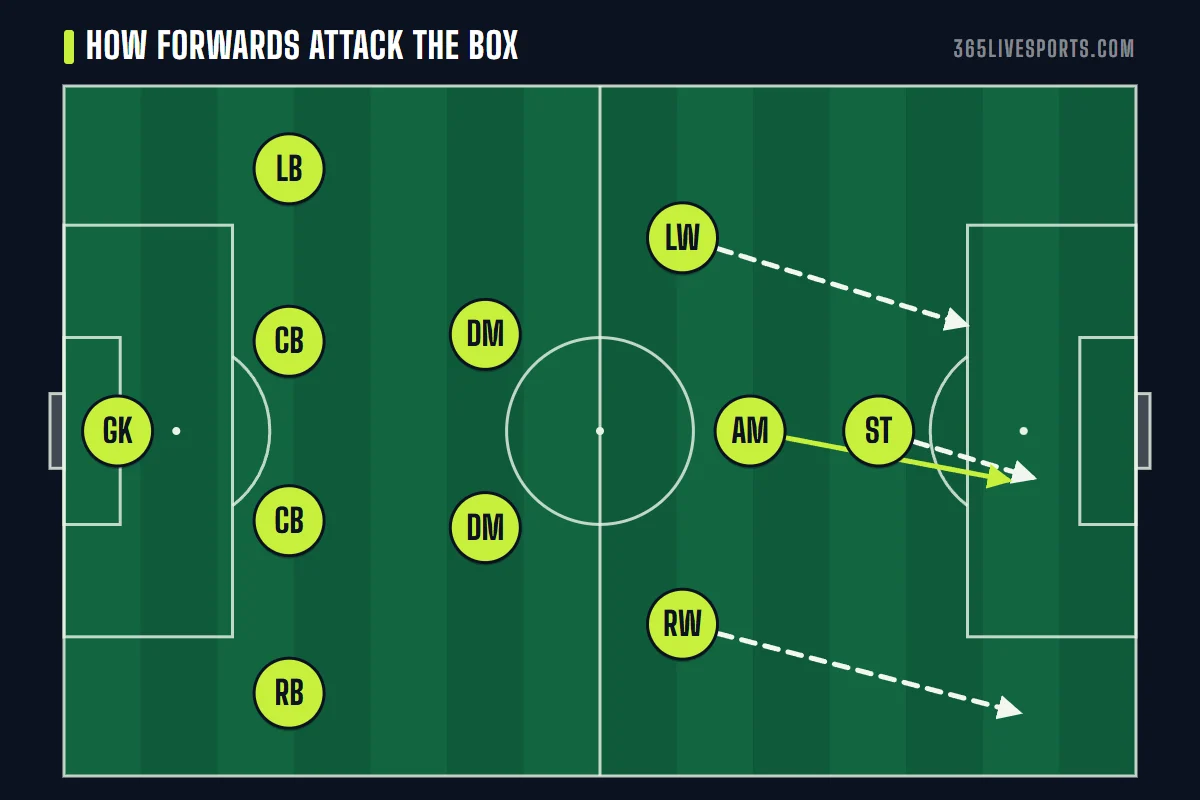
In the diagram, the left winger cuts inside as an inverted winger, the right winger stays wide, the striker runs across the near center back and the attacking midfielder slides the pass through. That gives the defense three different problems at once.
Without the ball, a winger blocks the pass from the center back to the full back and tracks the full back's runs. Wingers who skip this leave their own full back facing two attackers.
Attacking midfielder, wide midfielders and overlapping full backs
Not every attacker is a forward. The attacking midfielder (CAM or AM), the 10, plays between the opposition's lines and supplies the final pass. Wide midfielders (LM, RM) in a 4-4-2 have a similar attacking job to wingers but start deeper and have more defending to do. Full backs and wing-backs often provide the widest attacking position, especially when wingers move inside.
These roles are covered in more depth in the midfield positions guide and the defense positions guide.
Forward positions compared
| Position | Starts | Best at | Player type | Typical shapes |
|---|---|---|---|---|
| Striker (ST) | Central, highest player | Finishing, runs in behind | Quick, sharp, ruthless | 4-3-3, 4-2-3-1 |
| Center forward (CF) | Central, top of the team | Hold-up play, link play | Strong, good first touch | 4-4-2, 3-5-2 |
| Second striker (SS) | Just off the main forward | Linking and late runs | Clever, two-footed | 4-4-2, 3-5-2 |
| False nine | Central, drops deep | Creating space and overloads | Technical, unselfish | 4-3-3 |
| Winger (LW, RW) | Wide and high | Dribbling, crossing, cutting in | Fast, brave one against one | 4-3-3, 3-4-3 |
| Attacking midfielder (CAM) | Behind the striker | Final pass, long shots | Creative, calm in traffic | One-striker shapes, the diamond |
Attacking errors that cost goals, with fixes
| Mistake | Result | Fix |
|---|---|---|
| Running straight at the last defender | Caught offside again and again | Curve the run along the line, then go when the passer looks up |
| Standing still waiting for the ball | Easy to mark | Move away first, then come short, or the other way round |
| All forwards in the same spot | One defender marks two players | Near post, far post and edge of the box: one each |
| Shooting with every chance | Low quality shots, lost possession | Check for a teammate in a better position first |
| Switching off after losing the ball | Opponent counters freely | Five seconds of pressing after every loss |
Practice: 3v2 to goal
- Mark out the top half of a field with a full-size goal and a keeper.
- Three attackers (two wingers and a striker) start at the halfway line; two defenders wait at the edge of the box.
- The coach plays the ball into any attacker. The three must finish within ten seconds.
- Rules for runs: one attacks the near post, one the far post, one waits near the penalty arc for a pulled-back pass.
- Progress to 4v3 by adding an attacking midfielder and a defender, then add the offside line.
The offside law matters for every forward. The lawmakers publish the exact text on the laws of the game site. For the full list of roles in every line, return to the main soccer positions page.
Questions players and coaches ask
What are the forward positions in soccer?
The forward positions are striker, center forward, second striker and the left and right wingers. Some teams also use a false nine, a central forward who leaves the front line to collect the ball in midfield.
What is the difference between a striker and a winger?
A striker plays centrally and is the main goal scorer. A winger starts wide, beats full backs and either crosses or cuts inside to shoot. Both press the opponent's defenders without the ball.
Which soccer position scores the most goals?
Strikers score the most on almost every team, followed by wingers and attacking midfielders. Center backs often score a few each season from corners and free kicks.
How many forwards does a soccer team have?
Usually one to three. Shapes with one central forward are common, a 4-4-2 pairs two up front, and a 4-3-3 spreads three across the top. The attacking midfielders and full backs add more bodies to attacks.
Is attacking midfielder an offensive position?
Yes. The attacking midfielder is technically a midfielder but plays mostly as an attacker, creating chances and scoring from distance.
What makes a good striker?
Clean finishing off either foot and with the head, clever movement off the ball, the strength to hold it up and a short memory after missing a chance. Pace helps, but timing runs matters more.