
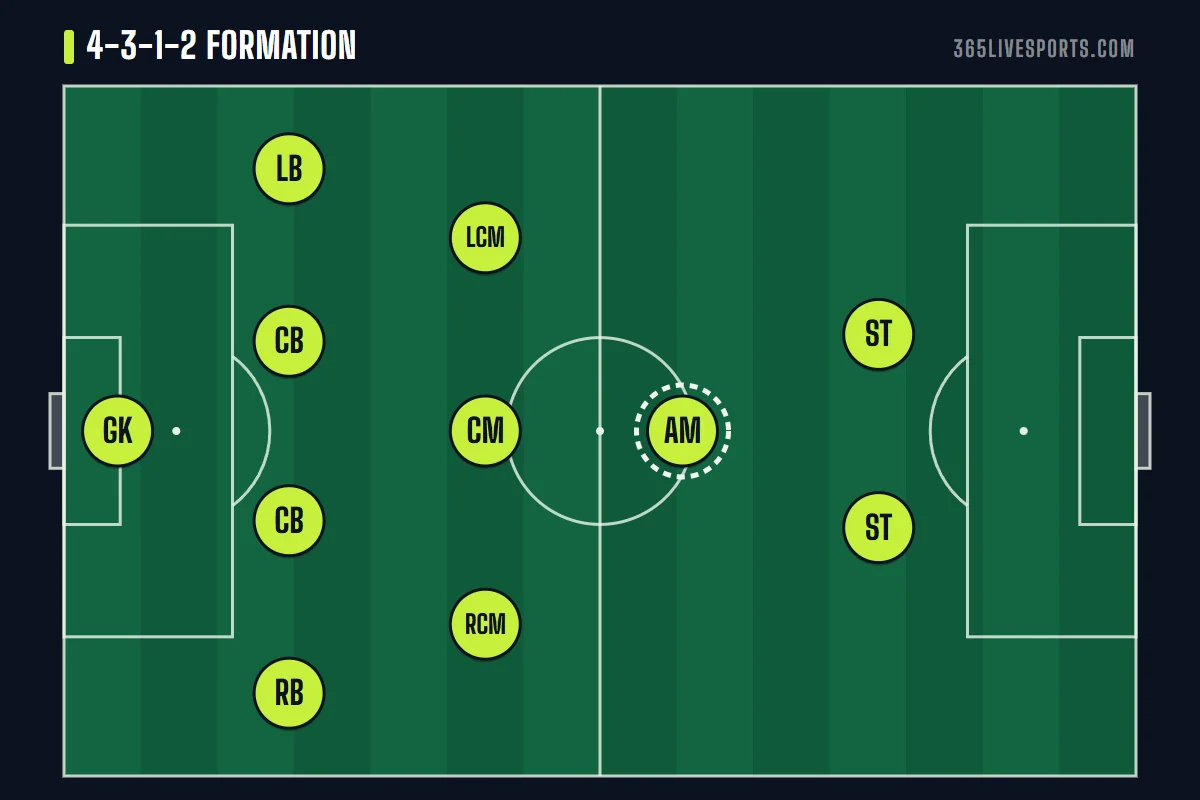
The 4-3-1-2 formation uses a flat back four, three central midfielders side by side, one playmaker in the hole and two strikers, so almost every player outside the defense stands in the middle third of the field's width. That makes it one of the narrowest soccer formations you can pick. It wins the center, gives a creative number 10 a free role and keeps two forwards together, but it asks the full backs to supply nearly all of the width. Below you will find the diagrams, a role table, how to defend the flanks and the matchups that make it creak.
Quick facts
Shape
4 defenders, 3 central midfielders, 1 attacking midfielder, 2 strikersWidth comes from
The two full backs, who push high when the team has the ballBest for
Teams with a gifted number 10 and two forwards who combine wellWeak spot
The wide areas in front of the full backsKey player
The number 10, plus two shuttling midfielders with big enginesGood matchup
A flat 4-4-2, where it has four central players against two
The 4-3-1-2 formation at a glance
Start from the goalkeeper and count forward. Four defenders across the box width and a little beyond it. Then three midfielders in a flat line roughly 12 yards ahead of the defense: a holder in the middle and a shuttler either side. Ahead of them the number 10 stands alone, and the two strikers play as a pair about 10 yards apart.
The diagram is the base picture. On the interactive board near the top of the page, try sliding the two outer midfielders wider and you will see how much of the field they are expected to cover once play reaches the touchline.
Why people call it the narrow formation
Six of the ten outfield players start inside the width of the penalty box. Nobody in midfield or attack is a natural winger. That is a choice, not an accident: by crowding the center the team can pass in short triangles and keep the ball away from the opponent's midfield.
The price is that width has to arrive from somewhere else. In this 4-3-1-2 soccer formation it comes from the full backs pushing up, and sometimes from a striker drifting into the channel.
Roles and responsibilities
| Role | Typical position | Main duties |
|---|---|---|
| Full backs | Wide, level with the midfield when attacking | Provide all the width, deliver crosses, recover fast |
| Center backs | Box width, 10 to 15 yards apart | Cover the strikers, play into the holder |
| Holding midfielder (6) | Center of the midfield three | Screen the defense, switch play to a full back |
| Shuttlers (8s) | Either side of the holder | Shift wide to defend, arrive in the box to attack |
| Number 10 | In the pocket ahead of the rival back line | Receive on the turn, thread passes, press their 6 |
| Strikers | A pair, one higher than the other | Pin the center backs, run the channels, finish |
Shirt numbers vary by country, but you will often see the 6, 8 and 10 used in this order. More on that in soccer positions by number.
Building attacks through the middle
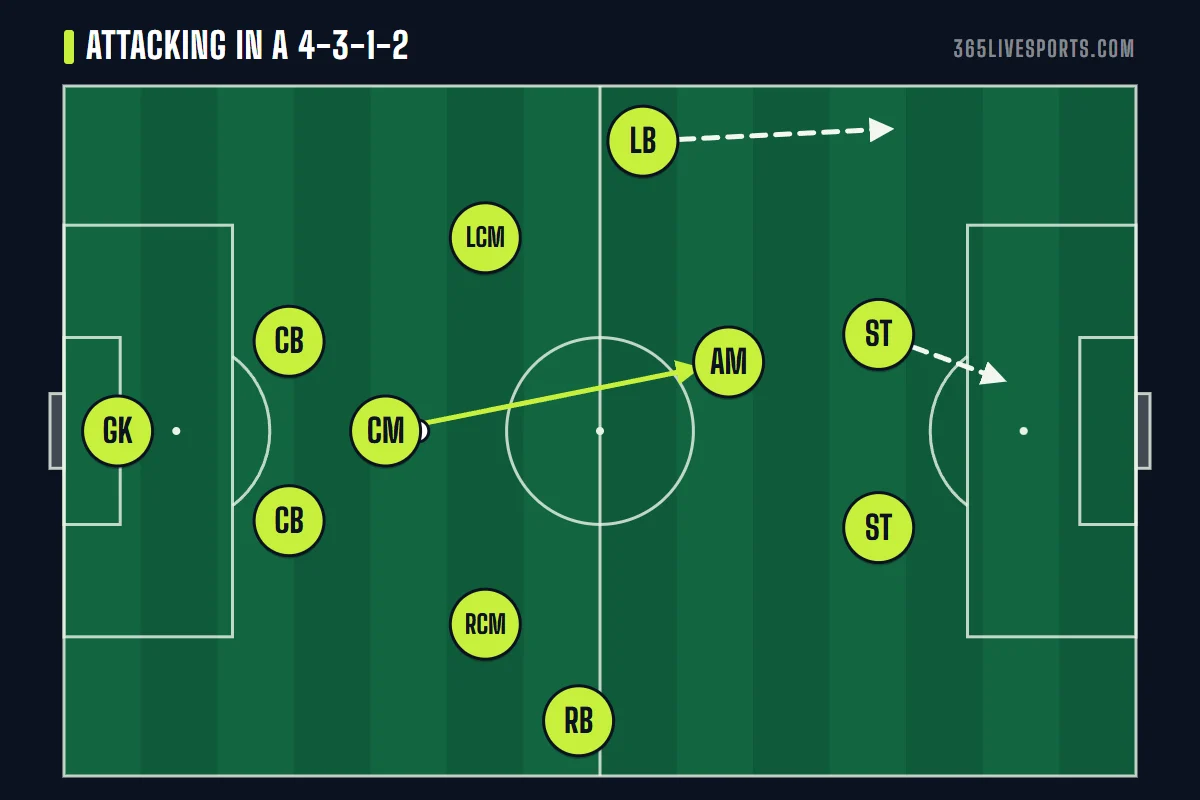
The best moments in this shape come when the number 10 receives facing forward with both strikers ahead. Three central attackers against two center backs is a problem for any defense. To get there, the team moves like this:
- The center backs split wide and the holder drops between them to receive from the goalkeeper.
- Both full backs push up to midfield height, which drags the opponent's wingers back with them.
- One shuttler moves toward the touchline as a passing option; the other stays inside near the 10.
- The 10 drifts into the pocket on the ball side. One striker runs in behind, the other comes short.
- If the middle is blocked, switch play quickly to the far full back, who now has room to cross.
Defending the flanks: the 4-3-1-2 formation tactical board view
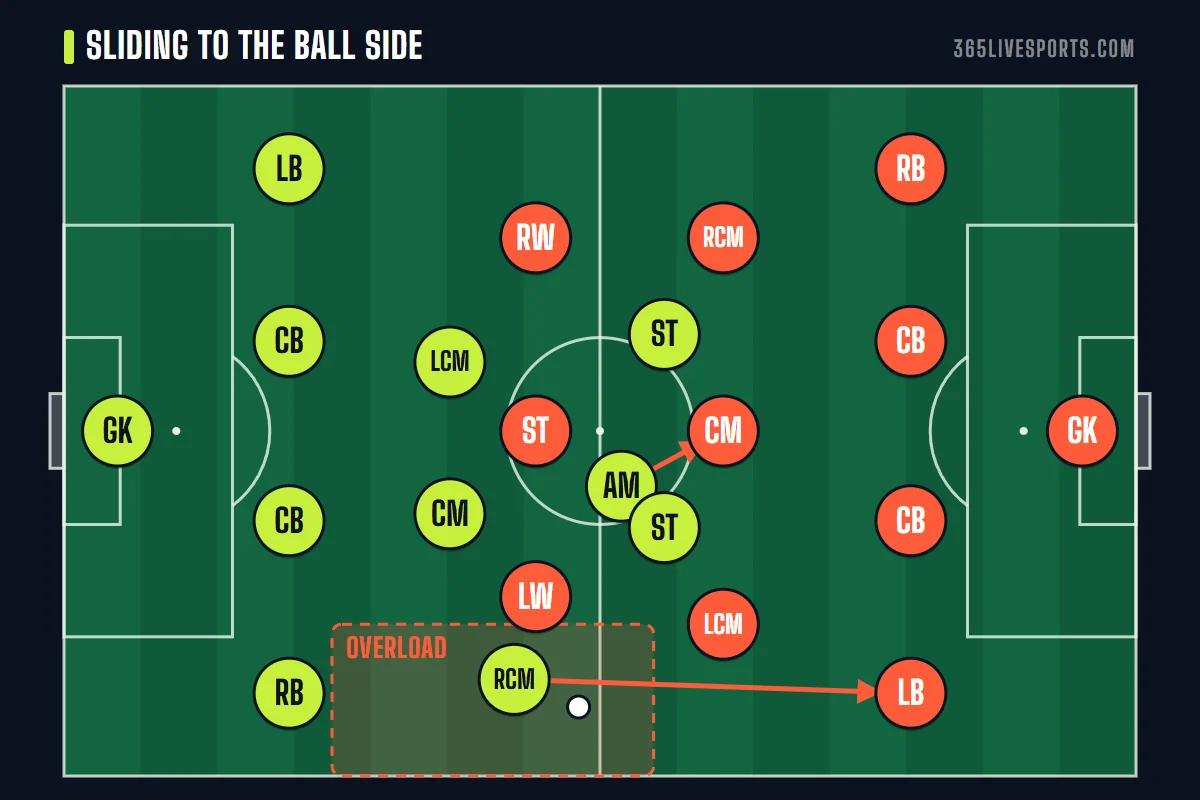
After a turnover, the shape becomes a 4-3-1-2 block with the two strikers screening the center backs and the 10 marking the opposing holding midfielder. The midfield three slides as one unit toward the ball. When the ball goes wide, the near shuttler steps out to the opposing full back or winger, the holder slides across behind him and the far shuttler tucks in.
Against a 4-3-3, those slides are long. The opponent's wingers stay wide and their full backs overlap, so you must decide who the full back marks and who the shuttler marks. A simple rule works for most teams: the full back takes the winger, the shuttler takes the overlapping full back.
What it does well, and where it hurts
Strengths
- Numbers in the center: against a flat midfield two, the holder, shuttlers and 10 make four against two.
- Two strikers stay close enough to combine with one-twos and flick-ons.
- The 10 gets a free role, which suits a creative player who struggles to defend.
- Pressing through the middle is compact, so the opponent is pushed wide.
Weaknesses
- Very little natural width; a crowded opponent can simply wait in the middle.
- Full backs are often exposed two against one by a winger plus an overlapping full back.
- Shuttlers run a huge distance and tire in the second half.
- If the 10 does not press, the opponent's holding midfielder has all day on the ball.
Matchups to plan for
| Opponent shape | What happens | Adjustment |
|---|---|---|
| 4-4-2 | Your central four outnumber their two central midfielders | Keep the ball inside, then attack their full backs late |
| 4-3-3 | Their wingers and full backs overload your flanks | Strikers press wide center backs; shuttlers mark full backs |
| 3-5-2 | Wing-backs have the whole touchline | Drop to a 4-5-1 block and let a striker track the wing-back |
| 4-2-3-1 | Their 10 sits on your holder | Let one center back step into midfield with the ball |
Choosing players and coaching the shape
Pick the 4 3 1 2 formation when your best player is a playmaker and your second and third best are forwards. You also need two full backs with real stamina and two shuttlers who can defend wide without complaint.
See how this narrow option compares with wider shapes in our guide to all football formations.
Questions players and coaches ask
What is a 4 3 1 2 formation?
Four defenders, a line of three central midfielders, one attacking midfielder and two strikers. It is narrow, so the full backs supply the width.
Is the 4-3-1-2 the same as a diamond?
Not quite. A midfield diamond is written 4-1-2-1-2 and has one holder behind two midfielders. In a 4-3-1-2 the three midfielders sit flat, which covers the width better but puts more distance between them and the number 10.
What is the best way to play against a 4-3-1-2 soccer formation?
Attack the flanks. Send a winger, plus a full back running on his outside, at their full back, and switch play quickly so their shuttlers have to cover long distances.
Who is the most important player in a 4-3-1-2 formation?
The number 10 creates most of the chances, but the shuttling midfielders keep the shape alive by covering both the center and the wings. Without them, the team is too easy to play around.
What does a 4-3-1-2 football formation diagram show?
It shows four defenders, a flat line of three midfielders, one player alone in the hole and two strikers side by side. In possession, the full backs appear much higher up the field.
Is the 4-3-1-2 good for youth soccer?
It can be, if you have a creative player and willing full backs. Rotate players through the full back and shuttler roles, because those are the positions that teach the most about covering space.