
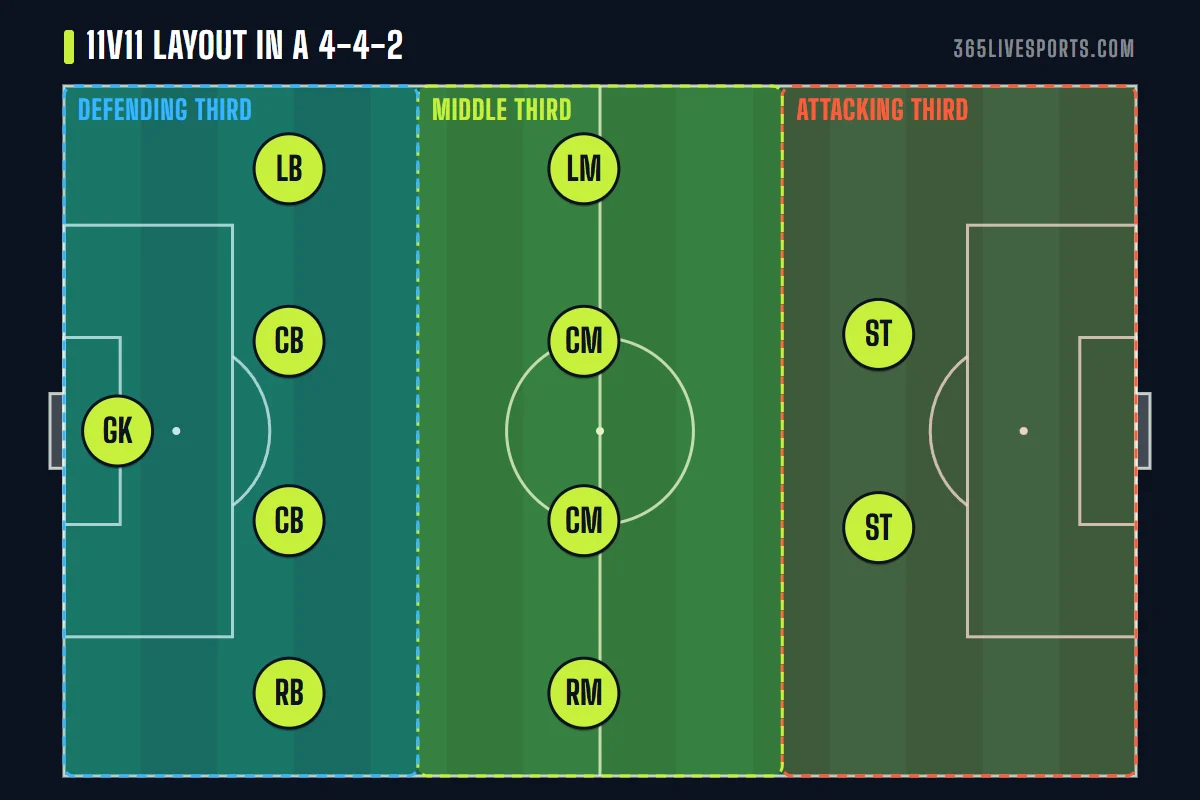
The 11v11 soccer positions are a goalkeeper plus ten outfield players, usually set out as four defenders, three or four midfielders and two or three forwards, on a full-size field with full-size goals. Compared with 9v9, each team gains two players, the field gets a lot bigger and some of the youth-only rules disappear.
The jump catches many teams off guard. Players who were stars in 9v9 suddenly find the far post is miles away, the back line has a gap they never had to cover and the midfield feels crowded and empty at the same time. This page explains the layout, what changes, and how to get a team comfortable in the first few weeks.
Quick facts
Players
11 per side: 1 goalkeeper and 10 outfield playersUsual starting shape
4-4-2 or 4-3-3New spots vs 9v9
Usually a fourth defender and an extra midfielder or forwardTypical age in the US
Around U13 and older; leagues decideBiggest change
Distance: longer passes, more running, wider gapsRules that go away
The build-out line used in many small-sided games
What are the 11 positions in soccer?
On a full field each team fields these 11 roles. The names shift a little with the formation, but the jobs stay recognizable:
- Goalkeeper: the only player who may handle the ball, inside their own penalty area.
- Left back and right back: the outside defenders, one per flank.
- Two center backs: the middle of the defense, in front of the keeper.
- Central midfielders (two or three): one may sit deeper as a holder, one may push on as a creator.
- Wide players (two): left and right midfielders in a 4-4-2, or wingers in a 4-3-3.
- Forwards (one to three): strikers who lead the attack.
The diagram shows the most familiar version, a 4-4-2, laid over the three thirds of the field. The full descriptions, abbreviations and skills for each role live in the main soccer positions guide.
11v11 vs 9v9: what changes for players
Most American players move up after two seasons of 9v9. Here is what actually feels different:
| Area | 9v9 | 11v11 | What players must adjust |
|---|---|---|---|
| Players | 8 outfield plus keeper | 10 outfield plus keeper | Two more teammates to find and to cover for |
| Field | Mid-sized | Full size, often well over 100 yards long | Longer passes, more running, wider gaps |
| Goals | Reduced size | Usually full size, 8 feet by 24 feet | Keepers cover a bigger frame; shots from distance matter |
| Back line | Often three | Usually four | Full backs learn to defend wide and push on |
| Build-out line | Used in many leagues | Gone | Opponents can press right away on goal kicks |
| Offside | Applies, with youth adjustments | Full Law 11 from the halfway line | Timing runs and holding the line become daily habits |
The offside rule is the same one adults use: a player is in an offside position when any part of the head, body or feet is in the opponents' half and nearer to the goal line than both the ball and the second-last opponent, and it only becomes an offense if that player gets involved in active play. You can read the official wording at theifab.com.
11v11 soccer positions by line
The table compares the two shapes most teams start with when they move to the full field.
| Line | 4-4-2 | 4-3-3 | Main job of the line |
|---|---|---|---|
| Goal | GK | GK | Shot stopping, crosses, starting play |
| Defense | LB, CB, CB, RB | LB, CB, CB, RB | Protect the goal and the space behind |
| Midfield | LM, CM, CM, RM | DM, CM, CM | Control the center, win second balls |
| Attack | ST, ST | LW, ST, RW | Score, press the defenders |
Which shape is better for a first season? The 4-4-2 is simpler: two banks of four, a partner for every player, and clear wide responsibilities. The 4-3-3 keeps more players in the middle and suits teams that like to pass. Both teach the habits players need later. Browse the rest on our formations page.
Spacing on a full-size field
Spacing is where new 11v11 teams struggle most. On a big field, the natural instinct is to spread out, and a team that spreads out without the ball is easy to play through.
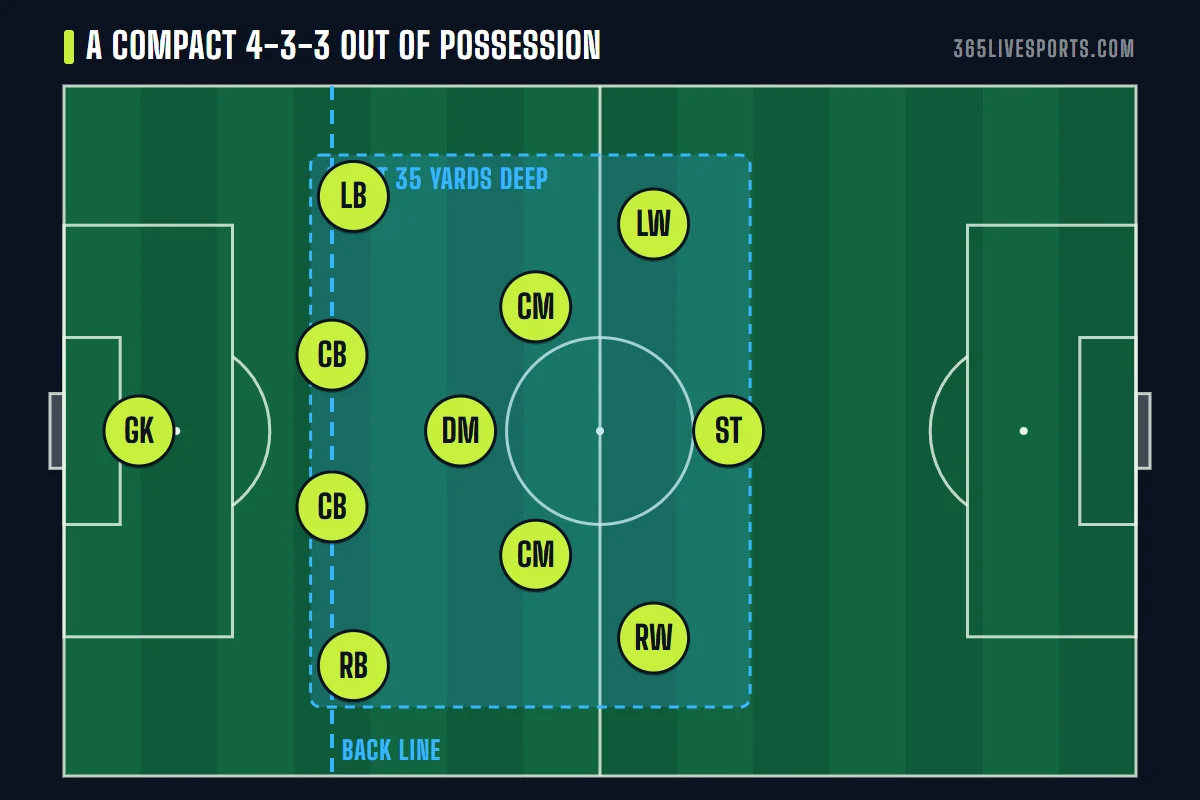
- Without the ball: squeeze the team into a block about 35 to 40 yards deep from the striker to the back line. The second picture has a 4-3-3 doing exactly this.
- Between defenders: roughly 10 to 15 yards between each member of the back four, less when the ball is central.
- Between lines: 10 to 15 yards from defense to midfield and midfield to attack.
- With the ball: stretch the opponent. Width from touchline to touchline and depth from your keeper to a forward on the last defender.
Tips for each line when moving up
Goalkeepers
The goal is bigger and crosses come from further out. Start a little further off the line, about two to four yards, and practice coming for high balls early in the week. Kicking range matters more because the field is longer.
Defenders
The usual new problem is the gap between a full back and the nearest center back. The fix: when play switches away from you, both full backs tuck in so the four defenders stay connected. Our defense positions guide covers this in detail.
Midfielders
A midfielder now has more space to receive in but also more ground to cover. Scan before the ball comes, play facing forward when possible, and do not all chase the ball at once. See the midfield positions guide for roles.
Forwards
Runs need better timing because there is more room behind the defense. Curve the run along the back line instead of sprinting straight, so you stay onside until the pass is played. More in the offense positions guide.
Common first-season mistakes and fixes
| Mistake | What happens | Fix |
|---|---|---|
| Strikers wait on the halfway line | The team splits into two halves with a big hole in midfield | Forwards drop to help, then press from the front together |
| Everybody follows the ball | The far side of the field is empty when the ball is switched | Assign one player per flank to hold width |
| Long balls every time | Possession is lost cheaply, players get tired chasing | Use the keeper and center backs to build short when the press allows |
| Back line stays deep | Opponents shoot from outside the box with no one closing | Step up together when the ball goes backward |
| Wide players never track back | The full back faces two attackers alone | Simple rule: the wide midfielder follows the opponent's full back |
A two-week plan to set up the full field
- Session 1: walk through the shape on the full field with cones at each position. Players say their job out loud, with and without the ball.
- Session 2: 11 versus no opponents, passing the ball around the shape, then a coach's call of "lost it" and everyone sprints into the compact block.
- Session 3: 8v8 across half the field to work on the back four and midfield staying connected.
- Session 4: full 11v11 scrimmage with stoppages to fix spacing.
- Before each game: show the lineup on a board. Our tactics board makes this quick.
Keep rotating players through two lines during the first season. Young teenagers grow fast and change shape physically, and today's left back can be next year's best midfielder. For age-group advice see youth soccer positions.
Questions players and coaches ask
What are the 11 positions in soccer?
Goalkeeper, left back, two center backs, right back, two or three central midfielders, two wide players and one to three forwards. The exact mix depends on the shape the coach picks, and the two most popular are the 4-3-3 and the 4-4-2.
At what age do kids start playing 11v11?
US national guidelines put the full 11v11 game at around U13 and older. Local leagues and clubs make their own decisions, so some move earlier or later.
What is the best formation for a first 11v11 season?
A 4-4-2 is the easiest to teach because every player has a clear partner and wide roles are simple. A 4-3-3 is a good choice for teams that already like to pass through midfield.
How is 11v11 different from 9v9?
Two more players per side, a much bigger field, full-size goals in most leagues and no build-out line. Offside applies from the halfway line just as in the adult game.
How far apart should players be in 11v11?
Without the ball, leave 10 to 15 yards from one player to the next and from line to line, and keep the whole team within roughly 35 to 40 yards from front to back. With the ball, spread as wide and deep as the field allows.