

The 4-2-1-3 formation starts with a back four, then a pair of screening midfielders next to each other, one attacking midfielder in the middle and a front three of two wingers and a striker. If you know the 4-3-3, picture its midfield triangle turned upside down: instead of one holder and two eights, there are two holders and one ten.
That small change matters. The pair at the base, often called a double pivot, gives the back four extra cover, and the ten gets a free role behind the striker. The front three stays high and wide, which separates this shape from its cousin with deeper wide men (4-2-3-1). Here is the full breakdown of the 4-2-1-3 formation in soccer, with diagrams you can copy onto your own tactical board.
Quick facts
Shape
Back four, double pivot, one ten, two wingers and a strikerIn short
A 4-3-3 with the midfield triangle invertedBest for
Teams with a creative ten and fast wingers who still want a safe baseWeak spot
The ten can be crowded out; wide areas when wingers do not trackKey player
The ten, the link between the pivot and the front threeMatchup
Solid against a front two; can be overloaded by a midfield three that marks the ten
The 4-2-1-3 formation diagram, line by line
Line one: two center backs between two full backs. Line two: a pair of holding midfielders, often wearing 6 and 8. Line three: a single ten in the center. Line four: a left winger, a striker and a right winger, usually 11, 9 and 7. Four, two, one and three make the ten outfield players, plus the goalkeeper.
On paper it barely differs from the 4-2-3-1. The difference is height: in a 4-2-1-3 the wingers start level with the striker, not level with the ten. Pull both wingers back toward the ten using the board on this page and you are looking at a 4-2-3-1 instead; return them and the original shape is back. To build any 4-2-1-3 football formation tactical board setup yourself, see our tactics board guide.
4-2-1-3 soccer formation: player roles
| Position | Attacking | Defending |
|---|---|---|
| Center backs | Spread across the box when the goalkeeper has it, then feed the pivot | Defend the box, step up together |
| Full backs | Run outside or inside the wingers, give width in the build-up | Defend the opposition wingers; one stays when the other attacks |
| Holding midfielders (double pivot) | First holder comes deep for the ball; his partner links up with the ten | Screen the center backs, cover the full back's space |
| Ten | Finds space between the lines, creates chances, arrives in the box | Presses the opposition holding midfielder |
| Wingers | Stretch the defense, beat the full back, cut in to shoot | Track the opposition full back or press high |
| Striker | Occupies the center backs, finishes, links with the ten | Leads the press, chooses the side to force play |
For the qualities a good ten needs, our offense positions page goes deeper.
Attacking moves with three forwards and a ten
The 4-2-1-3 is designed to give four attackers constant support. The pivot keeps the ball moving; the ten drifts to the side where the ball is; the wingers hold width so the opposition back four has to stretch. When it opens, the ten has a gap between the center back and full back to play through.
Three patterns that suit it:
- Ten to winger in behind: the winger takes his full back inside, then spins outside for a pass over the top from the ten.
- Underlapping full back: the winger stays wide, the full back runs inside him into the channel and crosses low.
- Striker drops, ten runs: the striker comes short to drag a center back, and the ten sprints into the space left behind.

Pressing and defending from a 4-2-1-3
Without the ball, most teams in this shape defend with two banks of four: the wingers drop to the midfield line, the ten sits just under the striker, and the double pivot holds the center. Teams that press high keep the wingers up to jump onto the opposition full backs, and the ten marks their holding midfielder.
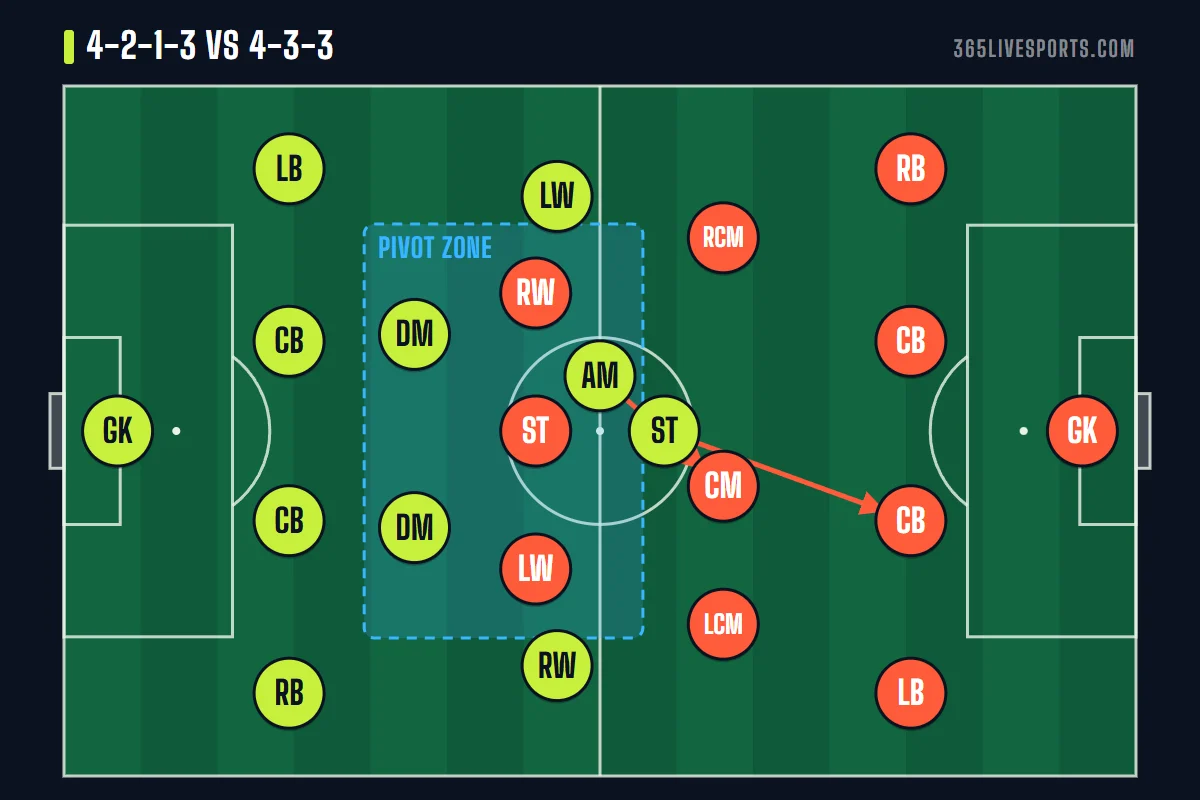
The pivot pair is the safety net. With two of them, one can step out to the ball while the other covers, which a single holder cannot do. Against a team that plays two strikers this is very comfortable. Against a 4-3-3 with two eights, though, the opponent has three central players against your two holders unless the ten helps. The diagram shows that matchup.
Side by side with its two closest relatives
| Shape | Midfield | Wide players | Best when |
|---|---|---|---|
| 4-2-1-3 | Double pivot plus a ten | High, level with the striker | You want a safe base and a creative ten |
| 4-3-3 | One holder, two eights | High and wide | Your midfield runners are your strength |
| 4-2-3-1 | Two holders, three attacking midfielders | Deeper, more defensive work | You expect to defend more and counter |
In practice many teams move between these three during a game. Plenty of sides drop one eight beside the holder when protecting a lead, so a three-forward team can slide into this shape without any substitution.
Is 4-2-1-3 a good formation?
For teams with one outstanding creative midfielder and two quick wingers, yes. It gives the ten freedom without leaving the defense exposed, and the front three keeps the opposition back line busy. It is less suitable if you have no true ten, because the shape loses its link between midfield and attack, or if the wingers refuse to defend.
| Strengths | Weaknesses |
|---|---|
| Two holders protect the back four | The ten can be marked out of the game |
| Front three pins the opposition defense | Gaps between the pivot and the wingers |
| Simple to reshape mid-game | Wide areas exposed when wingers stay high |
Coaching it with youth and amateur players
Remember that full-size eleven-a-side play generally starts at U13 in the US. Earlier, children play small-sided games, then 7v7 (about U9 and U10) and 9v9 (about U11 and U12), though leagues and clubs decide the details. A 9v9 version is the 3-2-1-2: three defenders, a pivot pair, a ten and two forwards.
For the pivot, a useful drill is the "shadow pair": two holders tied by an imaginary rope of about 10 yards. In a small game, whenever one presses, the other must drop into cover, and the coach stops play every time both press at once. After a few sessions the pairing becomes natural, and that habit is what keeps this formation safe. More team shapes for every age are on our formations hub.
Questions players and coaches ask
Is 4-2-1-3 a good formation?
For teams with a strong creative ten and quick wingers, it is an excellent balance of safety and attack. Without a true ten, a shape with two eights usually suits the players better.
How does 4-2-1-3 compare with 4-2-3-1?
Same personnel, different heights: here the wingers start level with the striker, whereas the other shape keeps them deeper, level with the ten. That makes the 4-2-1-3 more attacking.
Is 4-2-1-3 basically a 4-3-3?
Think of it as that shape with the midfield triangle inverted: two holding midfielders and one ten instead of one holder and two eights. The back four and front three are the same.
How do I set up a 4-2-1-3 on a tactical board?
Place four defenders across the back, two holding midfielders screening the defenders, a lone ten centrally and a front line of three. The board on this page loads the shape for you, so you can move players from there.
Which 4-2-1-3 player matters most?
Usually the ten, because he connects the double pivot to the front three and creates the bulk of the chances. The holding pair is close behind, since they protect the defense.