
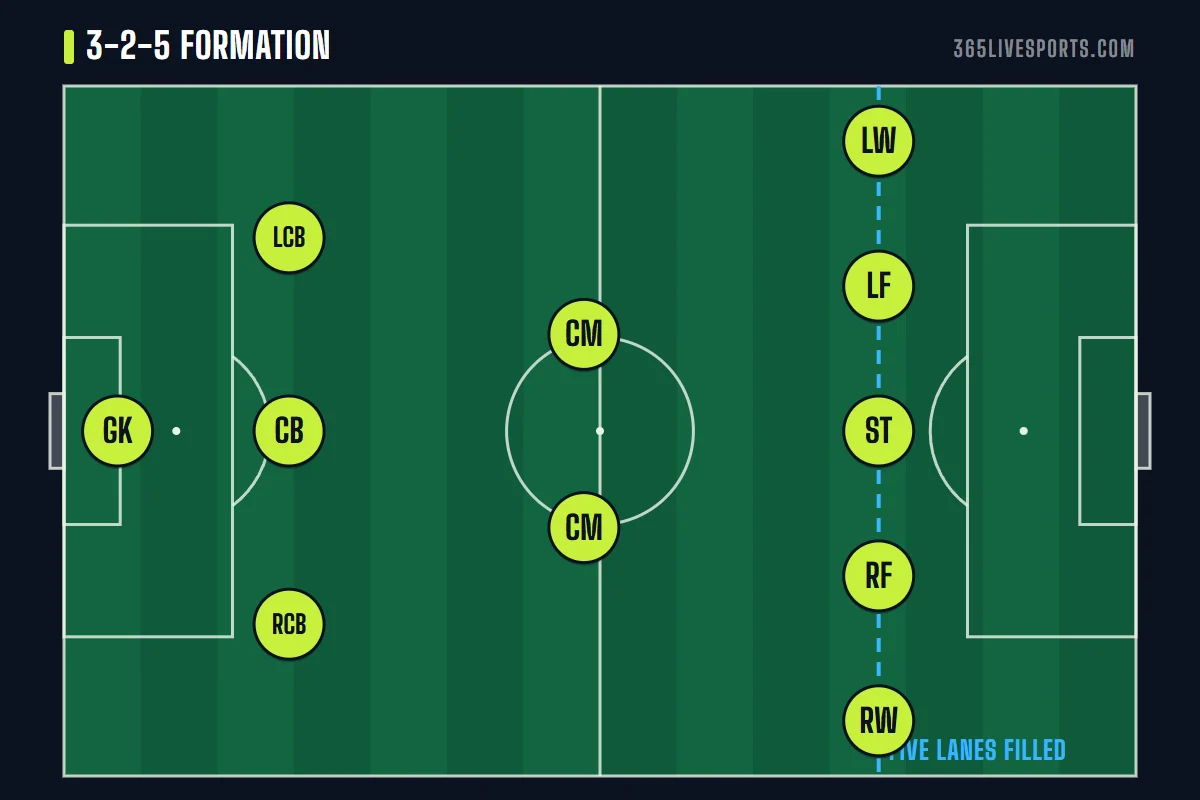
The 3-2-5 formation is an attacking structure with three defenders, two central midfielders behind the ball and five players stretched across the front line, one in each of the five vertical lanes of the field. Almost no team lines up in it at kickoff. It is what a team becomes after it has settled on the ball, typically starting from a back four in which one full back holds position while the opposite one pushes up, or from a back three whose wing-backs go high. Out of possession, the same players retreat to a 4-4-2 block, to 4-2-3-1, or to 5-4-1. Treat it as a picture of the attack, not a whole system, and you will understand it.
Quick facts
Shape
3 at the back, 2 pivots, 5 attackers across the fieldUsed when
The team has the ball in the opponent's halfBuilt from
A 4-3-3, a 4-2-3-1 or a wing-back systemMain idea
Pin all four defenders and leave one attacker freeKey players
The two pivots, who stop counter attacksWeak spot
Space behind the attackers when the ball is lost
What the 3-2-5 formation is, and what it is not
Draw a line across the field at the edge of the opponent's penalty box. In a 3-2-5 you will find five attackers on it, from touchline to touchline. Behind them, two midfielders sit near the center circle and three defenders hold a line near halfway.
It is not a defensive shape. Nobody defends in a 3-2-5 because five players high and five behind the ball cannot cover the width of the field against a counter. It also is not new: the attacking line of five echoes the old 2-3-5 pyramid, though modern teams put far more players behind the ball. Set up the five front players on the board above and then try defending with only three behind them, and the trade-off becomes obvious.
The five-lane idea behind the 3-2-5 soccer formation
Coaches split the field into five vertical strips: two along the touchlines, two inside channels (often called half-spaces) and the center. A back four can only guard four of them at once. Put an attacker in every lane and somebody is left unmarked, or a defender has to leave a gap to mark him.
| Lane | Who usually fills it | What they do |
|---|---|---|
| Left touchline | Winger or overlapping full back | Holds width, crosses, beats the full back |
| Left inside channel | Inside forward or attacking midfielder | Receives in the gap separating full back from center back, shoots or slips passes |
| Center | Striker | Pins both center backs, attacks the box |
| Right inside channel | Number 10 or advanced 8 | Combines with the striker, arrives late |
| Right touchline | Winger or wing-back | Stretches the line, attacks the far post |
The two pivots and three defenders behind them keep the ball moving and stop counters. If you want to know more about channel play, the offense positions guide breaks down each attacking role.
Three ways teams build it
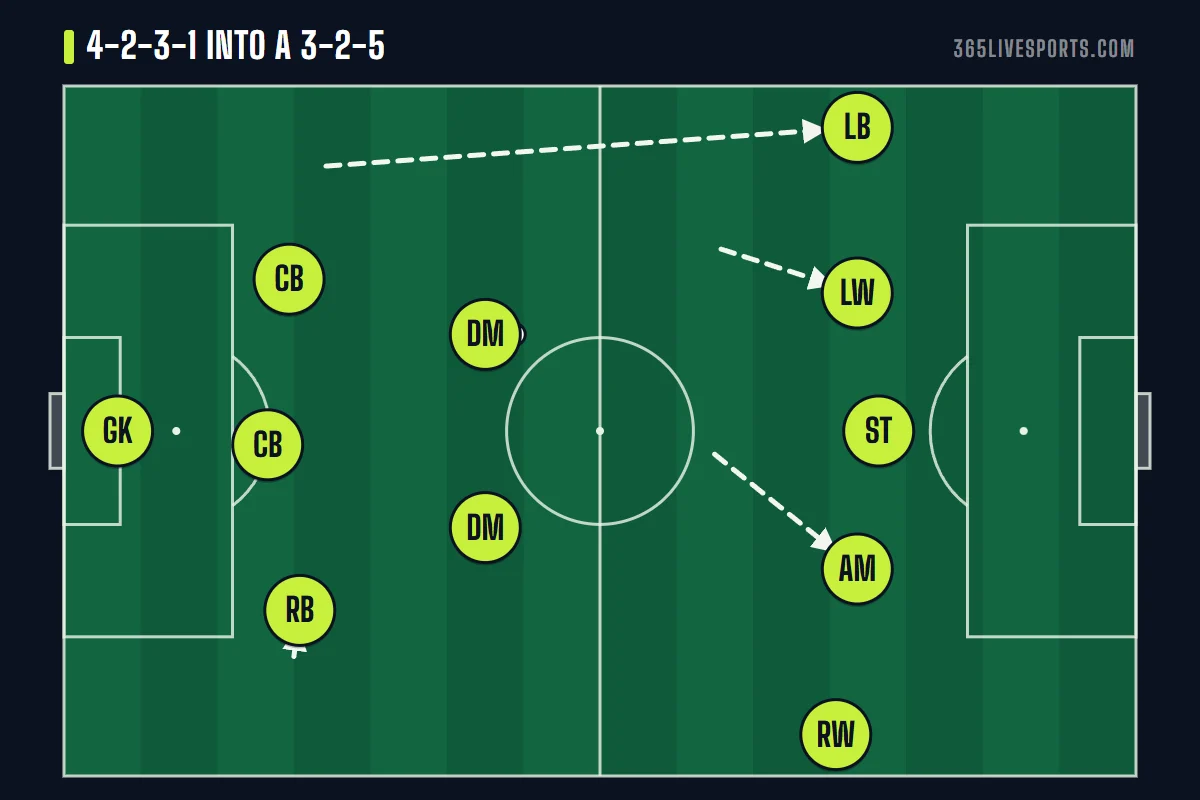
From a 4-2-3-1
The left back overlaps all the way to the touchline, the left winger moves inside into the channel, the number 10 drifts into the right channel and the right back tucks in as a third center back. The two holding midfielders stay as they are.
From a 4-3-3
One full back stays home to make a back three. The other moves up the wing while the winger on that side comes inside. One 8 joins the front line, and the other drops next to the holder.
From a 3-4-3
The simplest route: both wing-backs push level with the front three, and the two central midfielders stay as the pivot. This is why a 5-2-3 and a 3-2-5 can be the same team at different moments.
Protecting the 3-2 base after a turnover
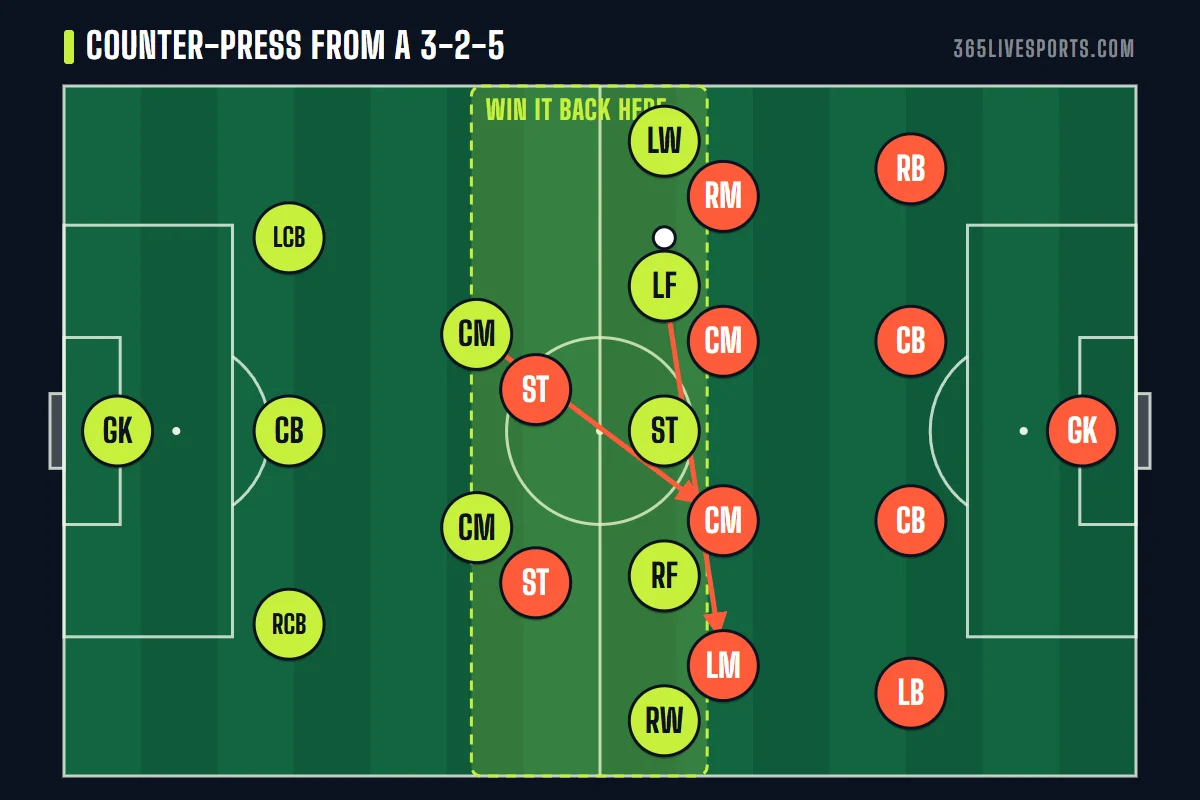
The whole structure lives or dies on the five players behind the ball. The moment an attack fizzles out, the nearest attackers press the ball at once, while the two pivots step onto the opponent's closest midfielders so a quick pass forward is not possible. The three defenders hold a line near halfway and squeeze forward if the ball goes backward.
Against a front two, three defenders give you a spare man. Against a front three, it becomes three against three, and one pivot must drop into the back line the instant possession goes.
Strengths and weak points of the 3-2-5 formation football teams use
| Strength | Weak point |
|---|---|
| Pins the whole back four; one attacker is always free | Only five behind the ball, so counters are dangerous |
| Width on both sides allows quick switches | Pivots can be overrun if the opponent leaves three forwards up |
| Many players arriving for crosses and cut-backs | Needs a full back or wing-back with real stamina |
| Forces the opponent to defend deep | Takes training time to learn the movements |
How opponents shut it down
Smart opponents defend a 3-2-5 with a back five of their own, so every lane is covered. Others leave three forwards upfield and dare you to attack, knowing a turnover leaves your back three alone. Here is how to answer each:
- Against a back five, use the pivots and wide center backs to overload one side, then switch quickly to the far touchline.
- Against three forwards left high, keep one pivot deeper so the base becomes four defenders and one midfielder.
- If the opponent counters into the channels, ask the nearest attacker to foul tactically, or better, to press the ball immediately so it cannot go forward.
Teaching it to your team
The 3-2-5 soccer formation is advanced. For youth and amateur teams, start with a familiar base such as a 4-3-3 and add a single trigger: when our center back has the ball in the middle third, the left back goes. Once players trust that movement, add a second one.
For the sibling shape with one player dropped into the hole, read our guide to the 3-2-4-1.
Questions players and coaches ask
What is a 3 2 5 formation?
Three defenders, two central midfielders and five attackers across the front. It is an attacking structure, used once a team has settled on the ball, rather than a full formation.
Do teams start matches in a 3-2-5 soccer formation?
Very rarely. Most teams list a back four or a back three on the team sheet and only move into the 3-2-5 when attacking. They drop back into a four or five when defending.
How do you defend against a 3-2-5?
Use a back five so every lane is covered, or keep three forwards high to punish turnovers. Fast counters aimed at the space beyond the wide center backs are the most dangerous weapon.
What are the five lanes in soccer?
Picture the pitch cut lengthwise into five strips: two along the touchlines, two inside channels and the middle. Filling all five forces a back four to leave someone free.
3-2-5 or 3-2-4-1: what separates them?
The 3-2-4-1 keeps its striker alone at the top with four players slightly behind him. Here all five attackers are in one line, which pins the defense harder but leaves fewer players to receive between the lines.
Is the 3-2-5 formation football's old pyramid?
No, but they share a front line of five. The old pyramid had only two defenders behind three halves. The modern 3-2-5 keeps five players back to stop counters.