
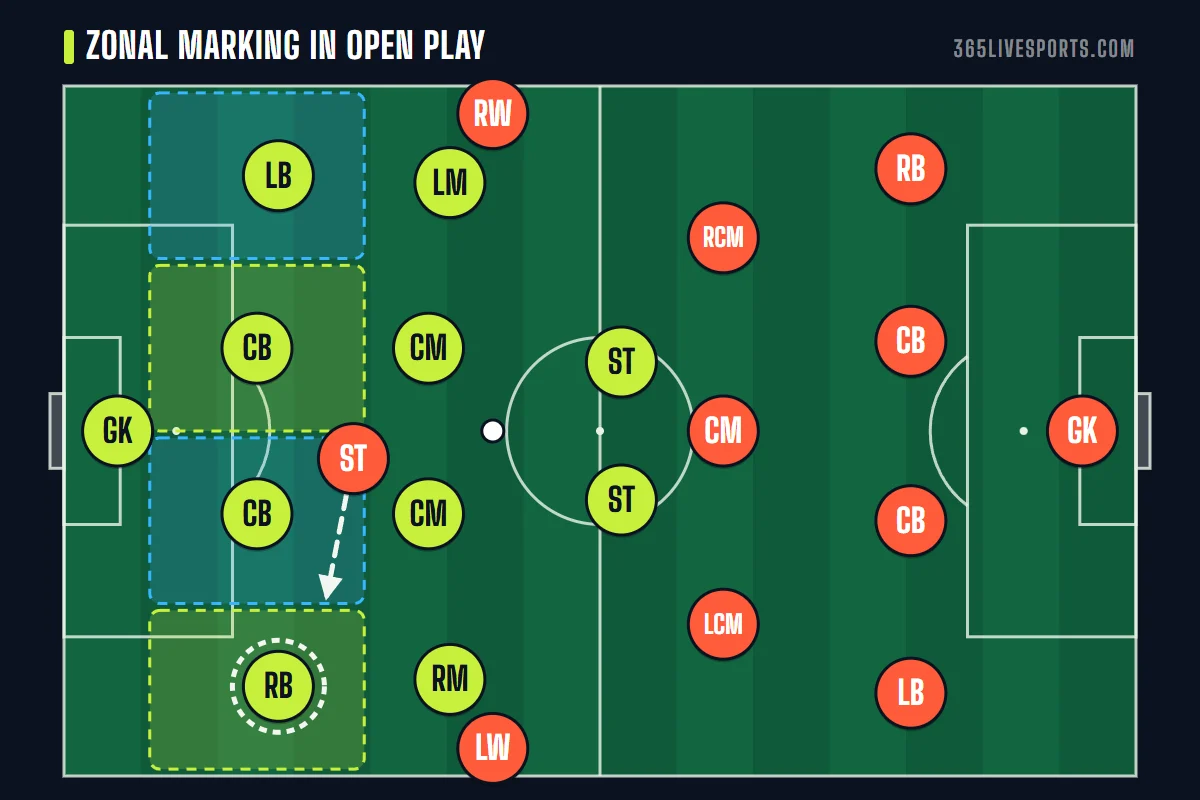
Zonal marking is a way of defending in which each player is responsible for an area of the pitch, not for a particular opponent: whoever enters your zone is yours, and when he leaves it you hand him on to a teammate. It is the opposite of man marking, where a defender follows one attacker wherever he goes.
Almost every team uses zonal ideas in open play today, and many use them at corners and free kicks. This page explains how it works in both situations, compares it with man marking, lists the defensive zonal marking strategies in soccer that coaches actually use, and finishes with a simple way to teach it.
Quick facts
Basic rule
Defend your space; mark whoever comes into itOpposite
Man marking, where each defender follows one opponentIn open play
Zones move with the ball, so the shape stays compactAt set pieces
Players guard spots in and around the six-yard boxStrength
Keeps the shape and is hard to drag apart with decoy runsWeak spot
Gaps between zones and attackers who arrive at speed
What zonal marking means on the pitch
Imagine the back four spread across the 18-yard box, each one owning a vertical strip. The striker starts in the strip of the right-sided center back, so that defender marks him. When the striker drifts toward the touchline, the center back follows him only to the edge of his strip, calls "yours", and the right back picks him up. The center back then returns to the middle, so the shape stays intact.
The zones are not fixed boxes painted on the grass. They move with the ball: when it goes left, the whole team shifts left, and each player's area slides with it. Coaches call this ball-oriented zonal defending.
Zonal vs man marking
| Zonal marking | Man marking | |
|---|---|---|
| Who you mark | Any opponent in your area | One named opponent |
| Team shape | Stays compact and predictable | Follows the attackers, can be pulled apart |
| Decoy runs | Easy to ignore, the space stays covered | Drag defenders out of position |
| Main risk | Two attackers in one zone, or a gap between zones | Losing your man, or one opponent beating you one on one |
| Communication needed | High, constant handovers | Lower, each player knows his job |
| Set pieces | Defenders hold spots and attack the ball | Defenders track runners from a standing start |
Many teams mix the two. A common open-play setup is zonal for the back line with one midfielder man-marking the opponent's playmaker, a job described on the regista page.
Defensive zonal marking strategies in soccer
Within the zonal idea, coaches use a handful of recurring strategies:
- Pass on and pick up. When an attacker leaves your zone, you call his name or "yours" and hand him over. The receiving defender confirms with "got him".
- Slide with the ball. The whole unit shifts toward the ball side; players away from the ball squeeze inward so the area near it is crowded.
- Pressure, cover, balance. One player presses the ball, the next covers behind him, and the far-side player keeps the balance of the shape.
- Close the inside first. In each zone, the defender stands goal-side and slightly inside his opponent, forcing play wide.
- Compact lines. Leave roughly 10 yards, give or take a couple, from one teammate to the next and a similar gap from line to line, so no attacker can receive between zones.
- Hybrid marking. Zonal shape, but the nearest defender goes tight on any player receiving in a dangerous area.
These ideas run through every defending shape, from a high press to a deep low block.
Zonal marking at corners and free kicks
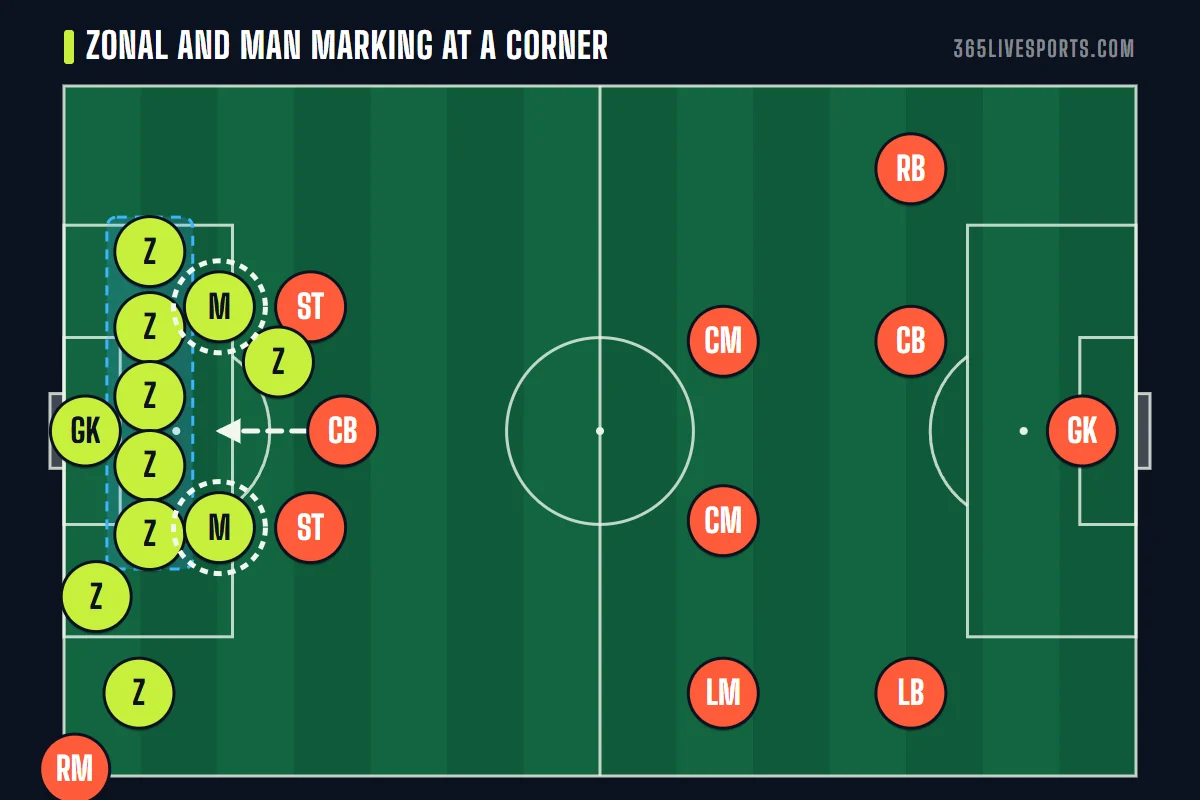
Set pieces are where the debate gets loud. A zonal setup at a corner usually looks like this:
- Three or four defenders stand in a line along the edge of the six-yard box, each covering a slice of the goalmouth.
- One player guards the near post, the most common target for flicked-on deliveries.
- One or two players stand further out, near the penalty spot or at the top of the box, to deal with knockdowns and cut-backs.
- One player stays near the corner taker to stop a short corner.
- In a hybrid system, one or two defenders man-mark the opponent's best headers.
The zonal players attack the ball, not the man: they step toward the ball as it comes into their space. The advantage is that the defenders start already in the right place and can jump without tracking a runner. The disadvantage is that attackers get a running start into the zones.
Strengths and weaknesses
Strengths. The shape stays organized, so the team rarely leaves huge holes. Decoy runs and rotations by the opponent have less effect. It saves energy, because players are not chasing a man all over the field. It fits sides who like to press as a unit, as described on the pressing page.
Weaknesses. Two attackers can stand in one zone and create a two against one. Attackers who time a run into the gap between two zones can find nobody responsible. Poor communication during handovers leaves a man free. At set pieces, a defender standing still is at a disadvantage against an attacker who runs and jumps.
Teaching it to a youth team
A simple progression:
- Shadow shape: four defenders and four cones. The coach carries the ball around and the four slide, keeping equal gaps.
- Handover game: two attackers walk across the line; defenders must call "yours" and "got him" as each one passes between zones.
- Live play: 4 defenders against 3 attackers and a server. A regain plus a pass to a target player is a point for the defenders; attackers aim for a goal.
- Set piece rehearsal: place players in the zonal corner setup and serve balls from both sides. Reward any defender who attacks the ball first.
The defense positions guide covers each defender's job in more detail, and the offside trap page explains how the same back line steps up together.
Questions players and coaches ask
What is zonal marking in soccer?
A defensive system where each player covers an area of the pitch rather than following a specific opponent. Attackers are marked by whoever is responsible for the zone they enter.
Is zonal marking better than man marking?
Neither is better in every situation. Zonal marking keeps the shape and handles decoy runs well; man marking makes responsibility clearer. Most teams use a mix of both, especially at set pieces.
What is a hybrid marking system at corners?
A setup where several defenders hold zones in and around the six-yard box while one or two others man-mark the opponent's most dangerous headers. It combines the strengths of both systems.
Why do teams concede from corners when zonal marking?
Usually because an attacker runs into a gap between two zones, or arrives at speed and out-jumps a defender who started from a standstill. Good zonal teams step toward the ball as it is delivered to reduce that disadvantage.
What are the main defensive zonal marking strategies in soccer?
Passing players on between zones, sliding with the ball, the pressure-cover-balance principle, closing the inside first, keeping lines compact and using hybrid marking where needed.