
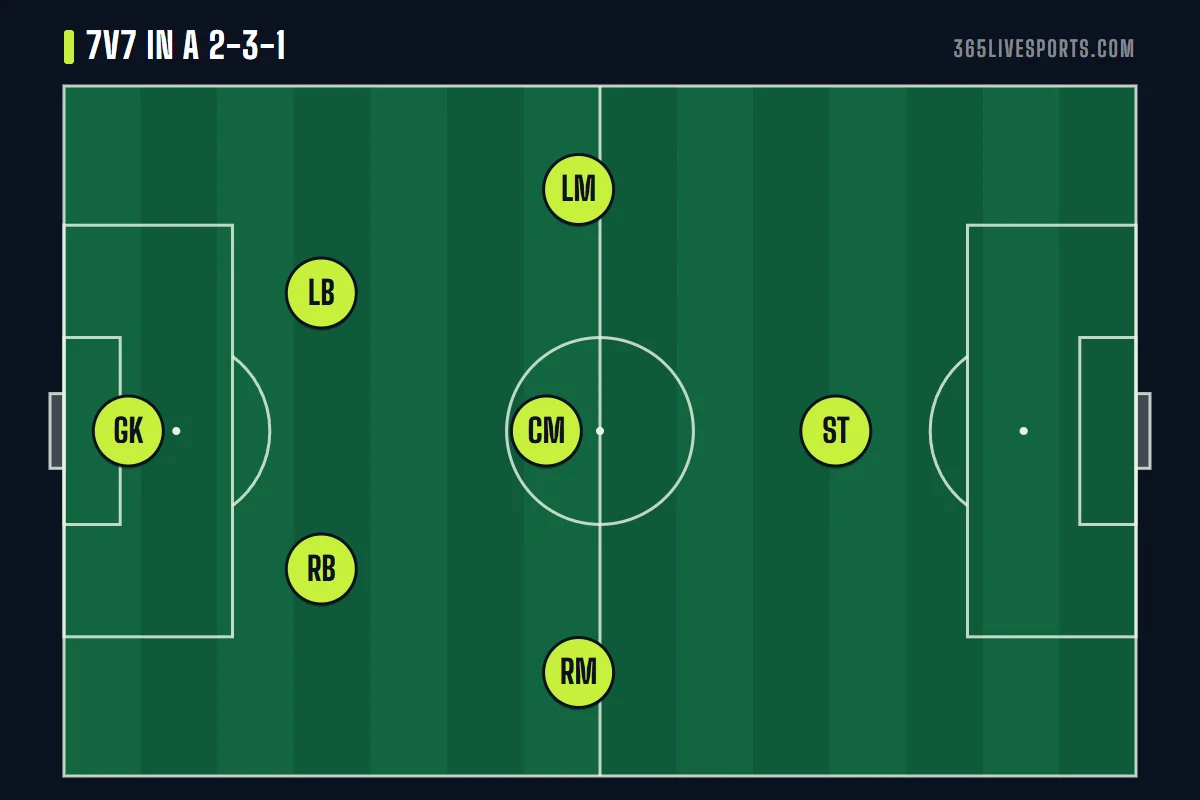
7v7 soccer positions are one goalkeeper and six field players, most often arranged in a 2-3-1 (a pair of defenders, three midfielders and one striker), with 3-2-1 and 2-1-2-1 as the other popular choices. In the United States, 7v7 is the standard game for U9 and U10 players, played on a smaller field with smaller goals. Fewer players means every child touches the ball more and has to both attack and defend. Below, you will find each position explained in plain language, formation diagrams, the rules that shape tactics at this age and a rotation plan that keeps every kid learning.
Quick facts
Players
7 per side: a goalkeeper and 6 field playersUsual ages (US)
Around U9 and U10; your league sets the exact rulesTop formation
2-3-1Other options
3-2-1, 2-1-2-1, 3-1-2, 2-2-2Rules to know
Build-out line, no punts and no heading in many US leaguesNext format
9v9, usually at U11
7v7 soccer positions in one picture
These are the soccer positions 7v7 coaches write on most lineup cards. With six field players, each line is small, so every player has a big area to cover. In the 2-3-1 shown here you have:
- Goalkeeper: guards the goal, handles inside the penalty area and starts most attacks.
- Two defenders: a left back and a right back who share the middle when the ball is far away.
- Three midfielders: a center midfielder plus a left and right midfielder who run the sidelines.
- One forward: the striker, who leads the press and finishes chances.
Formation numbers count only the field players, back to front, so in 7v7 they always add up to six.
Which age groups play 7v7
US Soccer's small-sided standards list 7v7 as the maximum format for U9 and U10. Before that, the youngest players play 4v4 or smaller games without fixed positions, and after it comes 9v9 at U11 and U12, then 11v11 from U13.
For a coach of U10 soccer positions in 7v7, the aim is not to win the tactical battle. It is to give each child a clear, simple job and then make sure they try several of them.
Rules that change how 7v7 is played
Many US 7v7 leagues follow the US Soccer player development guidelines, which add a few rules that matter for positions:
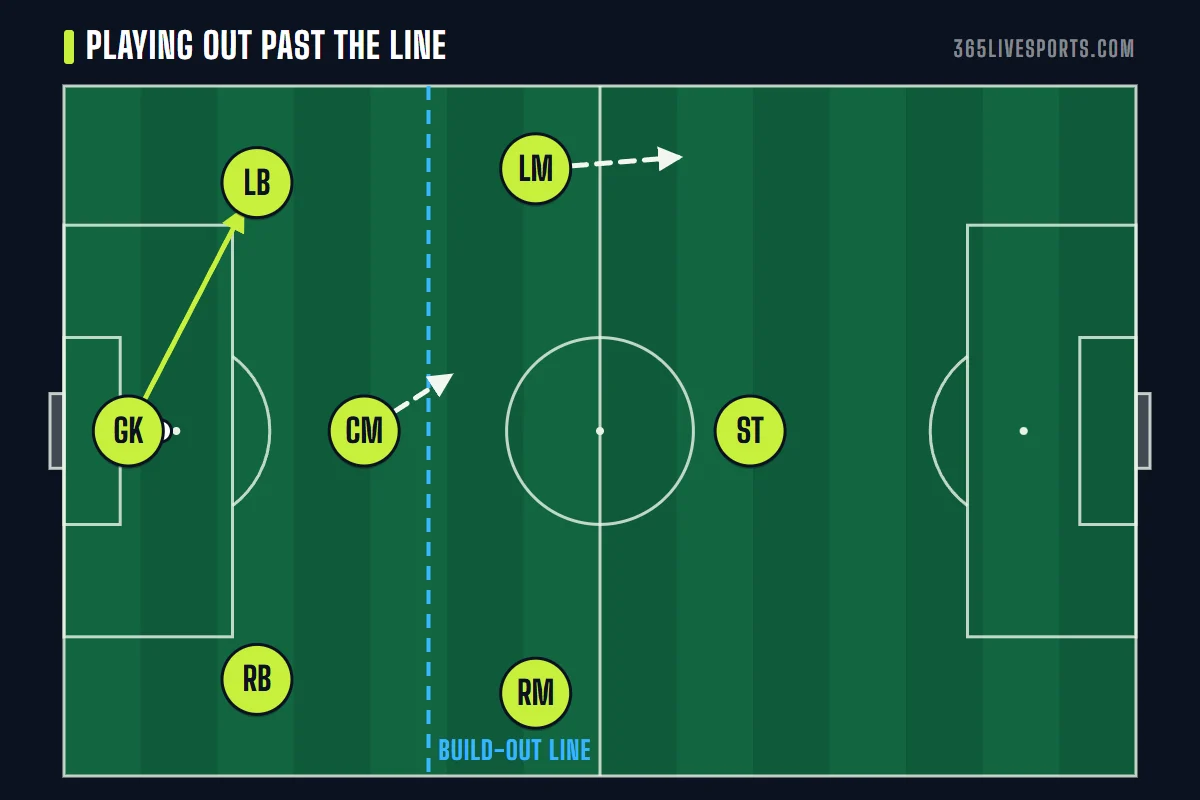
- Build-out line: a line across the field, halfway between the top of the penalty area and the halfway line. On a goal kick, or when the keeper holds the ball, the opponent must drop behind it. That gives your defenders space to receive.
- No punts: in many leagues the keeper may not punt or drop-kick, and must pass, throw or roll the ball instead.
- Offside: players cannot be called offside between the halfway line and the opponent's build-out line, only beyond it.
- No heading: US Soccer guidance bans heading for players aged 10 and under.
These rules exist to teach playing out from the back. Use them: put your two defenders wide near the sidelines on goal kicks, and drop the center midfielder in front of the keeper as a third option. For the full offside law, see the official Laws of the Game.
7 vs 7 soccer positions: attacking and defending jobs
| Position | Our ball | Their ball |
|---|---|---|
| Goalkeeper | Pass or roll it to a free defender | Stay on the line for shots, come out for through balls |
| Defenders | Split wide, take the first pass, dribble into space | Stay goal side, cover each other, talk |
| Center midfielder | Show for the ball, turn, switch play | Pressure the ball in the middle, protect the defenders |
| Wide midfielders | Hug the sideline, run with the ball, cross | Track your player back, help the defender on your side |
| Forward | Run behind, hold up the ball, shoot | Be the first defender: chase the ball toward the sideline |
The bigger version of each job is explained on our soccer positions page.
The best 7v7 formations
2-3-1
Balanced and easy to understand. Three midfielders give width and numbers in the middle. The forward can get lonely, so ask the wide midfielders to join attacks.
3-2-1
Safer at the back with three defenders and a sweeper-like middle defender. Good for teams that concede a lot, but it can leave the forward isolated.
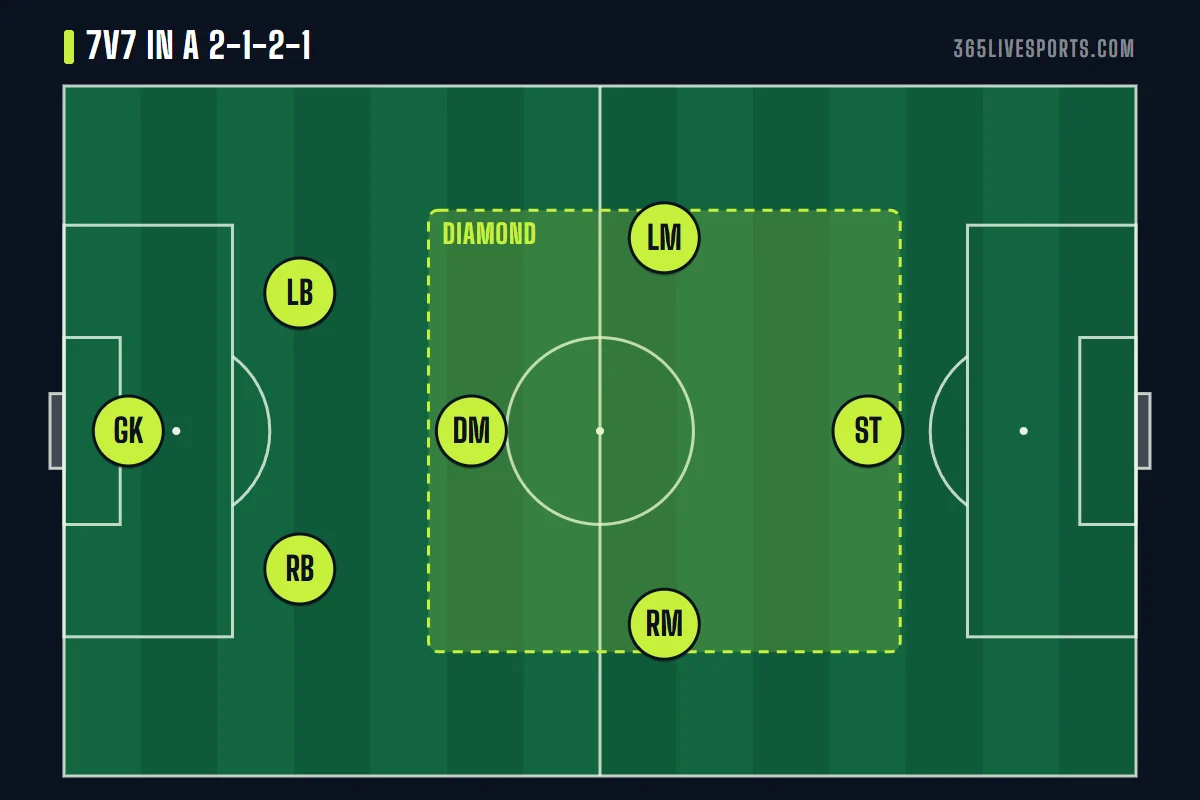
2-1-2-1
A diamond in midfield: one holding player, two attacking midfielders and a striker. It teaches triangles and support angles, which makes it a favorite with coaches who want passing.
3-1-2 and 2-2-2
Two forwards up front. More goals, but less cover. Useful for stronger teams or when chasing a game.
Whatever you pick, play it all season before judging it. Kids need time to learn where to stand.
7 vs 7 football tactics that work at this age
Keep it to a few clear ideas. Children of eight to ten can handle three or four principles at a time, not a full playbook.
- Get wide and long when we have the ball. Spread out so a teammate is always open.
- Make triangles. The player with the ball should always see two passing options.
- Nearest player pressures the ball. Everyone else gets between their opponent and our goal.
- Win it, then look forward. After a steal, the first look is toward the opponent's goal.
Rotation: let every child try every position
At U9 and U10, nobody is a defender or a forward yet. Growth spurts, confidence and skills change from season to season. Rotation also builds better soccer players: strikers who have played at the back understand what defenders dread.
- Give each player time in at least two lines per game, for example a half in defense and a half in midfield.
- Rotate the goalkeeper role for anyone willing, one half at a time.
- Keep a simple chart so playing time and positions are fair over the season.
- Explain each new role in one sentence before the player goes on.
Our youth soccer positions guide has more rotation ideas for every age, and the 11v11 positions page shows where these roles end up.
Questions players and coaches ask
What are the 7 on 7 soccer positions?
One goalkeeper and six field players. The field players usually split into defenders, midfielders and a forward, for example two, three and one in a 2-3-1.
Which 7v7 formation works best?
Most coaches start with the 2-3-1: it covers the field evenly and kids grasp it quickly. The 3-2-1 is safer defensively, and the 2-1-2-1 teaches passing triangles.
What age plays 7v7 soccer?
In America, US Soccer's guidelines for small-sided play put U9 and U10 at 7v7. Each league writes its own rules, so check the handbook.
What is the build-out line in 7v7?
A line between the halfway line and the penalty area. On goal kicks or when the keeper has the ball, the other team must retreat behind it, so the defending team can play out from the back.
Can U10 players head the ball in 7v7?
Under US Soccer guidance, heading is not allowed for players aged 10 and under. Leagues may add their own penalties, usually an indirect free kick.
How many defenders should a 7v7 team have?
Two or three. Two defenders (a 2-3-1) is most common; three (a 3-2-1) gives more cover if your team is struggling to keep goals out.