
The basic soccer positions in Spanish are portero (goalkeeper), defensa central (center back), lateral (full back), centrocampista or mediocampista (midfielder), mediapunta (attacking midfielder), extremo (winger) and delantero centro (striker). Many of these change from country to country, so a coach from Mexico and one from Spain may use different words for the same player.
This page is for coaches with Spanish-speaking players, bilingual families and players who grew up with fútbol in Spanish and now play in English. You will find a side-by-side chart, the main regional differences, how to say each term and a few short calls you can use from the touchline.
Quick facts
Goalkeeper
Portero in Spain and Mexico, arquero across much of South AmericaDefender
Defensa or defensor; center back is defensa central or centralMidfielder
Centrocampista in Spain, mediocampista or volante in Latin AmericaAttacking midfielder
Mediapunta in Spain, enganche in ArgentinaStriker
Delantero centro, also ariete or el nueveCoach
Entrenador, or director técnico (DT) in much of Latin America
Soccer positions in Spanish and English: the full chart
The Spanish column uses the standard forms most widely understood, with common alternatives in brackets. Abbreviations are the ones you will see on Spanish-language lineup graphics.
| English | Spanish | Abbr. | Short meaning |
|---|---|---|---|
| Goalkeeper | Portero (arquero, guardameta) | POR | Guards the goal, may use hands in own area |
| Center back | Defensa central (central, zaguero) | DFC | Central defender, the core of the back line |
| Right back | Lateral derecho | LD | Defender on the right side |
| Left back | Lateral izquierdo | LI | Defender on the left side |
| Wing-back | Carrilero | CAD, CAI | Runs the whole flank in a back three |
| Sweeper | Líbero | LIB | Spare defender behind the line |
| Defensive midfielder | Mediocentro defensivo (pivote, volante de contención) | MCD | Shields the defense |
| Central midfielder | Mediocentro (centrocampista, interior) | MC | Links defense and attack |
| Attacking midfielder | Mediapunta (mediocentro ofensivo, enganche) | MCO | Creates chances behind the striker |
| Right or left midfielder | Medio derecho, medio izquierdo (volante) | MD, MI | Wide player in a flat midfield |
| Right or left winger | Extremo derecho, extremo izquierdo (puntero) | ED, EI | Wide attacker |
| Striker | Delantero centro (ariete, centrodelantero) | DC | Main goal scorer |
| Second striker | Segundo delantero | SD | Plays off the main striker |
The general words are useful too: defensa (the defense, or a defender), medio campo (midfield), delantera (the forward line), suplente (substitute) and capitán (captain). Every English role is described in detail in our soccer positions guide.
A lineup labelled in Spanish
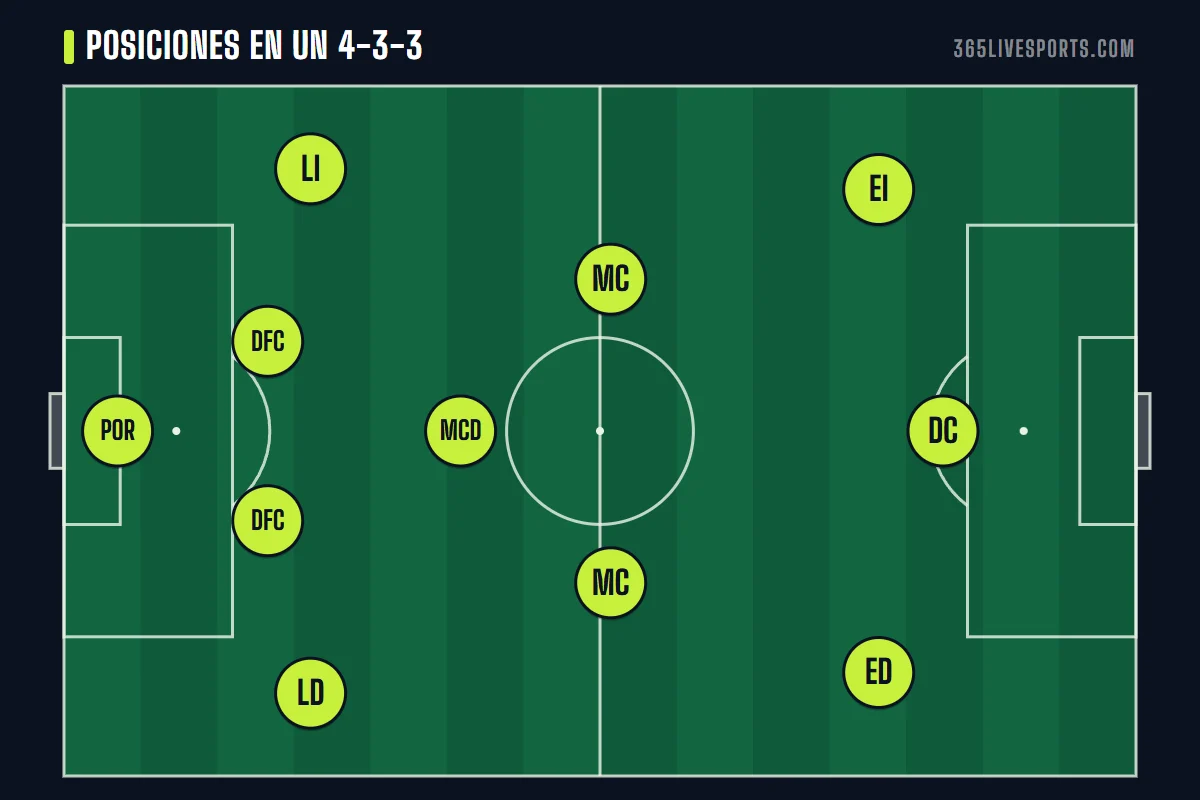
Here a 4-3-3 is labelled with Spanish abbreviations, attacking to the right. Read it from the back: POR in goal, LI and LD on the flanks of the defense with two DFC in the middle, an MCD at the base of midfield with two MC ahead, then EI, DC and ED across the front.
Spanish speakers also use shirt numbers as nicknames, much like English speakers say "the 6" or "the 10". El nueve is the striker, el diez the playmaker, and Argentines call their holding midfielder el cinco. The numbering traditions behind these nicknames are explained in soccer positions by number.
Spain vs Latin America: regional words
Spanish soccer vocabulary grew separately in each country, so the same player can have three or four names. The table shows the most common choices in each region. Usage overlaps a lot, and fans everywhere understand most of these from television.
| English | Spain | Mexico | Argentina and Uruguay |
|---|---|---|---|
| Goalkeeper | Portero, guardameta | Portero, arquero | Arquero |
| Center back | Central, defensa central | Defensa central | Marcador central, zaguero |
| Full back | Lateral | Lateral | Lateral, marcador de punta |
| Defensive midfielder | Pivote, mediocentro defensivo | Medio de contención, volante de contención | Volante central, el cinco |
| Midfielder in general | Centrocampista | Medio, mediocampista | Volante, mediocampista |
| Attacking midfielder | Mediapunta | Medio ofensivo, media punta | Enganche, el diez |
| Winger | Extremo | Extremo | Wing, puntero |
| Striker | Delantero centro, ariete | Delantero, centro delantero | Centrodelantero, el nueve |
| Coach | Entrenador, míster | Director técnico, DT | Director técnico, DT |
How to pronounce the key terms
Spanish spelling is consistent, so once you know a few rules you can say any position. Stress the syllable in capitals:
- Portero: por-TEH-roh. Arquero: ar-KEH-roh (the qu sounds like k).
- Lateral: lah-teh-RAHL. Central: sen-TRAHL in Latin America, then-TRAHL in most of Spain.
- Zaguero: sah-GEH-roh. Carrilero: kah-rree-LEH-roh, with a rolled rr.
- Pivote: pee-VOH-teh. Volante: boh-LAHN-teh (v sounds close to b).
- Mediocentro: meh-dyoh-SEN-troh. Mediapunta: meh-dyah-POON-tah.
- Enganche: en-GAHN-cheh. Extremo: eks-TREH-moh.
- Delantero: deh-lahn-TEH-roh. Ariete: ah-RYEH-teh.
Touchline calls in both languages
Short words carry best across a field. These calls are understood across the Spanish-speaking world:
| English call | Spanish | When to use it |
|---|---|---|
| Push up | Arriba, sube | Back line steps forward together |
| Drop | Atrás, baja | Team retreats toward its own goal |
| Man on | Viene, te marcan | Warn a teammate under pressure |
| Time | Solo, tienes tiempo | No opponent close, take a touch |
| Mark the 9 | Marca al nueve | Pick up the striker |
| Switch it | Cambia de banda | Move the ball to the other side |
| Press | Presiona, aprieta | Close down the player on the ball |
| Tuck in | Cierra | Wide player narrows toward the center |
Tiki-taka and other Spanish words in English soccer talk
Several Spanish terms have moved into English. The most famous is tiki-taka, a style of short, quick passing and constant movement linked to Spanish teams. The name copies the sound of rapid passes, a bit like "tick-tock", and in English it simply means patient possession play built on triangles and one-touch combinations.
- Líbero: the free defender, or sweeper.
- Enganche: the classic number 10, the "hook" between midfield and attack.
- Volante: literally "flying"; the midfielder who covers ground.
- Golazo: a spectacular goal.
- Rondo: the keep-ball circle used in nearly every practice.
The influence runs both ways: Spanish commentators say "el córner", "el penalti" and "el gol", borrowed from English. Learning a handful of these words helps when you watch matches in either language or compare English football tactics with the Spanish passing style.
Tips for coaches and parents of Spanish-speaking players
- Ask which words the family uses. A player from Argentina may call a defensive midfielder el cinco, while a player from Mexico says contención.
- Put both languages on the board. Write "RB / LD" or "striker / delantero" on the lineup.
- Use the numbers. Shirt-number nicknames work in both languages and remove a lot of confusion.
- Pair players. A bilingual teammate can translate quick instructions during water breaks.
- Explain the job, not just the name. Our guides to defense, midfield and offense positions break each role into simple tasks you can show with cones.
Parents of young players will find age-group advice in our youth soccer positions guide.
Questions players and coaches ask
How do you say soccer positions in Spanish?
Goalkeeper is portero or arquero, defender is defensa, midfielder is centrocampista or mediocampista and forward is delantero. Specific roles include lateral (full back), pivote (holding midfielder), mediapunta (attacking midfielder) and extremo (winger).
What is a striker called in Spanish?
Delantero centro is the standard term, often shortened to delantero. You will also hear ariete, centrodelantero and el nueve, after the classic shirt number.
What does volante mean in soccer?
Volante is the usual Latin American word for a midfielder. A volante de contención or volante de marca is a holding midfielder, while a volante ofensivo plays further forward.
Is a goalkeeper portero or arquero?
Both are correct. Portero is standard in Spain and common in Mexico, while arquero is the usual word in Argentina, Uruguay and much of South America. Guardameta is a formal option heard on broadcasts.
What is the tiki-taka meaning in English?
Tiki-taka describes a style of short, quick passing with constant movement to keep the ball. The name imitates the sound of rapid passes, and in English it is used for patient possession soccer.
What are soccer positions in English for Spanish speakers?
The main ones are goalkeeper, center back, full back, defensive midfielder, central midfielder, attacking midfielder, winger and striker. The chart on this page lists each one next to its Spanish name and abbreviation.