
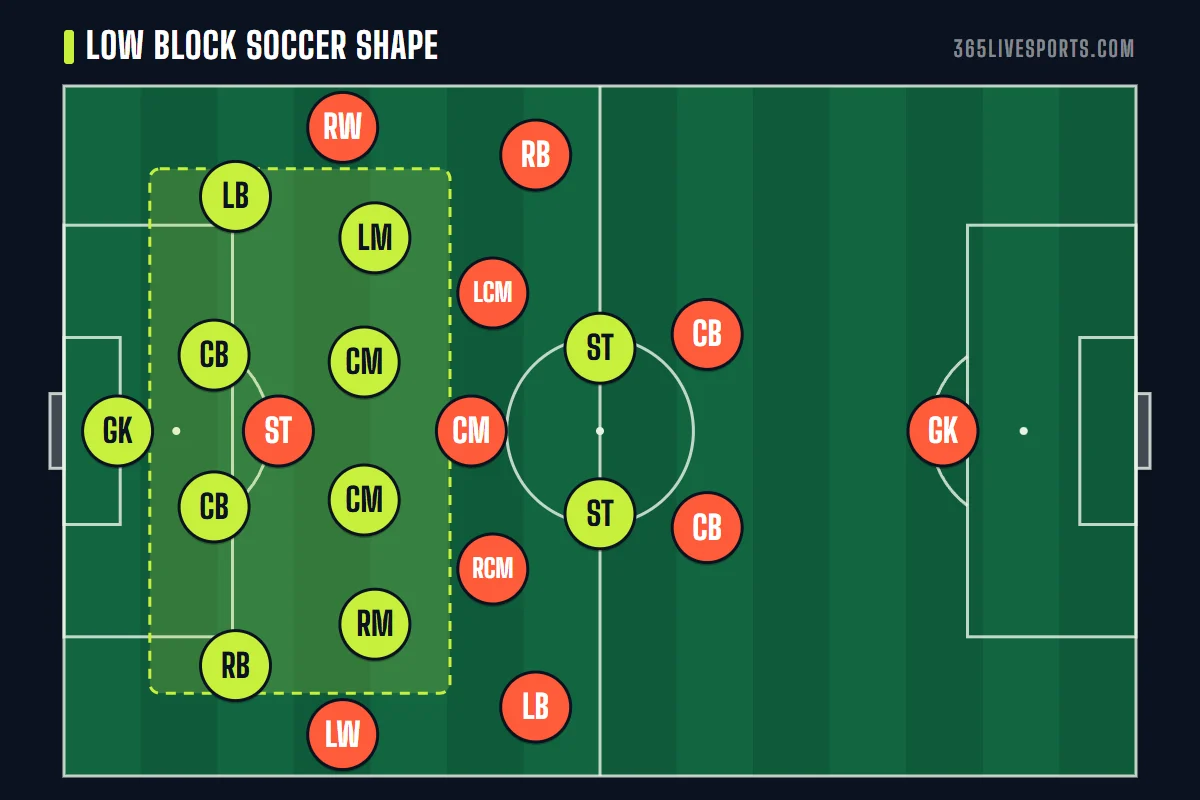
Low block soccer means defending deep: the whole team drops back so the defensive line sits near its own penalty area, keeps two tight lines in front of goal, and lets the opponent have the ball in areas where it can do little damage. The plan is to deny space behind and between the lines, then win the ball and counter-attack into the space the opponent left behind.
It is the opposite of a high press. Instead of chasing the ball near the other goal, a low block team chooses where the game is played. This guide explains what a low block is in football, how it compares with "parking the bus", the spacing that holds it together, the job of each player, its weak spots and how attacking teams break it down.
Quick facts
Where
Back line near the edge of its own penalty areaCommon shapes
4-4-2, 4-5-1 or 5-4-1 with two compact linesAim
Deny space behind and between the lines, then counterKey distance
About 25 to 30 yards from back line to front lineWeak spot
Shots from distance, crosses and cut-backs, long spells without the ballBeaten by
Quick switches, wing overloads, cut-backs and set pieces
Low block soccer meaning
A team has three basic choices without the ball: press high, wait around halfway in a mid block, or retreat into a low block. In the last case the defenders stand around 18 to 25 yards from their own goal, the midfield line sits just ahead of them, and only one or two forwards stay higher.
Look at the picture. The two banks of four are close together and narrow, the space between them is small, and the opponent's center backs have the ball with nobody pressing them. That is fine for the defending team: a pass between center backs on halfway hurts nobody. What matters is that every pass into the area around the box meets a defender.
Low block vs park the bus
People use the two terms loosely, but coaches usually separate them like this:
| Low block | Parking the bus | |
|---|---|---|
| Players behind the ball | Eight or nine | All ten outfield players |
| Plan with the ball | Counter-attack with two or three players | Clear it and defend again |
| Forwards' role | Stay high to receive and run | Drop deep to defend |
| When used | A whole match plan, even for good teams | Late in a game to protect a narrow lead |
"Parking the bus" suggests a team so deep and packed that it looks like a bus parked in front of the goal. A low block is more balanced: it defends deep, but it keeps a threat on the break.
Compactness: the distances that make it work
A low block lives or dies by spacing. Rough guidelines for 11v11:
- Vertical: 25 to 30 yards between the deepest defender and the strikers. Between the defenders and the midfielders, no more than 10 yards, so there is no room to receive between the lines.
- Horizontal: the back four spans about as wide as the 18-yard box. As the ball travels toward a touchline, the whole block slides across, and the far-side winger tucks in close to the central midfielders.
- Within each line: 8 to 12 yards between neighbors, close enough that a pass through the gap can be intercepted.
- The ball side: the nearest player presses the ball when it enters the danger zone, and the rest step across to cover him.
Who does what in a deep block
| Player | Main job |
|---|---|
| Goalkeeper | Commands the box, deals with crosses, organizes the line by voice |
| Center backs | Win headers, block shots, keep the line together rather than stepping out early |
| Full backs | Stay narrow, defend the back post, stop cut-backs |
| Central midfielders | Screen passes into the striker and the number 10, block shots from the edge |
| Wide midfielders | Track overlapping full backs, then break forward on the counter |
| Forwards | Block the pass into the deepest midfielder, stay ready to sprint forward on a regain |
The full backs have one of the hardest jobs. The defense positions guide explains their wider role in more detail.
When teams choose a low block
- Against stronger opponents, especially ones built around possession, such as teams playing the short passing style on the tiki-taka page.
- To protect a lead in the final part of a game.
- When your forwards are fast and there is room to counter behind a high opponent.
- Against very quick strikers, because defending deep removes the space they want to run into.
The usual shapes are the 4-4-2, which gives two clean lines of four, and back-five shapes such as the 5-3-2, where an extra defender guards the whole box.
The weak spots
Defending deep has costs that coaches must accept. The team spends long spells without the ball, which is tiring in a different way from pressing, and concentration slips. It concedes lots of corners and free kicks near its own box. Shots from 20 yards become a regular threat because nobody can guard the zone just outside the box and the box itself at once. And after a regain, the other goal is a long way off.
How to break a low block
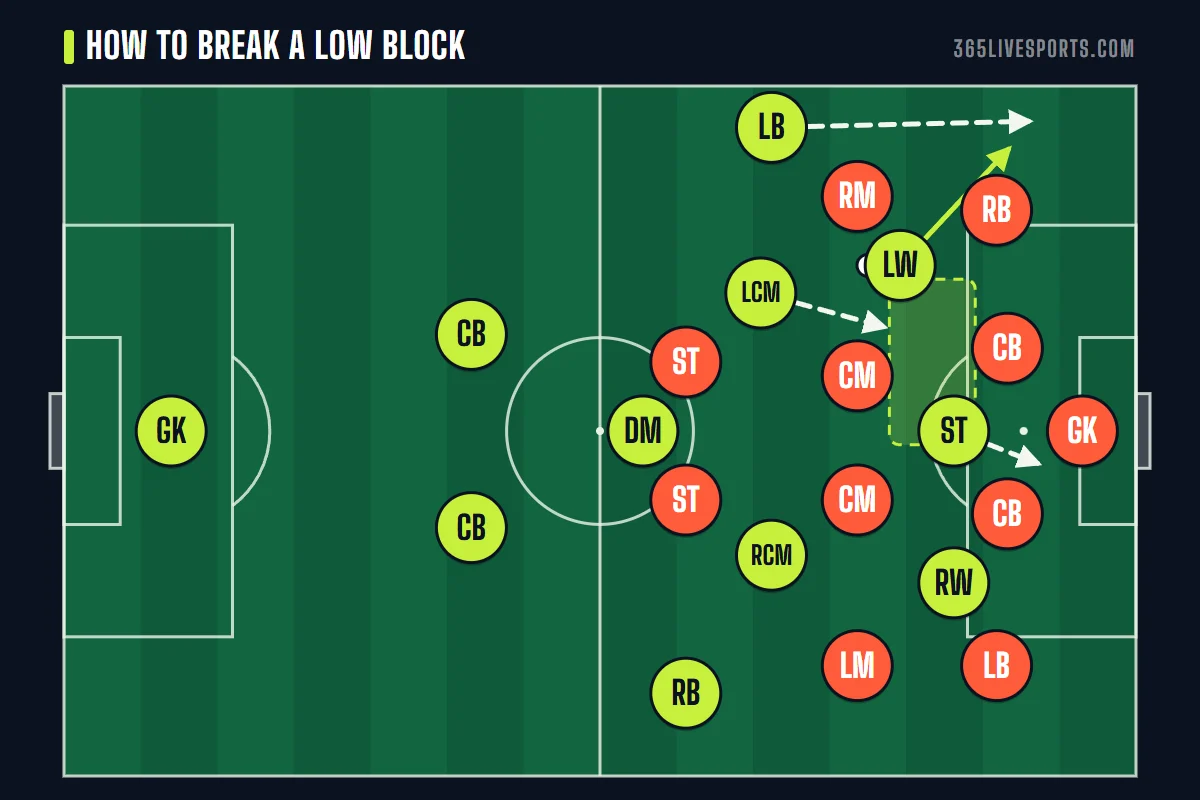
If you are the attacking team, patience and speed of passing matter more than individual dribbling.
- Switch the ball fast from flank to flank. Each switch forces the block to slide; the aim is to find the moment one player is late.
- Overload a wing. Three attackers against two defenders out wide creates a free man to reach the byline.
- Use the cut-back. From the byline, pass back to a runner arriving around the penalty spot rather than crossing high to tall center backs.
- Shoot from the edge. Shots from 18 to 22 yards pull defenders forward and create rebounds.
- Make runs to pull defenders. A striker running to the near post drags a center back with him and opens space behind.
- Win set pieces. A deep block concedes many corners; practiced routines often decide these games.
- Counter-press. When you lose the ball, win it back at once so the opponent cannot break. The gegenpressing guide shows how.
Practice: shifting as one block
Set up 8 defenders (a defensive line of four with four midfielders ahead) against 8 attackers on a pitch about 50 yards wide, with one big goal and a goalkeeper.
- Start with a walk-through: the attackers pass the ball around the outside slowly while the block slides, and the coach stops play whenever a gap is too big.
- Increase the speed of passing to game tempo.
- Defenders score a point for every interception that leads to a pass into one of two counter-attack gates on halfway.
- Attackers score with a goal, or a point for every completed pass between the defensive and midfield lines.
The last rule rewards the defenders for staying compact and the attackers for finding the spaces a low block is designed to close.
Questions players and coaches ask
What is a low block in soccer?
It is a defensive approach where the team drops deep, with its back line near its own penalty area and a compact midfield line just in front. The aim is to deny space close to goal and counter-attack after winning the ball.
What does low block mean in football tactics?
It describes where a team starts defending: low on the pitch, close to its own goal. A high block starts pressing near the opponent's goal and a mid block around halfway.
Is a low block the same as parking the bus?
Not quite. Parking the bus usually means every outfield player defends deep with little interest in attacking. A low block also defends deep, but it keeps players ready to counter-attack.
What formation is best for a low block?
Most coaches reach for two banks of four, so the 4-4-2 comes first, with the 4-5-1 a close second. The 5-4-1 adds a fifth defender so the full width of the box is guarded against teams that attack with wing backs.
How do you beat a low block in soccer?
Circulate the ball fast across the pitch, overload one wing, look for cut-backs rather than high crosses, try shots from around 20 yards and make the most of set pieces.
Should youth teams play a low block?
Occasionally, as a lesson in compact defending, but not as a habit. Young players learn more from trying to win the ball higher up and from having the ball more often.