
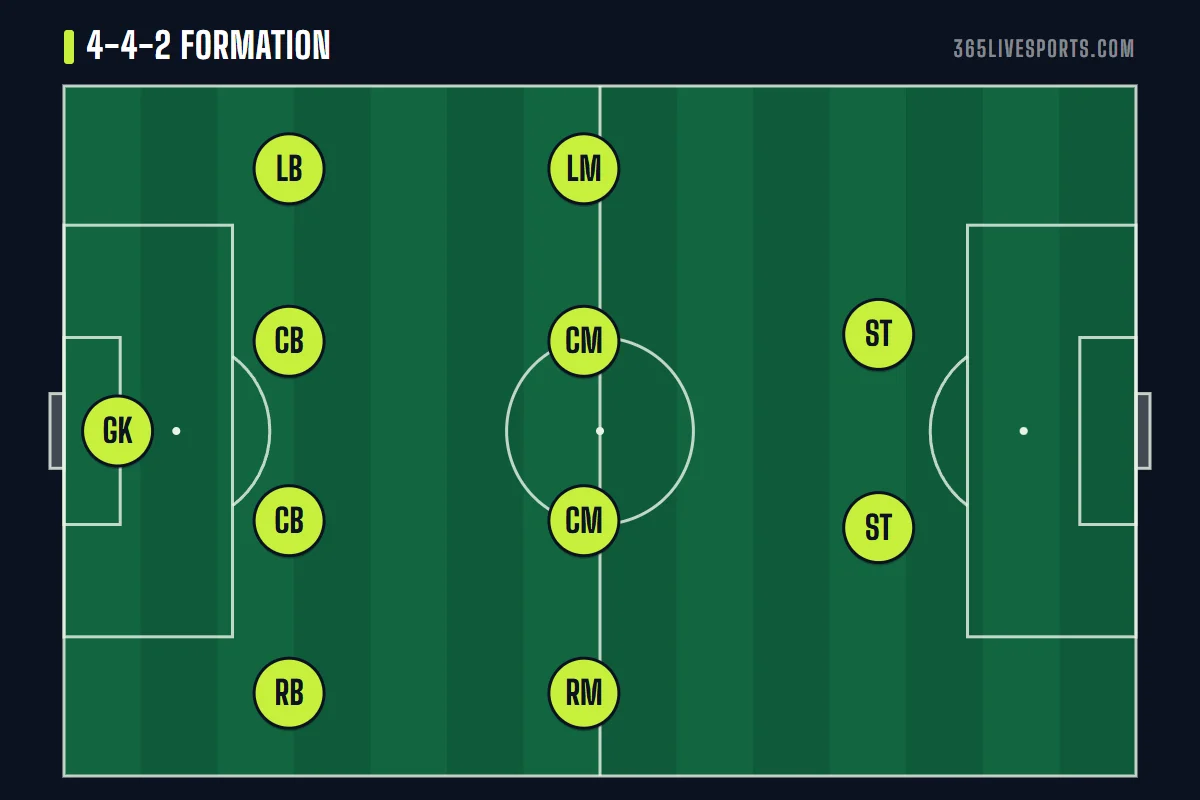
The 4-4-2 formation lines up two banks of four, four defenders and four midfielders, with two strikers in front of them and the goalkeeper behind. The midfield four is usually flat: two central midfielders flanked by a left and a right midfielder who cover the whole touchline.
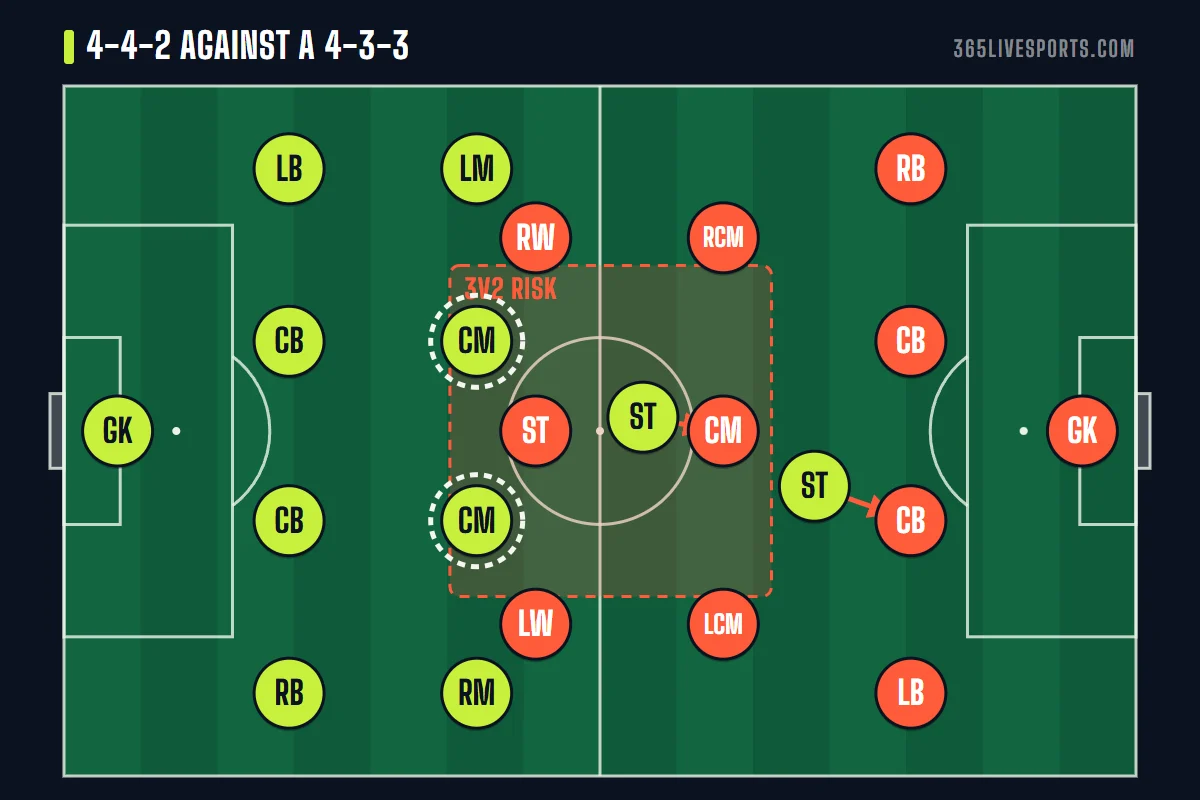
No shape is easier to explain to a team. Each player is paired with a neighbor in the same line and a clear opponent in front, which is why the 4-4-2 still works brilliantly for amateur, high school and youth sides. Where it suffers is the center circle area, where a midfield three can outnumber the two central players. This page covers the player responsibilities, how the shape attacks and defends, the diamond version, its history and how to beat it.
Quick facts
Shape
Back four, flat midfield four, two strikers.Back line
Two center backs with full backs who overlap the wide midfielders.Best for
Compact defending, crosses, strike partnerships, teaching young teams.Weak spot
Central midfield, where a three-player midfield gets a spare man.Key players
The two central midfielders, who must defend, pass and run.Other version
The diamond 4-4-2, written 4-1-2-1-2.
4-4-2 formation positions and player responsibilities
The classic numbers below come from the traditional way of numbering a 4-4-2 team sheet. Plenty of clubs and countries do it differently, so use them as a reference only.
| No. | Position | When we attack | When we defend |
|---|---|---|---|
| 1 | Goalkeeper | Distributes quickly to full backs or long to the strikers | Talks to the back four, claims crosses |
| 2 | Right back | Overlaps the right midfielder, crosses early | Stops the opposing winger, tucks in close to his center back whenever the ball is over on the left |
| 3 | Left back | Same on the left side | Same on the left side |
| 5, 6 | Center backs | Pass into midfield or long to the strikers | One attacks the ball, the other covers behind |
| 4, 8 | Central midfielders | One supports the strikers, one stays to protect | Stay close together, block passes through the middle |
| 7, 11 | Right and left midfielders | Beat the full back and cross, or come inside to shoot | Track the opposing full back all the way back |
| 9, 10 | Strikers | One drops to link play, one runs behind | Harry the center backs; one drops onto their six |
The 4-4-2 formation position names you will hear on a touchline are simpler still: back four, two in the middle, two wide, two up top. Our interactive pitch above starts in the flat version; drag a central midfielder forward and you can see how quickly it changes the balance.
How a 4-4-2 attacks
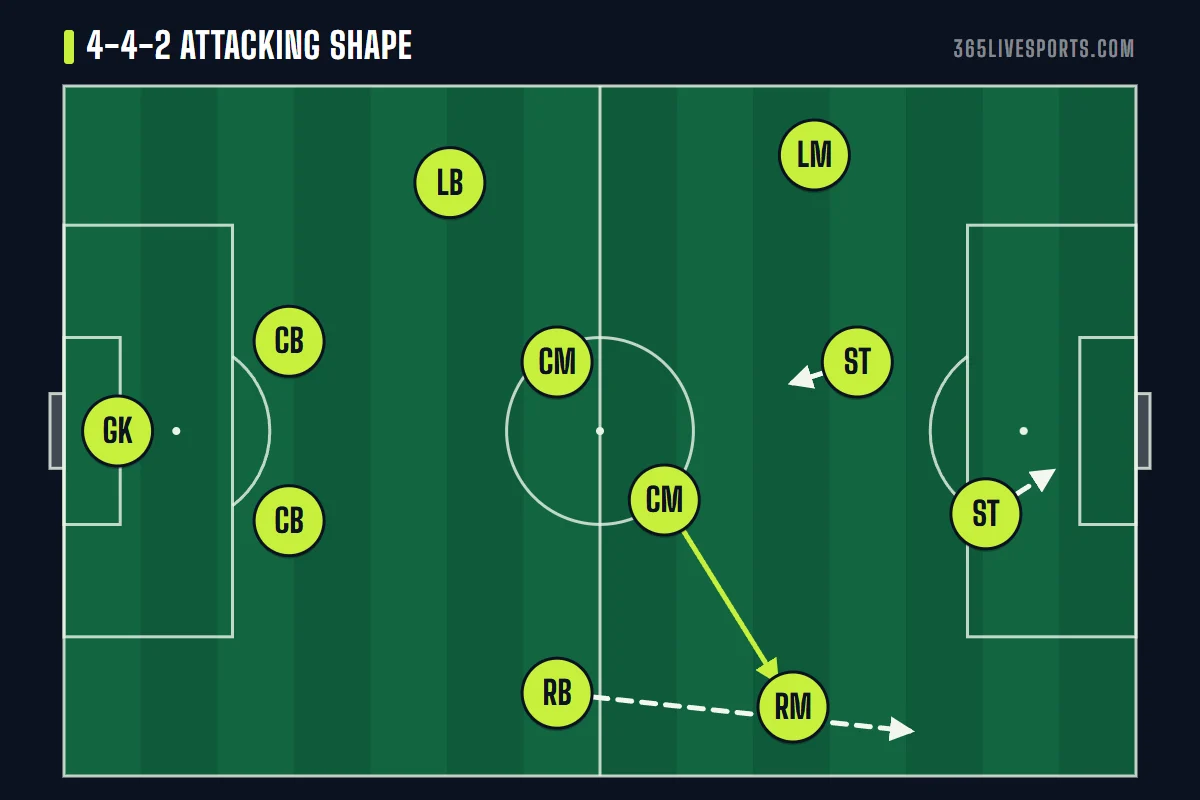
The beauty of the shape going forward is the pairs. Every attack is built from two-player partnerships: full back and wide midfielder on each flank, the two central midfielders, and the strike pair.
- Down the flanks. The wide midfielder gets the ball, the full back overlaps, and now the opposing full back has to choose. Whoever is free crosses early into the box.
- Through the strikers. Classic partnerships pair a big striker who holds the ball and wins headers with a quicker one who runs off him. When one comes short, the other goes long.
- Second balls. Because the 4-4-2 often plays forward quickly, the central midfielders must push up to win the ball when a long pass is headed clear.
- The far-side midfielder. When a cross comes from the right, the left midfielder attacks the back post. That one run turns two players in the box into three.
The main risk on the ball is that the two central midfielders get stuck on the same line as the opponent's midfield. Ask one of them to drop and the other to push, so the pair is staggered and passes can go through.
Defending with two banks of four
This is where the 4-4-2 is still among the best shapes in football. Two lines of four, close together, leave very few gaps from touchline to touchline.
- Distances first. Keep about 10 yards between the two banks and no more than 10 to 12 yards between neighbors in a line.
- Slide as one. When the ball goes to one flank, all eight players shift across. The far-side wide midfielder tucks in almost to the center.
- Strikers split the work. One presses the center back on the ball; the other drops onto the opposing holding midfielder so he cannot receive.
- Press on a trigger. A pass back to the goalkeeper or a square pass between center backs is the signal for both strikers and the near wide midfielder to go together.
- Protect the box. If the press fails, drop the whole block to the edge of the area and stay narrow. Our low block guide explains how.
Flat 4-4-2 vs the 4-4-2 diamond formation
The flat 4-4-2 and the diamond share a back four and two strikers, but the midfield works completely differently.
| Flat 4-4-2 | Diamond 4-4-2 | |
|---|---|---|
| Midfield | Two central, two wide | A holder, two shuttlers, a number 10 |
| Width comes from | Wide midfielders and full backs | Full backs only |
| Strong against | Teams that attack down the flanks | Teams with only two central midfielders |
| Weak against | A midfield three | Wingers who isolate the full backs |
| Typical numbers | 7 and 11 wide, 4 and 8 central | 6 holding, 8 plus 7 or 11 shuttling, 10 at the tip |
The diamond is covered in a separate diamond guide, with diagrams and coaching notes. A third option is the 4-4-1-1, where one striker drops into the hole behind the other and the shape starts to look like a 4-2-3-1.
Who invented the 4-4-2 formation?
No one person invented it; the shape grew out of the 4-2-4. When Brazilian sides showed the world a back four, coaches elsewhere began pulling their wingers back to help in midfield. English and Soviet coaches are usually credited with taking the final step, dropping both wide forwards into a flat midfield line so their teams had four in midfield and could press and cover the flanks. The result was the 4-4-2, which became the standard shape across much of Europe for a long time afterwards and is still the first formation many coaches learn.
Is 4-4-2 a good formation? Strengths and weaknesses
| Good at | Struggles with |
|---|---|
| Covering every lane across the field with two lines | Being outnumbered 3v2 in central midfield |
| Simple roles that every player understands | Players who drop between the lines (a number 10) |
| Two strikers who occupy both center backs | Keeping the ball under pressure; few passing angles |
| Crosses and second balls | Very tiring for the wide midfielders |
| Pressing with two forwards | A back three that has a spare defender against two strikers |
So, is 4-4-2 a good formation? Yes, especially if you have two strikers who complement each other and two hard-working central midfielders. Teams who want long spells of short passing usually prefer a midfield three.
How to beat a 4-4-2
Put a player in the spaces the shape cannot cover. A number 10 standing between the two banks of four makes the central midfielders choose between stepping up and leaving a hole, or dropping and leaving him free. A midfield three (from a 4-3-3, say, or a 3-5-2) creates the 3v2 in the center. A back three gives you three defenders for their two strikers, so you can build from the back calmly.
The practical game plan is to keep the ball in the middle until the wide midfielders tuck in, then switch fast to your full back on the far side. More detail is on the counter formations page.
Teaching the 4-4-2 to youth and adult amateur teams
Few shapes suit teams new to 11v11 better. Most US youth players reach the full game at under-13, once they have played seven-a-side and nine-a-side (leagues vary). The 3-3-2 used in a lot of nine-a-side games has the same idea, a line of midfielders and two strikers, so players already know the pairs. Our 9v9 formations page shows how it scales up.
- Use a rope or cones in training to show the two banks moving together, side to side and up and down.
- Give each strike partner a different job: one "comes to feet", one "goes away".
- Ask the wide midfielders to count: three touches to beat the full back, or play it back.
Practice: shadow shifting. Set up eight players in two banks of four. A coach on the side moves a ball between four target cones; the players slide and squeeze to each one. Then add four attackers who try to pass between the lines.
Questions players and coaches ask
What is a 4-4-2 formation in soccer?
Four defenders, four midfielders and a pair of strikers stand ahead of the goalkeeper. The midfield is usually flat, with two central players and one on each wing.
Is 4-4-2 a good formation?
For defending, and for teams blessed with two good strikers, few shapes are more reliable. Its weakness is central midfield, where a three-player midfield can outnumber its two central players.
What are the 4-4-2 formation numbers?
Traditionally the keeper wears 1, the full backs 2 and 3, 5 and 6 the center backs, 4 and 8 the central midfielders, 7 and 11 the wide midfielders and 9 and 10 the strikers. Numbering varies by country and by team.
What is the 4-4-2 diamond formation?
The diamond keeps the back four and two strikers but sets the midfield as a diamond: one holding midfielder, two shuttling midfielders and a number 10. Because it is narrow, all the width has to come from the full backs.
What are the 4-4-2 diamond formation numbers?
There is no fixed rule. A common pattern gives the holder 6, the two shuttlers 8 and either 7 or 11, the player at the tip 10, and the strikers 9 plus whichever wide number is left. Expect variations between teams.
Who invented the 4-4-2 formation in soccer?
No single coach invented it. It developed from the 4-2-4 when coaches, often credited to English and Soviet sides, pulled the wingers back into midfield to make a line of four.