
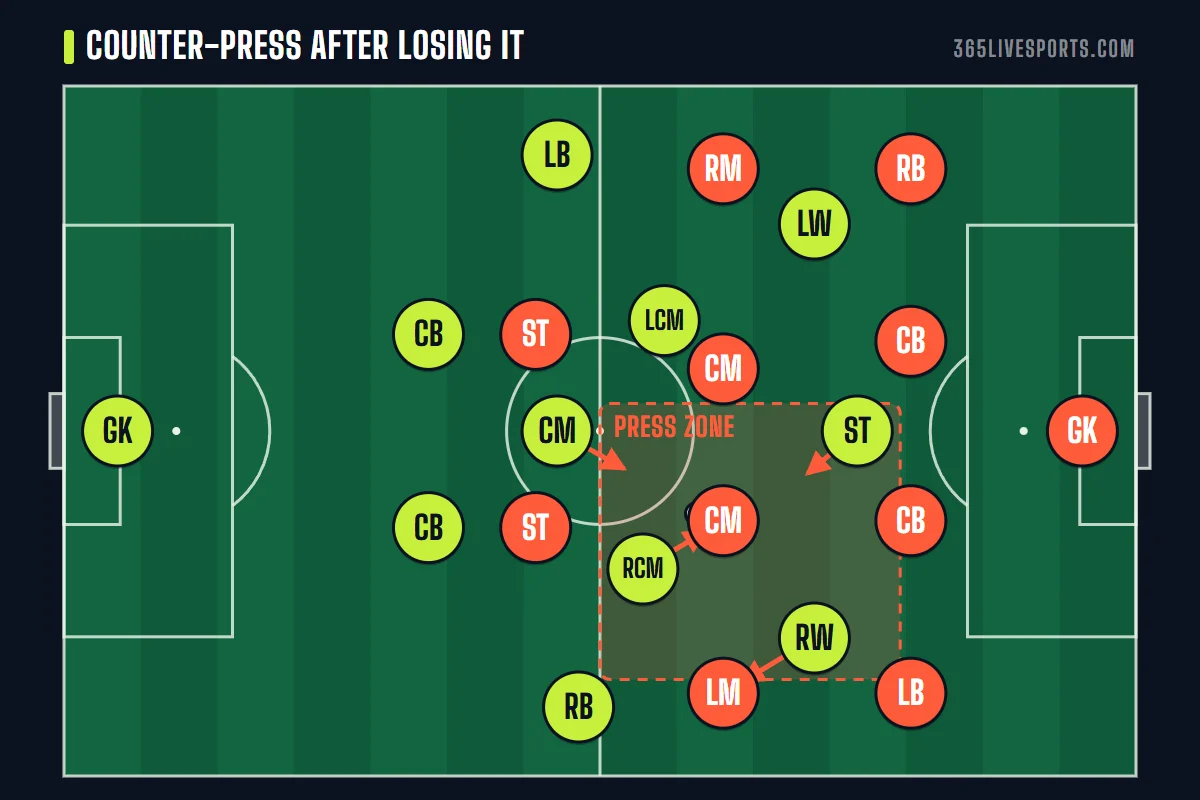
Gegenpressing is the German word for counter-pressing: the moment your team loses the ball, the nearest players attack it straight away to win it back, instead of running back into a defensive shape. It is often coached with a time limit of about five or six seconds, after which the team stops chasing and drops into its normal defense.
The idea is easy to describe and tough to pull off. It asks for fitness, quick reactions and a team that is already well spaced when it attacks. Done right, it turns a lost ball into one of the best scoring chances of the game, because the opponent is caught mid-transition and out of shape. Here is how counter pressing in football works, who does what, and how to start coaching it.
Quick facts
Meaning
"Gegen" means against or counter: pressing against the opponent's counter-attackWhen
The instant possession is lost, especially in the opponent's halfTime window
Commonly coached as about five or six secondsWho presses
The players nearest the ball, usually three or fourSafety net
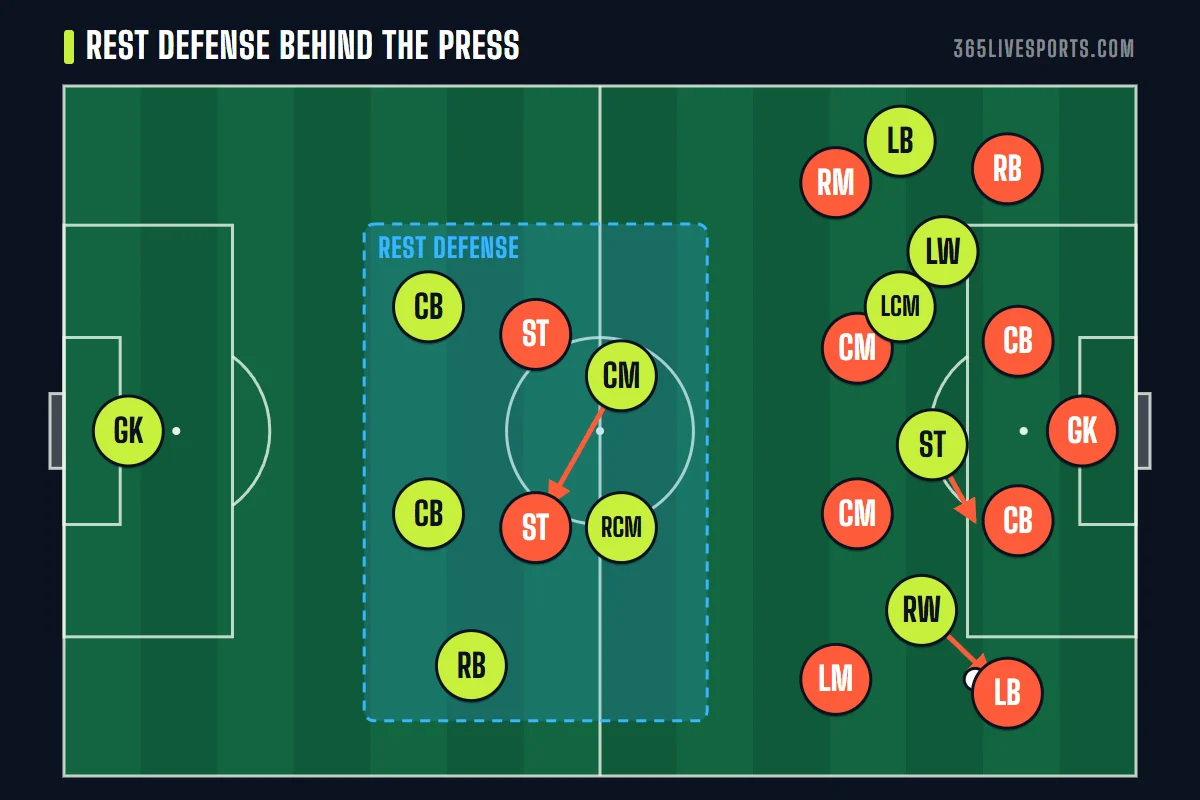
A rest defense of four or five players who stayed behind the ballRisk
One pass past the press and the back line faces a fast break
Gegenpressing meaning in plain words
Most teams react to losing the ball by retreating: everyone runs back, gets goal-side and rebuilds the defensive shape. A counter-pressing team does the opposite. The players who were attacking turn into defenders on the spot and hunt the ball where it was lost.
Fans recognize it by the swarm. Three or four shirts close in on the player who just won possession, from different sides, and he has no easy pass. Often he panics, kicks it long or loses it straight back. That is the counter-press working.
Why press right after losing the ball?
- The opponent is disorganized. The player who wins the ball has usually just made a tackle or interception. He is off balance, often facing his own goal, and his teammates were defending, not getting ready to attack.
- Your players are already close. You were attacking in that area, so several of you are within a few yards of the ball.
- The ball is near their goal. Winning it back high up the pitch means a short route to a shot, often against a defense that has just stepped out.
- It stops counter-attacks at the source. The most dangerous moment for any team is the second after losing the ball. Pressing immediately removes the time a counter needs.
Some coaches like to say the best moment to win the ball is right after you lose it, and the logic above is why.
The five-second window, step by step
Teams use slightly different numbers, but most work with a window of five or six seconds. The sequence usually looks like this:
- Second zero: the ball is lost. The player who lost it, or the nearest teammate, goes straight at the ball carrier.
- First two seconds: the next two closest players block the simplest passes, usually the one back toward a center back and the one into the middle.
- Seconds two to four: the rest of the team squeezes up, cutting the distance between lines, so any pass that escapes lands among more pressers.
- By about second five or six: if the ball is won, attack at once. If not, stop chasing and drop back into the team's defensive block.
Who does what in the counter-press
| Player | Task | Common mistake |
|---|---|---|
| Ball-nearest presser | Sprint at the ball, force a rushed touch or a pass in a predictable direction | Diving in and being dribbled past |
| Second and third pressers | Cut the short passes around the ball | Chasing the ball as well, leaving the passes open |
| Midfield screen | Step up to win the loose ball or the next pass | Staying deep, so the gap between lines grows |
| Rest defense | Mark the opponent's forwards, protect the space behind | Joining the press and leaving nobody back |
| Goalkeeper | Stand high to sweep balls played over the defense | Staying on the line |
Rest defense: the part fans do not see
A counter-press only works if the team was set up for it before the ball was lost. Coaches call the players who stay behind the attack the rest defense. A typical setup is three defenders and two midfielders, sometimes written as 3+2, guarding the opponent's forwards while five teammates attack.
With that base in place, the pressers can take risks, because a ball that escapes them still meets organized defenders. Without it, every failed press becomes a two-against-two at your own back line. The shape on the 4-3-3 formation page shows how one full back can tuck in to complete the base.
Gegenpressing vs tiki-taka
These two styles are often presented as rivals, but they share a lot. Both want the ball high up the pitch; they differ in how they plan to get it there and what they do next.
| Tiki-taka | Gegenpressing | |
|---|---|---|
| Main idea | Keep the ball through short passing | Win the ball back right after losing it |
| After regaining | Secure possession, then build patiently | Attack quickly while the opponent is disorganized |
| Tempo | Controlled, sometimes slow | Fast and intense |
| Physical demand | High, mostly through positioning | Very high, lots of sprints |
| Where you see it | Spanish passing tradition | German pressing tradition |
A possession side that loses the ball also counter-presses, so the two styles often appear in the same team. Read the full tiki-taka guide for the passing side.
How opponents escape the press
If you face a counter-pressing team, three habits help. First, the player who wins the ball should look for the pass away from pressure, often backward or sideways, rather than dribbling into the swarm. Second, a forward who stays high gives an outlet for a quick long ball over the press. Third, switching play fast to the far side, where the pressers are not, can turn a dangerous moment into a counter-attack.
The wider topic of pressing, including the high press and PPDA, is covered on the pressing in football page, and a team that chooses not to press at all is described on the low block page.
A drill to coach it
Try this transition game with players from about U12 upward.
- Lay out a pitch of about 40 by 30 yards, cut in half by a line of cones. Play 6v6 with small goals at each end.
- When a team loses the ball, it scores a point if it wins it back within five seconds, counted out loud by the coach.
- Goals scored within ten seconds of a regain count double, which rewards attacking fast after winning it.
- After a few rounds, add a rule that two players from each team must stay in their own half, which introduces the rest defense idea.
Keep the games short, two to three minutes, with rests in between. The intensity is the point, and tired players stop pressing properly.
Questions players and coaches ask
What is gegenpressing?
It is counter-pressing: pressing the opponent immediately after losing the ball, to win it back before they can counter-attack. The team stays aggressive for a few seconds and only retreats if the press fails.
What does gegenpressing mean in English?
"Gegen" is German for against or counter, so the word means counter-pressing. It describes pressing in response to losing the ball, as opposed to pressing an opponent who is building calmly from the back.
What is counter pressing in football?
Counter pressing in football is the same thing as gegenpressing. The players nearest the ball close down the opponent who has just won it, while others block the short passes around him.
How long should a counter-press last?
Many teams coach a window of about five or six seconds. If the ball is not won back by then, the opponent has usually escaped and the team should drop into its defensive shape.
Is gegenpressing better than tiki-taka?
Neither is better in every case. Tiki-taka focuses on keeping the ball and gegenpressing on winning it back fast. Most modern teams mix both, passing to keep possession and pressing hard when they lose it.
Is gegenpressing good for youth teams?
The basic habit, reacting quickly when the ball is lost, is great for young players. Full-team pressing schemes are better left until players are older and fitter, and coaches should keep sessions short to manage the workload.