
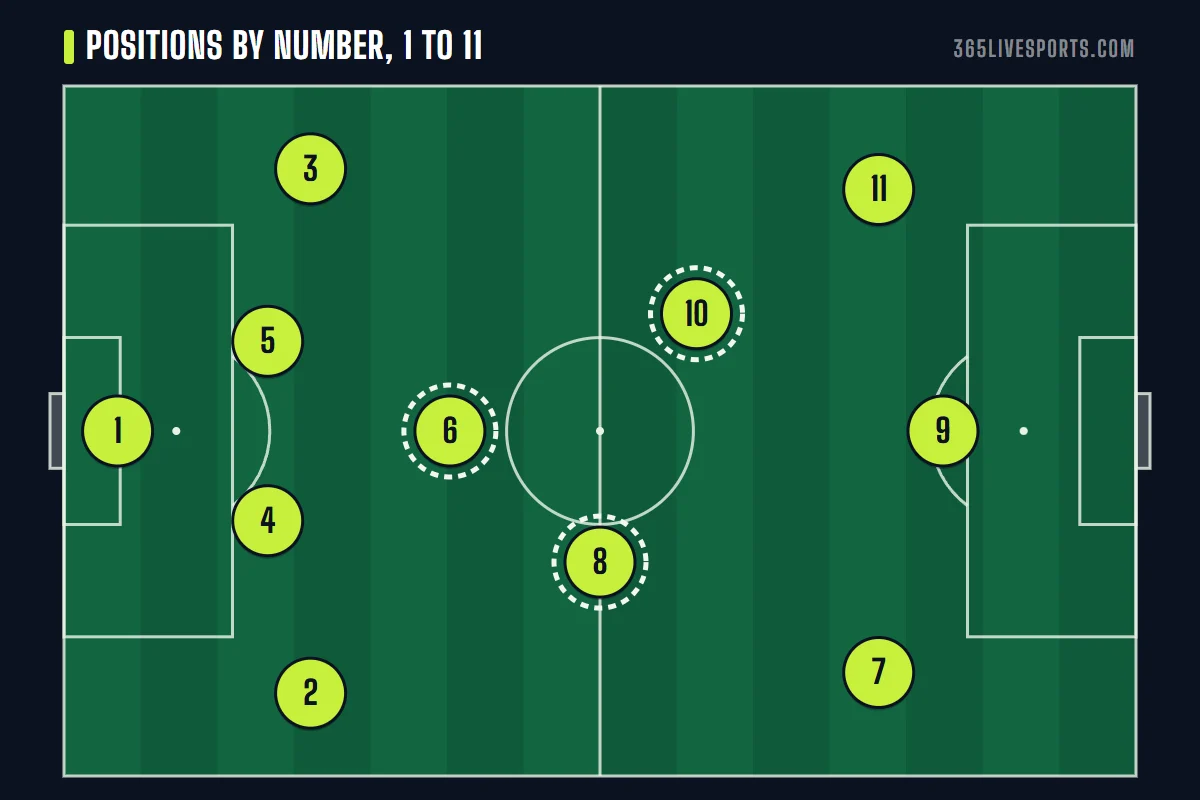
In the classic system of soccer positions by number, 1 is the goalkeeper, 2 and 3 are the right and left backs, 4 and 5 are the center backs, 6 is the holding midfielder, 7 and 11 are the wingers, 8 is the central midfielder, 9 is the striker and 10 is the playmaker. That is the version most American coaches use on a whiteboard.
It is a convention, not a rule. Different countries grew their own traditions, teams in the modern game give out squad numbers that have nothing to do with position, and youth programs often hand jerseys out by size. What survives everywhere is the language: coaches still say "we need a better 6" or "play as a 10", and knowing what they mean helps you understand any team talk.
Quick facts
Goalkeeper
1Defenders
2 right back, 3 left back, 4 and 5 center backsMidfield
6 holding, 8 central, 10 attackingAttack
7 right wing, 9 striker, 11 left wingWhere it varies
The 4, 5 and 6 change most between countriesModern twist
Squad numbers up to 99, chosen for the season
Soccer positions by number: the classic 1 to 11
The diagram puts each number where it traditionally plays in a 4-3-3, attacking to the right. Notice the midfield triangle of 6, 8 and 10: the 6 sits deepest, the 8 covers the middle, and the 10 plays closest to the striker.
Two things trip people up. First, the right side takes the even numbers in defense (2) but the 7 on the wing, while the left side has 3 and 11. Second, the 4 and the 5 are interchangeable in many places: which center back wears which depends on the team.
Numbers, positions and roles at a glance
| Number | Position | Code | What the role does |
|---|---|---|---|
| 1 | Goalkeeper | GK | Last line of defense, first line of attack with the hands and feet |
| 2 | Right back | RB | Defends the right flank, supports the right winger |
| 3 | Left back | LB | Defends the left flank, overlaps on the left |
| 4 | Center back (or holding midfielder in some countries) | CB or DM | Wins the ball in central areas, starts build-up |
| 5 | Center back | CB | Organizes the back line, wins headers |
| 6 | Holding midfielder (or center back) | CDM or CB | Screens the defense and recycles possession |
| 7 | Right winger or right midfielder | RW or RM | Width, crosses, goals from the right |
| 8 | Central midfielder | CM | Links the lines, works box to box |
| 9 | Striker or center forward | ST or CF | Main goal threat, leads the press |
| 10 | Attacking midfielder or playmaker | CAM or SS | Creates chances between the lines |
| 11 | Left winger or left midfielder | LW or LM | Width, dribbling and goals from the left |
For the full description of each role with and without the ball, see the main soccer positions guide.
Where the numbering came from
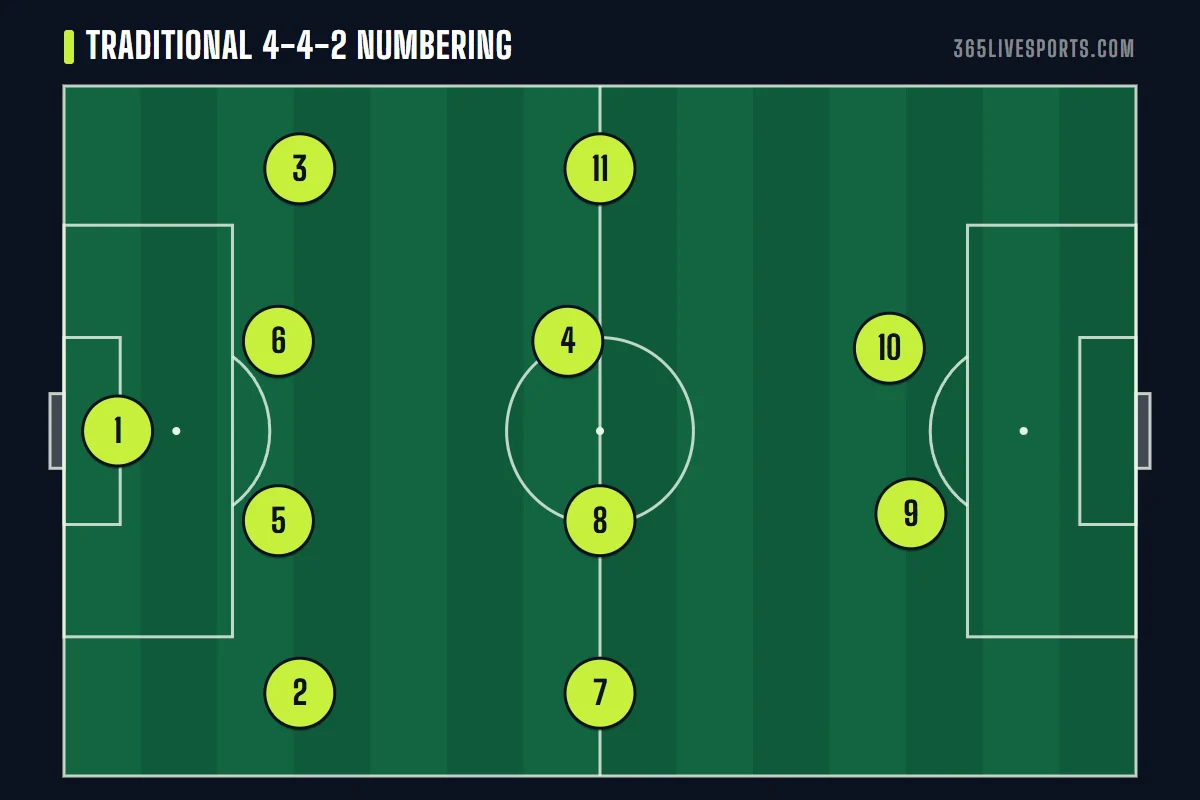
Shirt numbers arrived when nearly every side used a 2-3-5 pyramid layout. Numbering simply ran from the back, right to left, line by line: 1 in goal, 2 and 3 the two backs, 4, 5 and 6 the three halfbacks, and 7 to 11 the five forwards from right winger to left winger. That is why 9 sat in the middle of the front five as the center forward and 10 next to him as the inside left.
Later, the center half (the 5) dropped back between the two backs to stop the opponent's center forward. Teams kept the shirt, so 5 became a center back. The two wing halves, 4 and 6, ended up in different places depending on the country: some made one of them a second center back, others kept one as a defensive midfielder. That single change explains most of the confusion you see today about 4, 5 and 6.
The forwards kept their identities longest. The 7 and 11 are still wingers in most numbering systems, the 9 is still the striker, and the 10 drifted back into the attacking midfield role it is known for now.
Why the numbering changes from country to country
Each soccer culture kept its own habits as the formations changed. These are broad traditions, and individual teams break them all the time:
| Role | English style | Spanish style | Argentine style | Brazilian style |
|---|---|---|---|---|
| Right back | 2 | 2 | 4 | 2 |
| Left back | 3 | 3 | 3 | 6 |
| Center backs | 5 and 6 (or 4 and 5) | 4 and 5 (or 2 and 6 in some sides) | 2 and 6 | 3 and 4 |
| Holding midfielder | 4 | 6 or 4 | 5 | 5 |
| Playmaker | 10 or 8 | 10 | 10 | 10 |
The practical upshot: in Argentina "el cinco" is the defensive midfielder, while in an English lineup the 5 is a center back. In Brazil the 6 is traditionally the left back. If you coach players from different backgrounds, ask what a number means to them before you use it as shorthand. Our page on soccer positions in Spanish covers the terms that go with these numbers.
The numbers as job titles: the 6, the 8, the 10 and the 9
In modern coaching talk, the numbers describe a role more than a shirt. You will hear these constantly:
- The 6: the holding midfielder who protects the back line and starts attacks. A deep passer in this role is a regista.
- The 8: a central midfielder who covers both penalty areas, the classic box-to-box midfielder.
- The 10: the creator behind the striker, often the most skillful player on the team.
- The 9: the main striker. A "9 and a half" mixes striker and playmaker, and a false nine wears the striker's role but drops into midfield.
- Double 6: two holding midfielders side by side, as in the 4-2-3-1.
- Number 7 and 11: the wide attackers; "inverted" ones play on the side opposite their stronger foot.
Because these names describe the job, they travel across formations. A 4-3-3 has a 6, two 8s, or a 6, an 8 and a 10, depending on how attacking the coach wants the midfield.
Modern squad numbers
At professional level, most competitions now use fixed squad numbers: each player keeps one number for the whole season, often anything from 1 to 99 depending on the competition's rules. A center back might wear 23 and a striker 19. Numbers are picked for superstition, availability or a favorite player, so the shirt no longer tells you the position.
A few habits stick. The first-choice goalkeeper usually still wears 1, backup keepers often take 12, 13 or a higher number such as 25 or 31, and the best attacking player often gets the 10 or the 9 as a sign of status. In high school and youth soccer, numbers usually come with the uniform set, so a keeper wearing 14 is perfectly normal.
Using numbers to coach smaller formats
The 1 to 11 system was built for 11v11, so it needs adapting for the smaller games most kids play first. In a 7v7, many coaches keep 1 for the keeper, use 2 and 3 for the two defenders, 6 or 8 for the central midfielder, 7 and 11 for the wide players and 9 for the striker. In 9v9 you add a third defender (often 4 or 5) and a second central midfielder (8 or 10).
- Write the numbers on a whiteboard in the shape you will play.
- Say the number and the job together for the first few weeks: "the 6 protects the middle".
- Rotate the numbers each quarter so every player hears and plays several roles.
- Once the team knows the language, use numbers alone during games.
For shapes that suit each format, see 7v7 formations, 9v9 formations and the full layout of 11v11 soccer positions.
Questions players and coaches ask
What number is a striker in soccer?
The striker is traditionally the 9. A second striker or forward playing just behind often wears the 10, especially in a 4-4-2 with two forwards.
What number is the defensive midfielder?
Usually the 6 in modern talk, though older English teams used the 4 and Argentine and Brazilian teams use the 5. When a coach says "the 6", they almost always mean the holding midfielder.
What are the numbered positions in soccer?
From 1 to 11: goalkeeper, right back, left back, two center backs (4 and 5), holding midfielder (6), right winger (7), central midfielder (8), striker (9), attacking midfielder (10) and left winger (11). The middle numbers vary most between countries.
Why does the goalkeeper wear number 1?
Numbering started from the back of the team, and the keeper was the deepest player. The habit has stuck even with modern squad numbers, so most first-choice goalkeepers still wear 1.
What does the number 10 mean in soccer?
The 10 is the playmaker who plays in the pockets behind the opposing midfield and creates chances. Because the best creative players wore it, the shirt also became a symbol of a team's star player.
Do youth soccer numbers match positions?
Rarely. Youth and high school jerseys are usually handed out by size or availability. Coaches can still use the classic numbers as names for positions in training and team talks.