
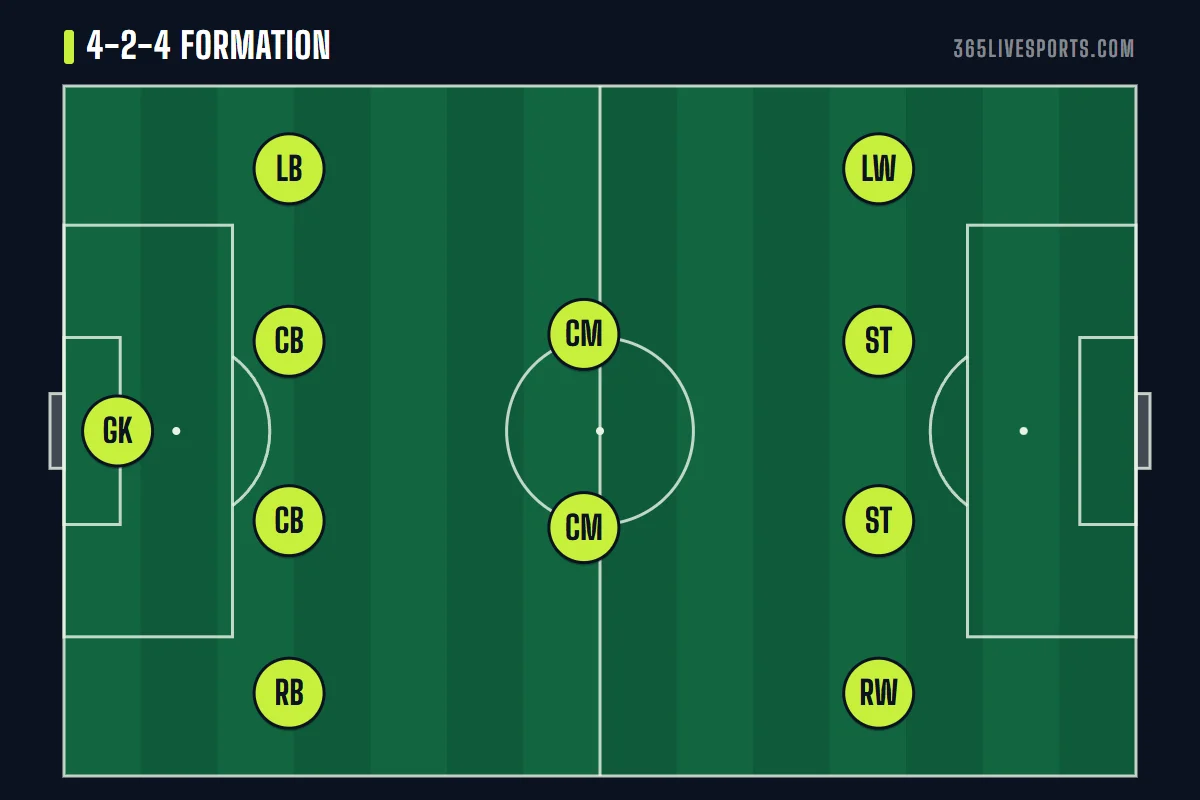
The 4-2-4 formation lines up four defenders, a bare pair in central midfield and a front four built from two wide players flanking two center forwards, which makes it one of the most attacking shapes in soccer. It fills the opposition back line with bodies and dares the other team to cope.
The price is the middle of the pitch. Two midfielders have to cover a space that most modern teams fill with three, so the 4-2-4 lives or dies on how hard the wingers and strikers work when the ball is lost. Here is how the shape was born, how each player should move, why it is rare as a starting shape today and where you still see it.
Quick facts
Shape
Back four, two central midfielders, two wingers and two strikersStyle
All-out attack, crosses and runs in behindBest for
Chasing a goal, or teams far stronger than their opponentWeak spot
Central midfield: two players against three or moreKey players
The midfield pair, who must defend a huge areaModern use
Mostly as an in-possession or pressing shape, rarely from kickoff
The 4-2-4 formation at kickoff
On the team sheet it is a back four (two full backs and two center backs), a central pair in midfield and a front line of four. The wingers start close to the touchlines, the strikers stay between the opposition center backs. That adds up to the ten outfield players, with the goalkeeper behind.
Look at the gap between the midfield pair and each winger. That empty band down both sides of midfield is the whole story of this formation: brilliant when you have the ball, exposed when you do not. You can test it yourself by moving the wingers back 15 yards on the board placed above this article; the shape becomes a 4-4-2 almost instantly, which is exactly how most 4-2-4 teams defend.
Where the 4-2-4 came from
Long ago, when the sport was young, almost every team attacked with five forwards. As defending improved, coaches pulled players back. The 4-2-4 grew out of that process: Hungarian coaches developed a version by dropping a forward into midfield and a midfielder into defense, and Brazilian teams later refined it into a shape that won the biggest prize in the sport.
Later still, coaches noticed that two midfielders were not enough against compact opponents. Wingers were asked to drop back, and the 4-2-4 slowly turned into the 4-4-2 and the 4-3-3. For the older ancestor with five forwards, see the 2-3-5 pyramid.
Roles in a 4-2-4 soccer formation
| Player | Main job going forward | Main job when defending |
|---|---|---|
| Center backs | Pass quickly into midfield or straight to the strikers | Defend against two strikers without cover from a holding midfielder |
| Full backs | Support the wingers but rarely overlap | Stay home; they are the only wide defenders |
| Two central midfielders | One sets the tempo, one carries the ball forward | Screen the back four, slide together, never both commit |
| Wingers | Beat the full back, cross, cut inside to shoot | Track back to make a midfield four |
| Two strikers | First striker occupies both center backs; his partner drops short or attacks the space behind | Press the center backs, block passes into their midfield |
The two midfielders carry the heaviest load. A player who can do both jobs, defend and carry, is described on our box-to-box midfielder page.
4-2-4 attacking formation patterns
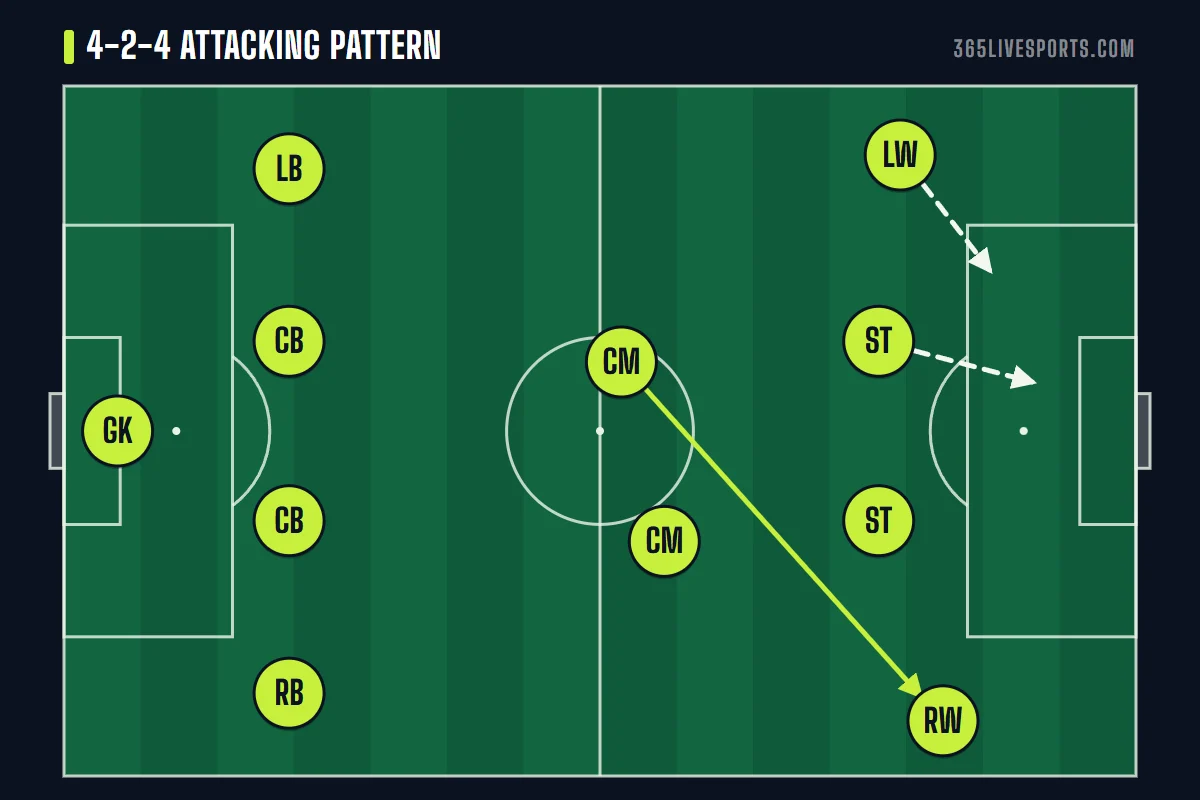
With the ball, the attack is direct. Four forwards occupy the whole opposition back four, so every defender has someone to mark and nobody can step out freely. The quickest route is a pass from a center back or midfielder into one striker, who lays it off for the second striker or spreads it to a winger.
Three patterns worth rehearsing:
- Winger isolation: switch play quickly so the winger faces his full back one against one.
- Near and far post: on every cross one striker attacks the near post, the other the far post, the opposite winger the back of the box.
- Drop and spin: one striker drops to receive, drawing a center back; the other spins into the space he leaves.
In the modern game you see the 4-2-4 most clearly in this phase: a team set up as a 4-4-2 pushes its wide players up when it has the ball and suddenly has four forwards across the box.
The midfield problem: defending with only two
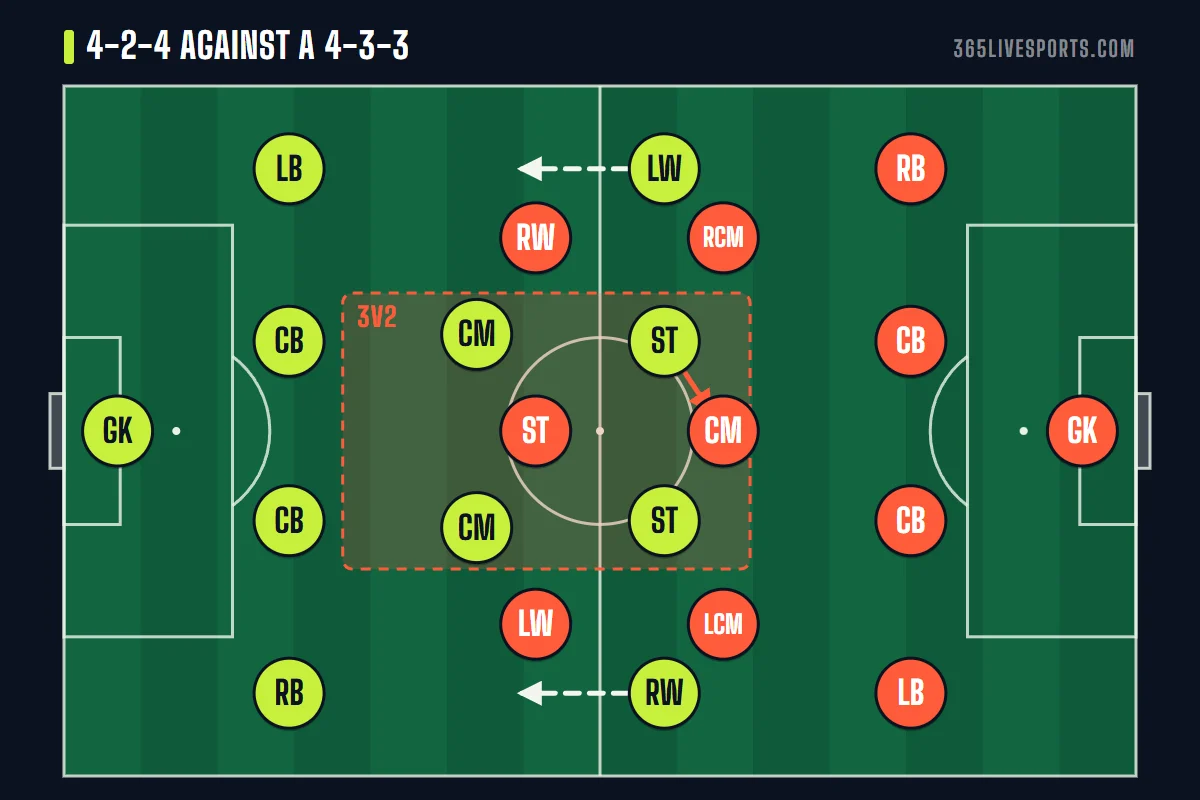
Against an opponent with three central midfielders, the 4-2-4 starts every defensive phase a player short in the most important area. The opposition holding player receives in the space between your strikers and your midfield pair, turns and plays forward.
Most coaches fix it with structure rather than hope:
- The instant the ball is lost, wingers retreat level with the midfield pair, so the shape becomes a 4-4-2.
- One striker drops onto the opposition holding midfielder; the other harries whichever center back has possession.
- The two central midfielders stay within 10 yards of each other and never cross the halfway line together.
Is 4-2-4 a good formation today?
| Strength | Weakness |
|---|---|
| Four players attack the box on every cross | Outnumbered in central midfield |
| Opposition full backs are pinned and cannot attack | Large gaps between midfield and attack |
| Natural high press with four forwards | Exhausting for the two midfielders |
| Simple to understand | Easy to counter if wingers stay high |
As a starting formation for a full match it is rarely the right choice against organized teams. As a closing plan while trailing late on, or as the shape a 4-4-2 takes in possession, it is very useful. People often ask which team uses the 4-2-4 formation currently: few senior teams list it from kickoff, but many use it during matches without calling it that. Our counter formations guide shows what to switch to if the risk stops paying off.
Teaching the 4-2-4 with young players
Youth coaches like the 4-2-4 because it is easy to explain and gets children attacking. Remember that in the US, the youngest groups play small-sided games, around U9 and U10 the game is usually 7v7, around U11 and U12 it is 9v9, and full 11v11 begins around U13, with leagues and clubs free to set their own formats. A 9v9 team can play a 3-2-3 with the same attacking idea; our youth positions guide has more.
Questions players and coaches ask
Is 4-2-4 a good formation?
It is excellent for attacking but risky in midfield, where two players face three or more. Most coaches use it as a late-game plan or an in-possession shape rather than a full-match formation.
Which team uses the 4-2-4 formation currently?
Very few senior teams start in a pure 4-2-4. Plenty of sides listed as a 4-4-2, or as a 4-2-3-1, turn into a 4-2-4 when they attack, so you will see it during matches even when the team sheet says something else.
What is the 4-2-4 formation in football?
Picture a back four, a central duo and four attackers: two out wide, two through the middle. It was developed by Hungarian and Brazilian coaches and later gave way to the 4-4-2 and 4-3-3.
How does a 4-2-4 team defend?
Both wide forwards fall back beside the central pair, so the team defends as a 4-4-2, and one striker drops onto the opposition holding midfielder. Without that, the two central midfielders are overrun.
Is the 4-2-4 good for youth soccer?
At 11v11 it can work, because it is simple and encourages attacking. Coaches should still teach wingers to track back, and younger age groups play smaller formats where a 4-2-4 does not fit.