
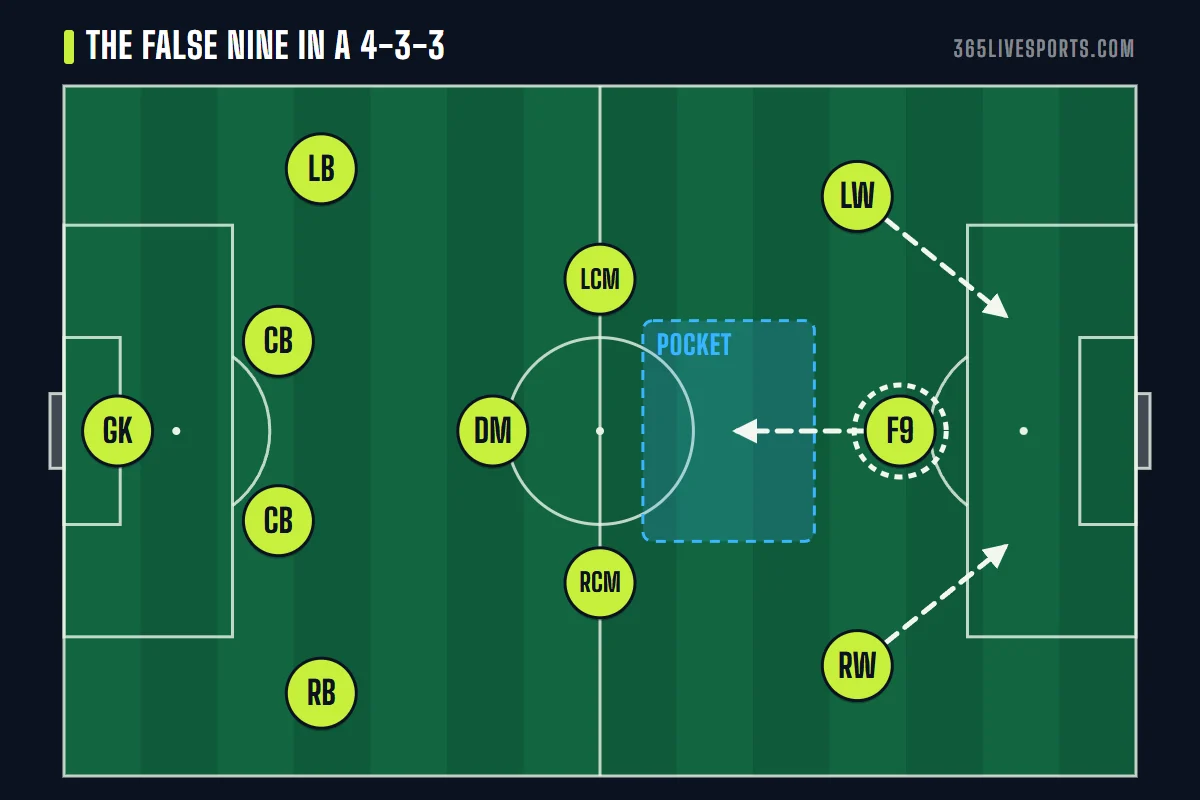
A false nine is a center forward who starts in the striker's spot but keeps dropping back into midfield, so the opposing center backs have nobody to mark. The name comes from shirt number 9, the classic striker: this player wears the striker's position on the team sheet but plays like a midfielder for long spells of the game.
For a fan it is one of the easiest roles to spot once you know the clue: watch the front of the pitch when your team has the ball. If the central player is standing level with the midfielders while two wide forwards are sprinting past him, you are watching a false nine in football. Below I explain how the role works, what a player needs to play it, and how to coach it with a simple practice.
Quick facts
Starts as
The lone central striker, usually in a 4-3-3Main move
Drops 10 to 20 yards into the space between the opposition midfield and defenseGoal threat
Comes mostly from wingers and midfielders running past the F9Shirt number
Often 9 or 10, though the number varies by teamNeeds
First touch, vision, short passing and the patience to wait for runnersWeak spot
Nobody attacking the six-yard box when crosses come in
What is a false nine in soccer?
Think of a normal number 9. He stays high, pins the two center backs and waits for crosses and through balls. A false nine starts in that same spot at kick-off, then walks away from it. When his team wins the ball, he drifts toward his own half and asks for it to feet in the gap between the opponent's back four and their midfield, the area coaches call between the lines.
That one movement creates a puzzle for the defense. If a center back follows him, a hole opens in the back line. If nobody follows, the false nine turns and faces goal with time on the ball. Either answer helps the attacking side. The term "false" simply means the player is a striker in name only.
The false nine dropping deep: what it does to defenders
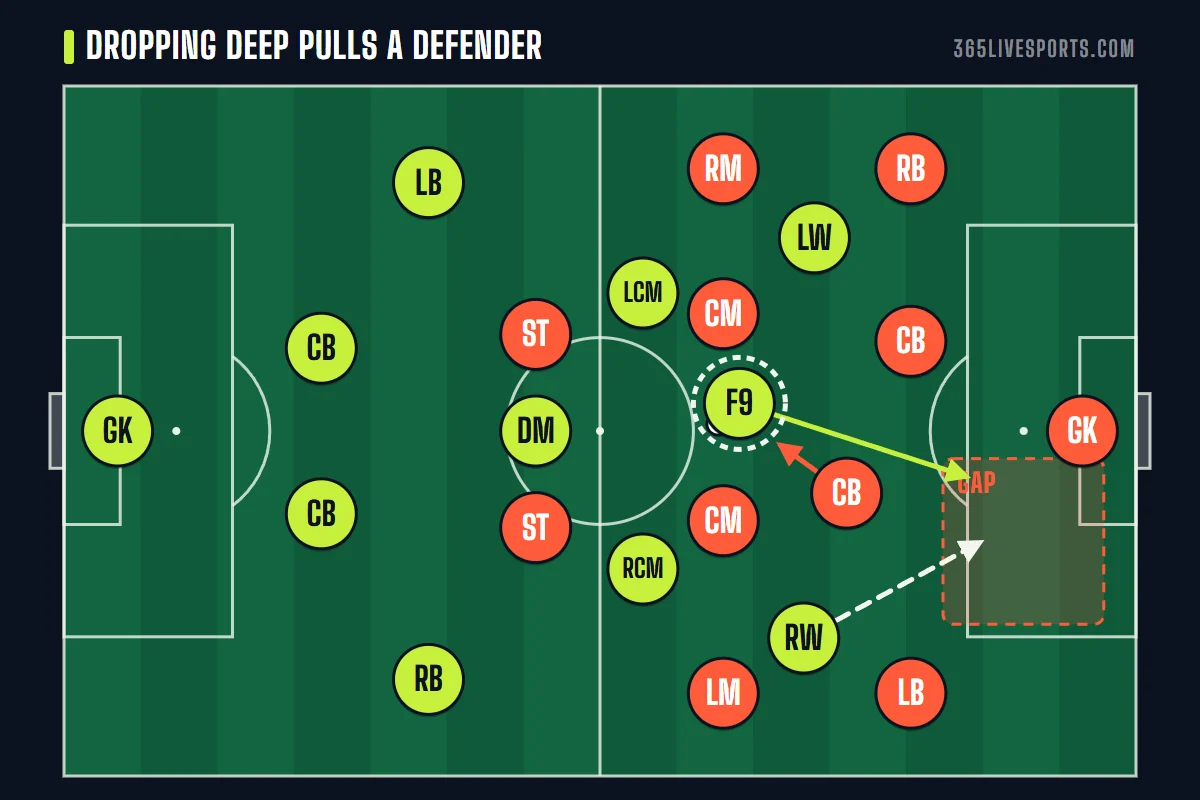
Center backs like a direct opponent. They can stand close, feel him with an arm and win headers. Take that reference away and they start to argue among themselves: who steps out, who stays, who covers? Here is the sequence a coach wants to see:
- The F9 checks short as a midfielder or full back gets the ball facing forward.
- He receives on the half-turn, side-on, so he can see the goal and the ball at once.
- One center back hesitates or follows him up the pitch.
- A winger or a midfielder runs diagonally into the space that defender left.
- The F9 slips a pass into that run, or turns and shoots if nobody came.
The diagram shows the second picture: the center back has chased, so the right winger attacks the gap behind him. In a back three the problem is smaller for defenders, because the spare center back can step out while two remain.
Skills the role needs
Not every striker can do this job, and not every attacking midfielder either. The player needs a mix of both:
- Receiving under pressure: a clean first touch with a defender on his back, and the habit of checking his shoulder before the ball arrives.
- Passing range: short combinations around the edge of the box plus a disguised through ball for the runners.
- Timing: dropping too early just crowds the midfield; dropping as the passer looks up is the key.
- Finishing: he still needs to score, usually from late arrivals at the edge of the area rather than headers at the back post.
- Unselfish work rate: the job often means making space for teammates and never touching the ball.
False nine vs striker vs number 10
Parents and new players often mix these three up because they all play centrally near the opponent's box. The difference is where each one wants to receive and what the team expects from him.
| Role | Usual starting spot | Where he wants the ball | Main job |
|---|---|---|---|
| False nine | Striker position | Between the lines, facing play after a turn | Pull defenders out, link, create for runners |
| Traditional striker (9) | Striker position | In the box or in behind the back line | Score, hold the ball up, pin center backs |
| Number 10 | Behind the striker | Between the lines, already facing goal | Final pass, shots from the edge of the area |
The false nine and the number 10 end up in similar places. The difference is where they came from: the F9 leaves the front line empty on purpose, while a number 10 plays behind a real striker who stays high. The guide to positions by shirt number explains where the 9 and 10 labels come from.
Which false nine formation works best
The role fits best in a front three, because the two wide forwards are the ones who exploit the space. Inside a 4-3-3 the wingers start wide and run inside as the F9 drops. In a 3-4-3 the wing backs give width, so the two wide forwards can play narrow and attack the gaps on either side of the center back.
A 4-2-3-1 can use one too, but watch the crowding: the number 10 and the false nine want the same pocket of space, so one of them must move. Two-striker shapes such as 4-4-2 rarely need the idea, since the second striker already offers a link player. The role was a big part of the short passing style made famous by a Spanish club side, which you can read about on the tiki-taka page.
A practice to teach the movement
Use half a pitch with a full-size goal. Set up 6 attackers (a false nine, two wingers, two central midfielders and a full back) against 4 defenders and a goalkeeper.
- The coach plays the ball to a central midfielder facing forward.
- The F9 must check toward the ball and receive outside the penalty area.
- Wingers may not enter the box until the F9 has touched the ball, which teaches the timing of the diagonal run.
- A goal scored by a winger or midfielder after an F9 assist counts double.
- After a few rounds, let the defenders choose to follow the F9 or not, and ask the attackers to read the choice and react.
Stop the play when the F9 receives facing his own goal with a defender tight. Ask him where his first touch should have taken him and replay the moment.
How to defend against a false nine
If you coach the other team, you have three common answers:
- Hand him to the holding midfielder. Your number 6 screens the pocket and the center backs stay home. This is the safest choice.
- Let a center back follow, with cover. Works best with a back three, so two defenders remain behind.
- Squeeze the space. Push the back line up so the gap between defense and midfield stays very short, about 10 to 15 yards.
A compact low block also blunts the role, because there is little space behind the defense for the wingers to attack.
When a false nine is the wrong choice
The idea has limits. With no player in the box, crosses from wide areas are wasted, so teams who like to cross early should keep a traditional striker. It also asks a lot of the wide forwards: if they are not quick and willing to run inside, the dropping movement creates space that nobody uses. At youth level, many coaches prefer to teach the classic striker role first, then add the false nine as a second option once players understand space. The guide to offense positions covers the other attacking jobs.
Questions players and coaches ask
What does false nine mean in soccer?
It means a player who is listed as the center forward, the number 9 position, but who plays much deeper than a real striker. He drops into midfield to receive the ball and to drag defenders out of position. The "false" part tells you the position on paper is not where he really plays.
Is a false nine a striker or a midfielder?
Both, in a way. He starts in the striker's spot and still has to score goals, but much of his work happens in midfield areas. Coaches usually pick a forward with midfield skills or an attacking midfielder who can finish.
How is a false nine different from a number 10?
A number 10 plays behind a real striker, so the front line is never empty. A false nine is the most advanced player on paper but leaves the front line on purpose. That empty space is what the wingers attack.
Why do teams use a false nine?
It gives the team an extra player in midfield, which helps keep possession, and it confuses center backs who prefer a direct opponent. It works best when the wide forwards are quick and like to run in behind.
Can youth teams play a false nine?
Yes, from around 9v9 upward, if the players understand space and the wide players are ready to run past. With the youngest groups it is usually better to teach all players to attack the goal first and add the dropping movement later.
What does a false nine movement diagram show?
Usually two arrows: the F9 dropping toward midfield and the wingers running diagonally toward goal. The diagrams on this page add the defender's choice, to follow or not, because that choice decides which pass is on.