
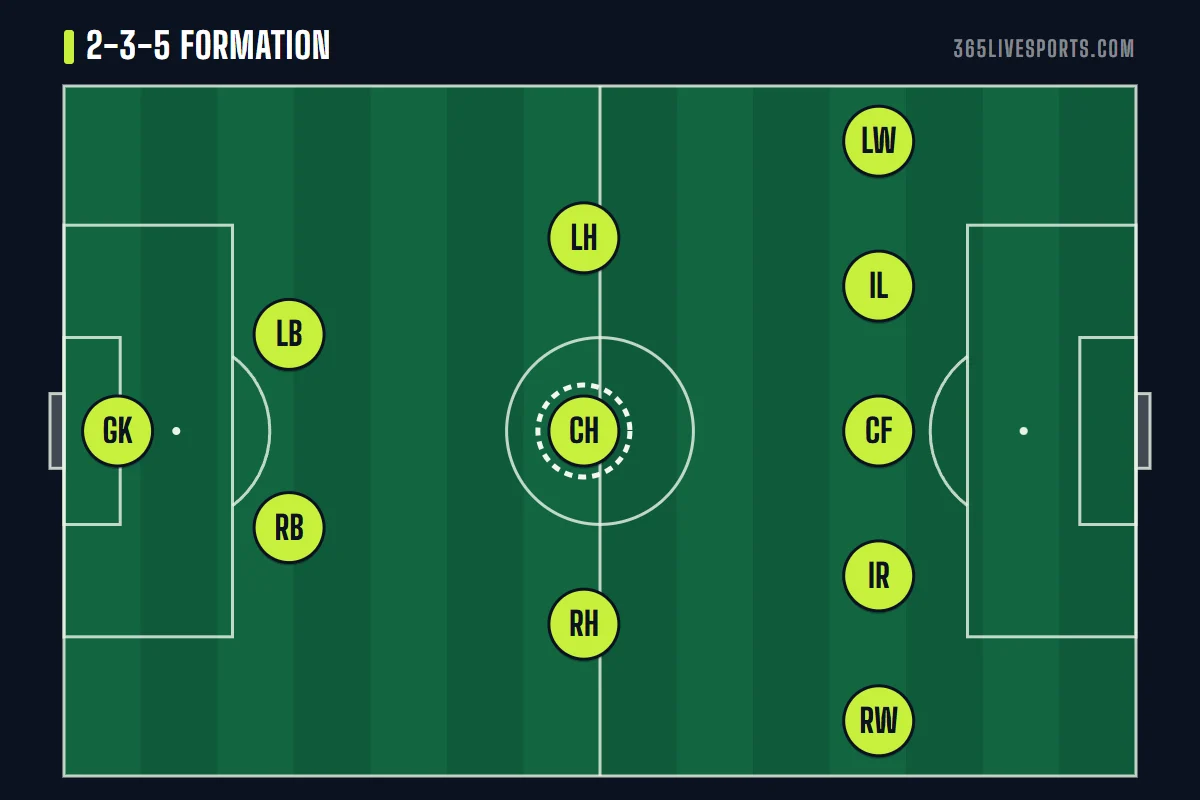
The 2-3-5 formation, known as the pyramid, uses two full backs, three half backs and five forwards: two wingers, two inside forwards and a center forward. Turn the diagram upside down and you see why it got its name: a narrow point at the back, a wide base in attack. It was the standard shape across the world for a very long stretch of the game's history, and it is the reason players still wear numbers 1 to 11 the way they do. No serious team defends in it today, yet modern attacking structures look surprisingly similar. Here is how it worked, why it faded and what it still teaches.
Quick facts
Shape
2 backs, 3 half backs, 5 forwardsNickname
The pyramidEra
The early days of organized football, long before back foursKey player
The center half, who attacked and defendedWhy it faded
A change to the offside law exposed two defendersLegacy
Classic shirt numbers 1 to 11
What the 2-3-5 formation looked like
Two backs stood near their own penalty area, fairly central and close together. In front of them, three halves spread across the field: a left half, a center half and a right half. The front five filled the width: an outside left on the touchline, an inside left, the center forward, an inside right and an outside right on the other touchline.
Compared with modern shapes, it looks reckless. Half of the outfield players were forwards. The board above is preloaded with the pyramid, so try moving one forward back and you will feel how the old game slowly turned into the modern one.
Classic 2-3-5 football formation shirt numbers
When numbered shirts arrived, teams lined up in the pyramid, so the numbers simply ran from defense to attack and from right to left within each line. That is where many of today's numbers come from.
| Number | Pyramid position | Where that number often ended up later |
|---|---|---|
| 1 | Goalkeeper | Goalkeeper |
| 2 | Right back | Right back |
| 3 | Left back | Left back |
| 4 | Right half | Center back or holding midfielder, depending on the country |
| 5 | Center half | Center back |
| 6 | Left half | Center back or holding midfielder |
| 7 | Outside right | Right winger |
| 8 | Inside right | Central midfielder |
| 9 | Center forward | Striker |
| 10 | Inside left | Attacking midfielder or playmaker |
| 11 | Outside left | Left winger |
Numbering varied by country and changed over time, so treat this as the most common pattern rather than a rule. Our soccer positions by number page follows each number into the modern game.
How the pyramid came about
In the earliest organized football, teams played with most of their players as forwards, dribbling in packs with only one or two players behind. Passing changed that. Once teams discovered that moving the ball between players beat dribbling into a crowd, they needed players who could win the ball and pass it forward, so they pulled more of them back.
Through trial and error, the balance settled on two backs, three halves and five forwards. It spread with the game itself, carried by teams, teachers and touring sides, and for a long time almost everyone played it.
Roles in the pyramid
- Backs (2 and 3): defended the middle of the field, mostly against the inside forwards and the center forward. One often stepped up to catch forwards offside while the other covered.
- Wing halves (4 and 6): marked the opposing wingers and fed their own forwards. They were the workers of the team.
- Center half (5): the most complete player on the field. He defended, organized and started attacks, much like a modern box-to-box midfielder.
- Inside forwards (8 and 10): the creators and goal scorers, linking the halves to the center forward.
- Wingers (7 and 11): beat the back with pace and crossed for the center forward.
- Center forward (9): the main finisher, strong in the air and brave in the box.
The attack worked through triangles: a wing half, an inside forward and a winger combined down each side, then crossed for the center forward and the far inside forward.

Why the game moved away from the 2-3-5 soccer formation
The big push came from the offside law. Under the original rule, an attacker needed three opponents between himself and the goal line, so two backs could catch forwards offside by stepping up together. When the law changed so that only two opponents were needed, that trick stopped working. Forwards suddenly had acres of space behind a back line of two.
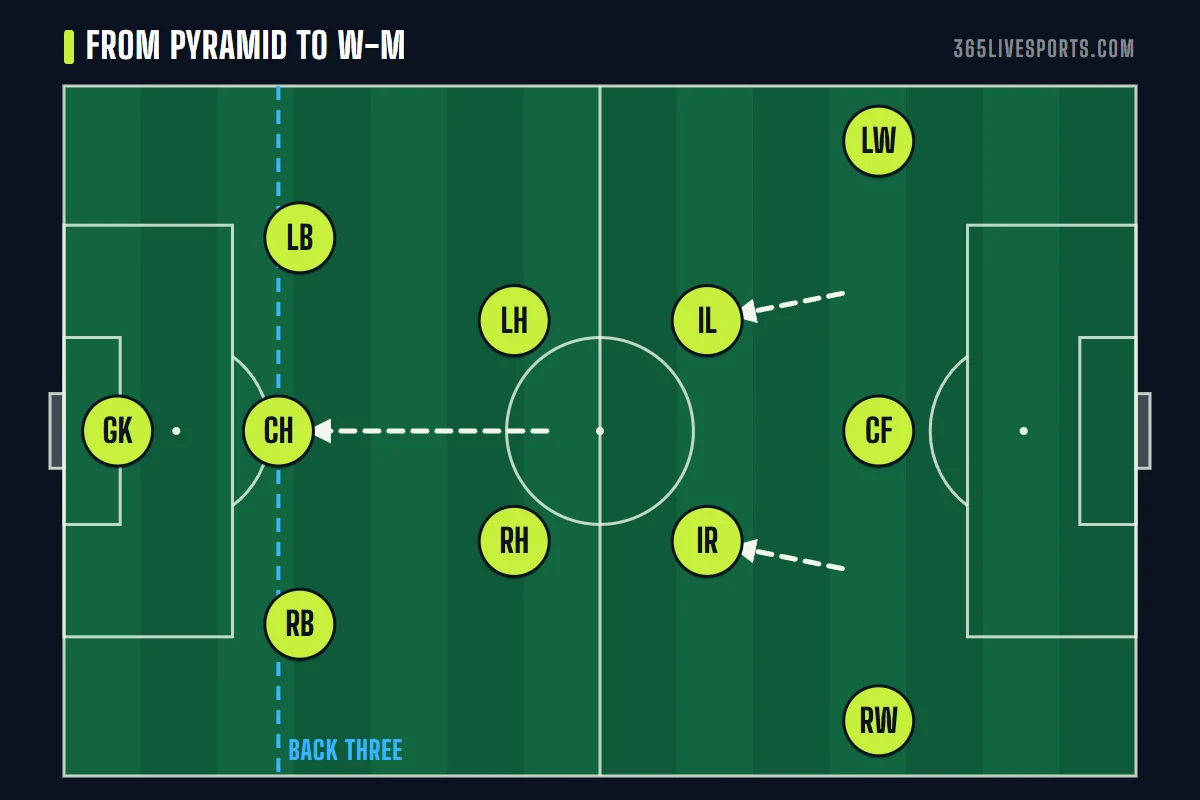
Coaches responded by pulling the center half back between the two backs as a third defender, and dropping the two inside forwards into midfield. The result, written as 3-2-2-3, was known as the W-M because of the letters the players made on paper. Later shapes, first the 4-2-4 and then the 4-4-2, kept adding defenders and midfielders.
Other reasons followed: five forwards cannot press or defend wide areas, two backs are always outnumbered by a modern front three, and the passing game needs numbers in midfield to keep the ball.
Strengths and weaknesses then and now
| Strengths | Weaknesses |
|---|---|
| Five forwards fill every attacking lane | Only two defenders against modern front lines |
| Natural triangles down each side | The center half has too much ground to cover |
| Simple to understand: everyone has a clear zone | Wingers and inside forwards rarely defend |
| Huge attacking threat from crosses | Very easy to counter with a long ball behind the backs |
Does anyone still play a 2 3 5 formation?
Not as a starting shape. But watch a top possession team attacking and you may see something familiar: two center backs at the back, three players in midfield (often a holder plus two full backs who have stepped inside), and a front line of five attackers. Coaches today call it a 2-3-5 in possession, or describe the closely related 3-2-5. The difference is that modern teams use it only with the ball and retreat into four or five defenders without it.
For the shapes that replaced it, browse our full list of football formations.
Questions players and coaches ask
What is the 2-3-5 soccer formation?
A historic shape with two backs, three halves and five forwards, also called the pyramid. It was the standard formation in the early days of organized football.
Why is the 2 3 5 formation called the pyramid?
Drawn on paper with the goalkeeper at the top, the lines grow from one to two, three and five players, which looks like a pyramid. The narrow tip is the defense and the wide base is the attack.
What are the classic 2-3-5 shirt numbers?
1 goalkeeper, 2 right back, 3 left back, 4 right half, 5 center half, 6 left half, 7 outside right, 8 inside right, 9 center forward, 10 inside left and 11 outside left. Numbering varied by country, so this is the common pattern, not a fixed rule.
Why did teams stop playing the 2-3-5 formation in football?
Once the offside law was rewritten, two backs could no longer catch forwards offside easily. Coaches dropped the center half into defense and the inside forwards into midfield, creating the W-M, and the game kept adding defenders from there.
What replaced the 2 3 5 soccer formation?
The W-M, a 3-2-2-3, came first. Later came back-four shapes, first 4-2-4, then 4-4-2.
Do modern teams use a 2-3-5?
Some possession teams attack in a 2-3-5 structure, with two center backs behind a midfield three and five forwards. They switch back to a back four or five as soon as they lose the ball.