
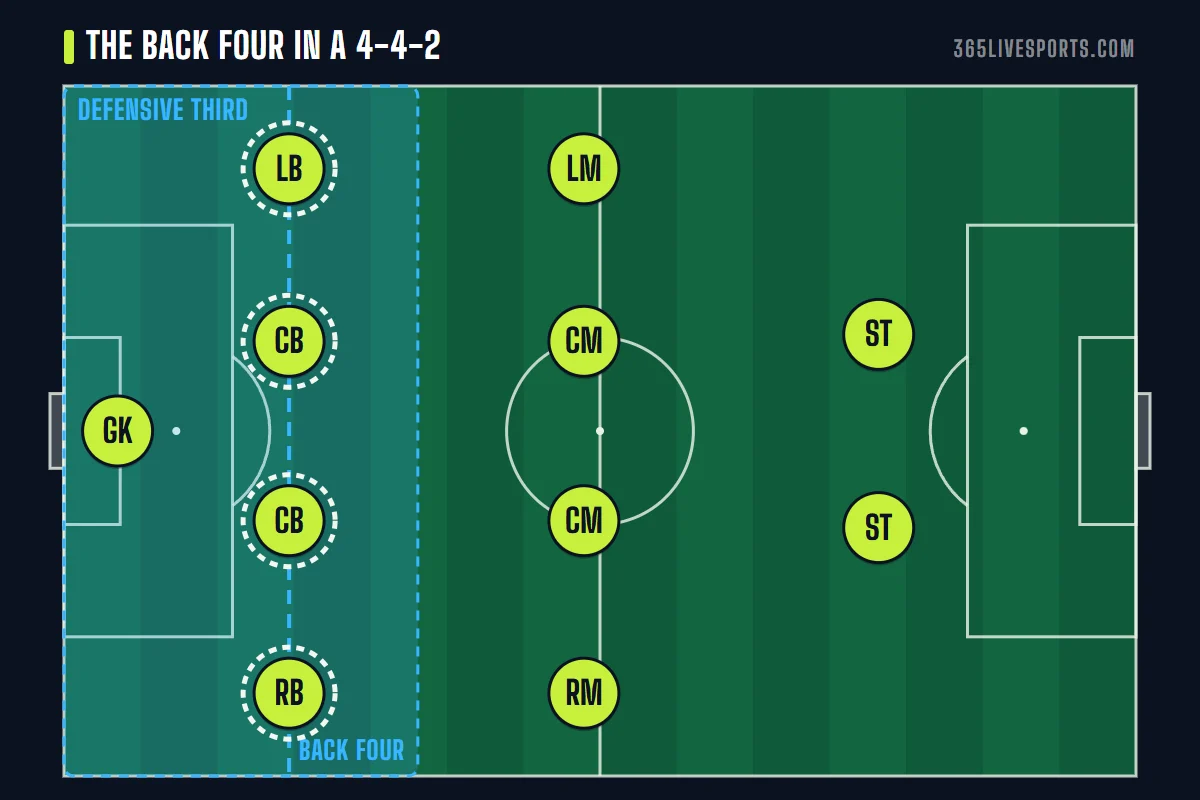
The soccer defense positions are the center backs, who guard the middle in front of goal, the full backs on each flank, the wing-backs used in a back three or back five, and the rarer sweeper and stopper roles. Together they form the back line, usually of four players, with the goalkeeper behind them and a defensive midfielder in front.
Defending gets less praise than scoring, yet every coach I have worked with picks the back line first. A team with an organized defense stays in games it should lose. Below you will find each role, the habits that separate good defenders from busy ones, the usual mistakes and a simple drill to fix them.
Quick facts
Main roles
Center back, full back, wing-backRare roles
Sweeper (libero) and stopperUsual number
Four defenders, sometimes three or fiveClassic shirts
2 right back, 3 left back, 4 and 5 center backsCore habit
One defender presses, the next one coversAlso defending
The goalkeeper and the holding midfielder
Soccer defense positions at a glance
Most teams defend with a back four: a left back, two center backs and a right back. The diagram shows them in a 4-4-2, spread across the width of the field about 15 to 20 yards in front of their own goal. Others use a back three of center backs, with wing-backs on the sides who drop in to make a five when the opponent attacks.
Defense is a team job, though. The goalkeeper is the last defender and organizes the line, the defensive midfielder screens the space in front of it, and in a good team the forwards start the defending by pressing. When people ask what positions are defense in football, the formal answer is the back line, but the practical answer is everyone.
Center back
Center backs (CB) are the heart of the defense, playing in the middle of the back line just in front of the keeper. In a back four there are two: a left center back and a right center back.
Out of possession: protect the penalty area and the space behind the line. One center back challenges the striker while the partner covers at an angle, a few yards deeper and inside, ready to sweep up if the first one is beaten. Win the first header, then react to the second ball.
In possession: split wide so the keeper can pass to you, then look to pass into midfield, switch the play to a full back or carry the ball forward into space. A center back who can break a line with a pass is gold for any team that likes to play out from the back.
Skills: heading, tackling, reading the game, communication, calm passing with both feet. Pace helps but is not essential if positioning is good.
Full backs on each flank
The full backs (LB and RB) play on the outside of a back four. They are often the most underrated players on the field and among the busiest.
Out of possession: defend the opposing winger one against one, show the attacker toward the touchline or toward help, and squeeze inside toward the center backs whenever the attack is on the opposite flank so no gap opens in the middle. At the far post, the full back marks the runner a striker leaves behind.
In possession: give width high up the field, overlap the winger, or tuck into midfield as an extra passer. Which one depends on the coach and the formation.
Skills: stamina for repeated sprints, one against one defending, crossing, the judgment to know when to go and when to stay.
Wing-backs and the back three
In a 3-5-2 or 3-4-3, three center backs hold the middle and two wing-backs (LWB and RWB) cover the whole touchline. When the team attacks, the wing-backs are wingers; when it defends, they drop alongside the three center backs to form a back five, as in the 5-3-2.
The outside center backs in a back three have their own job. They step out wide to meet wingers and runners in the channel, and in possession they can carry the ball forward or overlap their wing-back. The middle one usually organizes, wins headers and covers behind both partners.
Sweeper and stopper
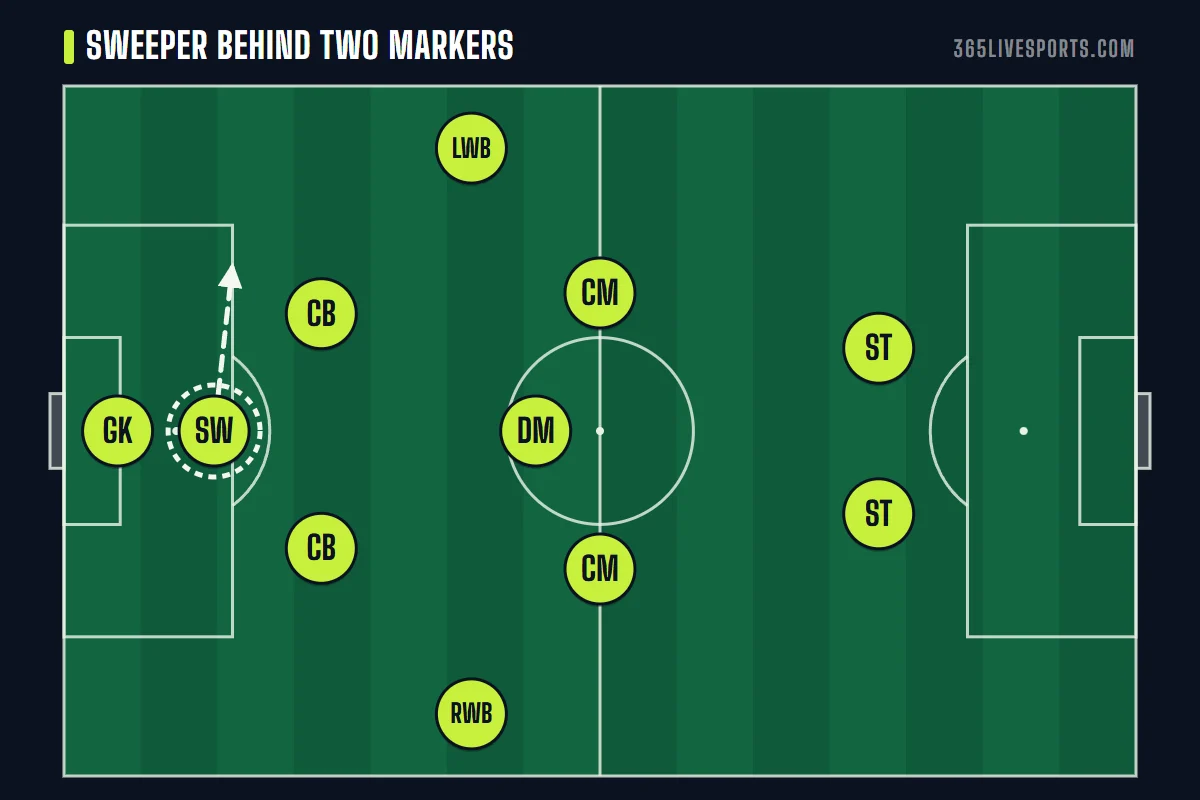
The sweeper, also called the libero, plays behind the other defenders with no player to mark. The job is to "sweep" up through balls and loose balls the markers miss. The stopper is the center back who attacks the striker the moment a pass is played in, tight and physical, so the ball cannot be received cleanly.
The sweeper was a feature of Italian catenaccio and of many back three systems. It is rare in the modern game, because a sweeper standing deeper than the rest of the line keeps every opposing forward onside and leaves the team defending too deep. Most teams now defend with a flat line and use the goalkeeper as an extra sweeper behind it.
You still see sweepers in youth and amateur soccer, and it can make sense there: if your center backs are slow, a spare player behind them protects against balls over the top.
All defensive positions in soccer compared
| Position | Where | Main job | Key skill | Formations |
|---|---|---|---|---|
| Center back (CB) | Middle of the back line | Protect the box, win headers | Reading danger | All |
| Full back (LB, RB) | Wide in a back four | Stop wingers, support attacks | One against one defending | Most back four shapes |
| Wing-back (LWB, RWB) | Whole touchline | Width in attack, fifth defender | Stamina | 3-5-2, 3-4-3, 5-3-2 |
| Outside center back | Left or right of a back three | Cover the channel, step out | Pace and timing | Back three systems |
| Sweeper (SW) | Behind the back line | Spare player, clears danger | Anticipation | Older back three and back five |
| Stopper | In front of the sweeper | Mark the striker tightly | Aggression in the tackle | Sweeper systems |
The defensive midfielder sits just in front of these roles and is covered in the midfield positions guide.
How a back line works as a unit
Individual defending matters, but most goals come from the line breaking shape. These principles keep it together:
- Pressure, cover, balance: the nearest defender presses the ball, the next one covers behind at an angle, the far side players tuck in to balance.
- Step up together: when the opponent passes backward or the ball is cleared, the whole line moves up five or ten yards. This shrinks the space and can catch attackers offside, the idea behind the offside trap.
- Drop together: when an opposing midfielder has time to look up and play forward, the line drops a few yards so the ball cannot be played in behind.
- Zones or players: most teams defend by area, passing runners on to the next defender, as explained in zonal marking.
- Talk: "push", "hold", "drop", "I've got 9". A silent back line is a broken one.
Common defensive mistakes and fixes
| Mistake | Why it hurts | Fix |
|---|---|---|
| Diving into tackles | One step and the attacker is through | Stay on your feet, side-on, and wait for a heavy touch |
| Ball watching | Runners arrive unmarked at the back post | Open your body so you see ball and runner together |
| Full back stays wide while play is on the far flank | A hole opens inside the full back | Squeeze inside until the gap to your center back is under ten yards |
| One defender drops, the rest hold | Plays everyone onside | One voice, usually a center back, calls the line |
| Both center backs go to the same ball | Nobody covers behind | Agree in advance: one attacks, one covers |
Drill: back four shadow shift
- Set up four defenders on a line of cones about 40 yards wide, with a coach and two passers in front.
- The passers move the ball across the front. On every pass the line shifts toward the ball: nearest defender steps up to press, the next covers, the far side tucks in.
- When the coach passes backward, the line steps up five yards together. When a passer turns and looks forward, the line drops.
- Add two attackers who make runs in behind. Defenders must pass runners on with a call rather than follow them out of the line.
- Finish with a 6v4 to goal: six attackers against the back four plus a keeper.
Want to see how these roles fit into a full team? Start with the main soccer positions guide, or see how numbers 2 to 6 map to defenders in positions by number.
Questions players and coaches ask
What are the defensive positions in soccer?
The main ones are center back, left back and right back in a back four, and wing-backs plus three center backs in a back three. Older or youth systems may also use a sweeper behind the line and a stopper in front of it.
How many defenders are on a soccer team?
Most teams use four defenders. Some use three, often with wing-backs who become defenders without the ball, and some use five when guarding a narrow lead late on.
What is a sweeper in soccer?
A sweeper, or libero, is a defender who plays behind the others without a direct opponent to mark. The job is to clear up balls that get past the markers. It is uncommon at higher levels because a deep sweeper makes the offside line hard to hold.
Is a defensive midfielder a defender?
Strictly no, the defensive midfielder is part of the midfield. In practice the role is mostly about defending: shielding the center backs and blocking passes into the striker.
What is the easiest defensive position for a beginner?
Most beginners find full back easiest to learn, since the touchline cuts the attacker's options in half. Center back demands more reading of the game and communication.
What positions are defense in football?
In association football, the defense is the back line: center backs, full backs and wing-backs, sometimes a sweeper. The goalkeeper and defensive midfielder also have mostly defensive jobs.