
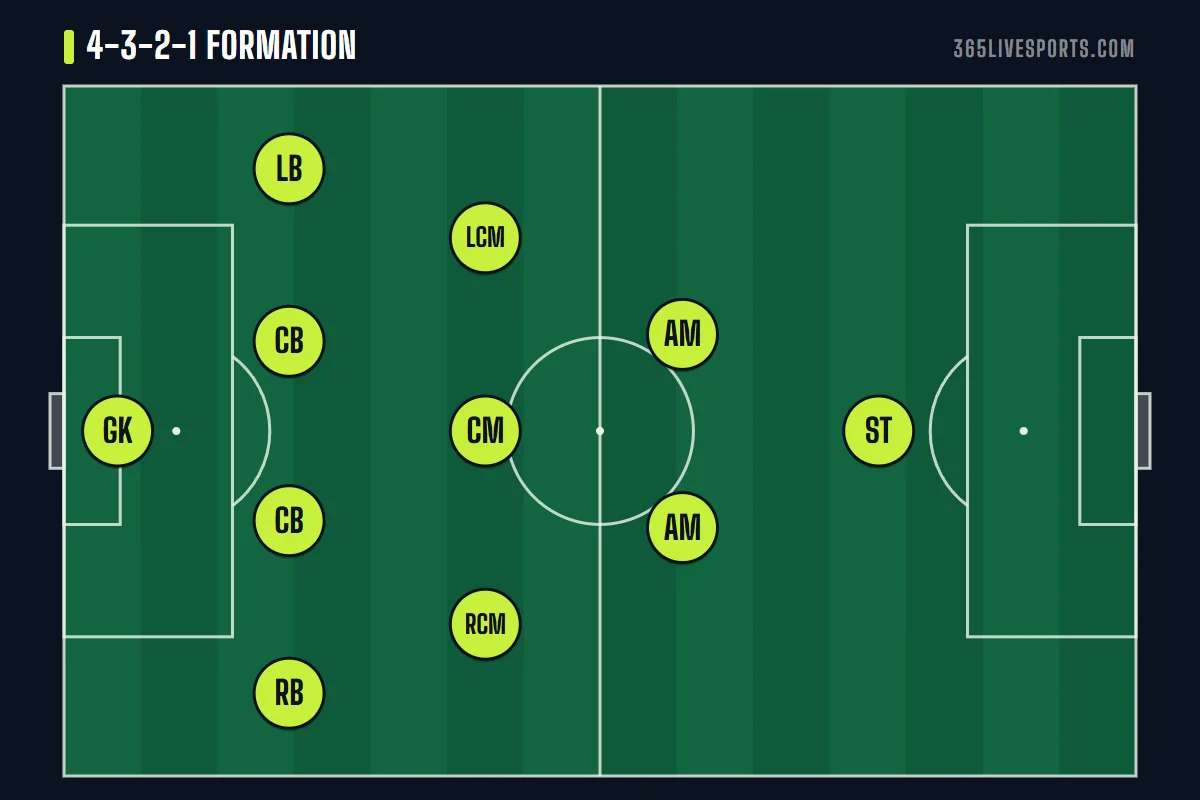
The 4-3-2-1 formation stacks a back four, a central midfield three, two attacking midfielders and a single striker, so the shape narrows as it goes up the pitch like a fir tree, which is why it is usually called the Christmas tree. It is a central, possession-minded football system that floods the middle and relies on the full backs for almost every yard of width.
When it works, the ball keeps moving through a crowd of your own players in the center and the two number tens find pockets between the lines. When it fails, the opponent simply goes around it. This page covers player instructions for each position, the attacking and defending patterns, and when the tree is the right choice for your team.
Quick facts
Nickname
The Christmas tree, from its narrowing pyramid shapeShape
4 defenders, 3 central midfielders, 2 attacking midfielders, 1 strikerWidth from
The full backs, almost entirelyBest for
Teams rich in central midfielders and creative tensWeak spot
The flanks, especially when full backs are caught upfieldKey player
The two attacking midfielders behind the striker
Reading the 4-3-2-1 shape from the back
Start at the bottom of the tree. A flat back four protects the goalkeeper. Above it sit three central midfielders, normally one anchor flanked by two runners. Next come two attacking midfielders who play inside, not on the wings, and at the very top a lone striker. Four plus three plus two plus one makes ten outfield players.
Because nobody is stationed on the touchlines in front of the full backs, the 4-3-2-1 looks thin on the outside of a team sheet. That is deliberate: the idea is to win the ball and the game in the middle of the pitch. Try moving the two tens wider on the board at the top of this page and the tree starts to resemble a 4-3-3 almost at once.
4-3-2-1 formation player instructions by position
| Position | Instructions on the ball | Instructions off the ball |
|---|---|---|
| Center backs | Split wide when the keeper has it, pass into the holding midfielder | Stay compact, one attacks the ball, one covers |
| Full backs | Overlap high, give width, cross | Recover quickly, defend the wingers one against one |
| Holding midfielder | Takes the ball from the center backs, switches play | Screens the back four, never chases into wide areas |
| Two wide central midfielders | Shuttle into wide spaces when the full back overlaps | Slide out to the flank, protect the full back |
| Two attacking midfielders | Find pockets between lines, combine with the striker, shoot | Press the opposition center midfielders, drop to make a five |
| Striker | Hold up the ball, run in behind, finish | Press the center back, block the pass to the holding player |
More detail on the deeper roles is on our midfield positions page.
How the Christmas tree attacks
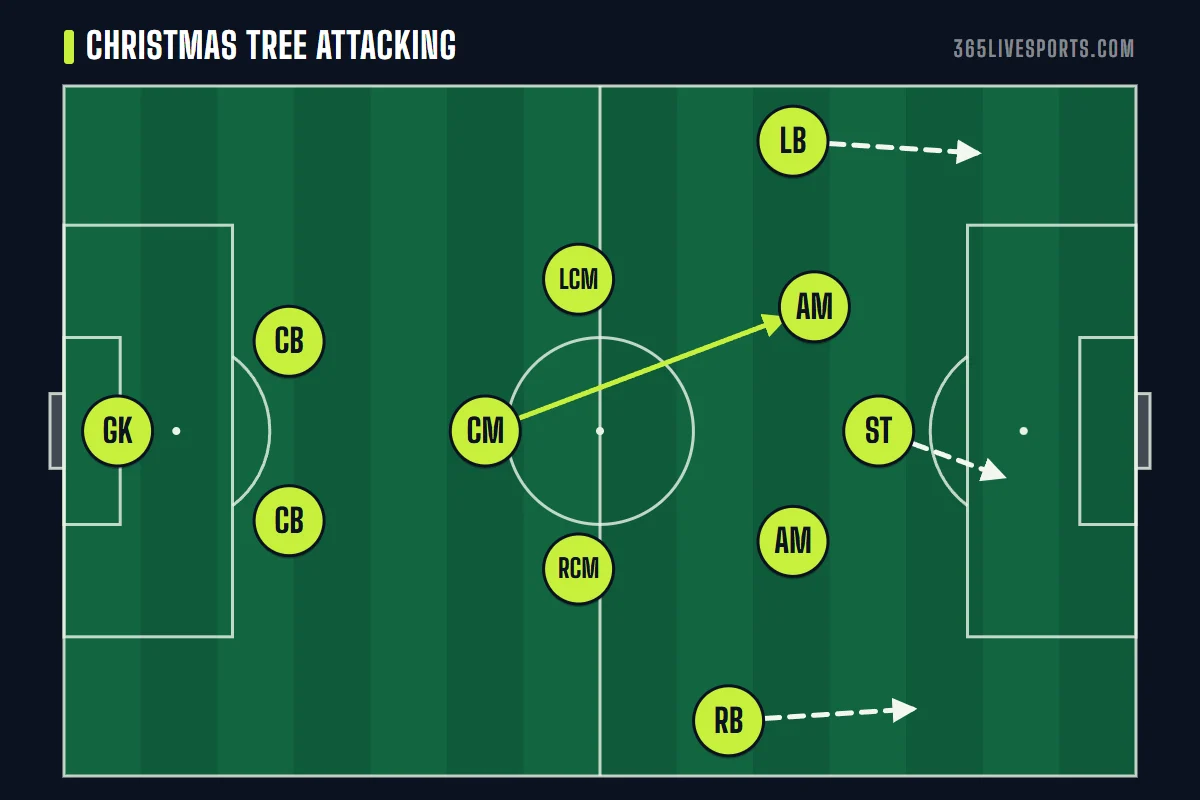
Picture a triangle on top of a triangle. The striker and the two tens form the top triangle; the three midfielders form the one below. Short passes inside those triangles pull opponents toward the middle, and that is when the full backs sprint up the outside into the space that has opened.
A typical move: the holding midfielder plays into a ten, who sets it back to a wide central midfielder facing forward. The striker runs across the center back, the far ten arrives around the penalty arc, and the full back is already overlapping for a cutback. The tens must play facing the goal as often as possible; a ten who keeps receiving with his back to goal is a sign the spacing is wrong.
Defending in a 4-3-2-1 formation
Out of possession the tree usually becomes a 4-5-1. The two tens drop alongside the midfield three, sliding out toward the touchlines, and the striker stays up to press. Some coaches prefer a 4-3-3 press instead, with the tens pushing up beside the striker to jump onto the opposition center backs and full backs.
The midfield three must move as a chain. A pass out to the touchline pulls the closest midfielder across; the anchor drops into the hole he leaves and the third man narrows. The full back on the ball side now has help, so he can be aggressive with the winger.
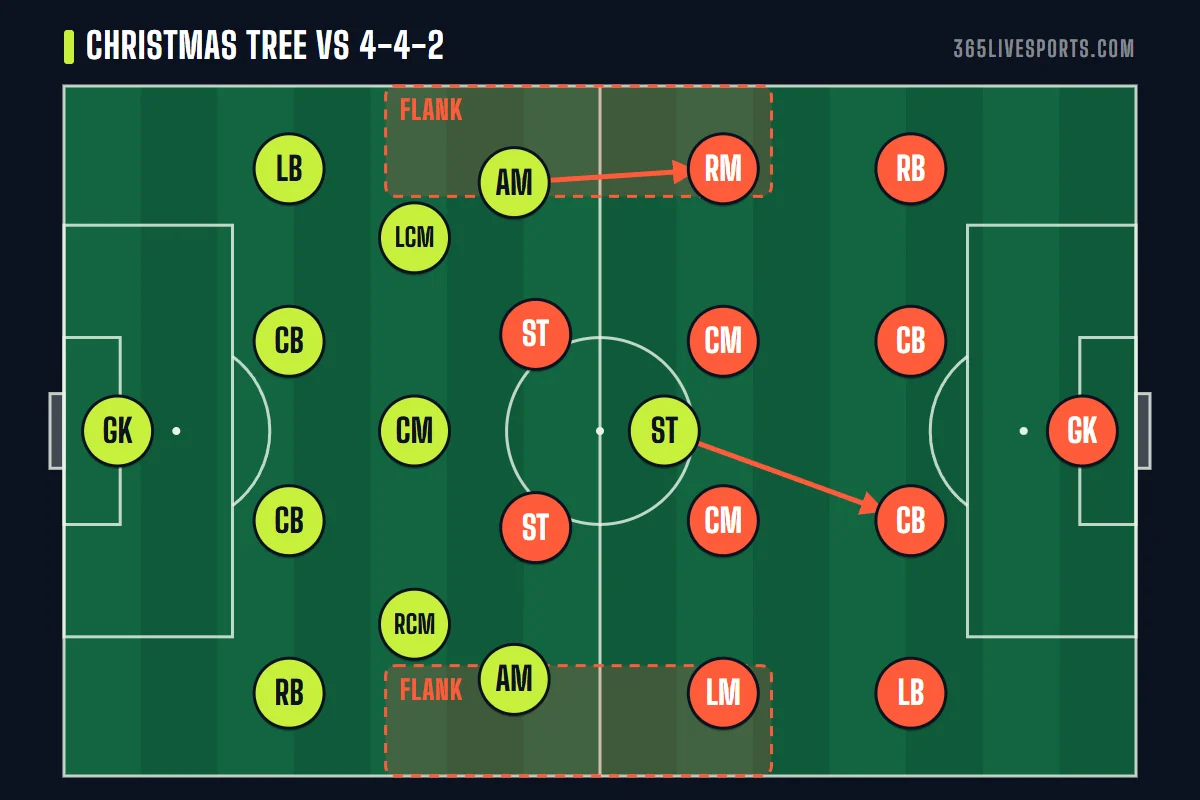
The picture below shows the main danger against a flat midfield four: the opposition wide midfielders and full backs both get free on the flanks if your tens forget to drop.
4-3-2-1 formation weakness and the fix
| Strength | Weakness |
|---|---|
| Midfield superiority: often 5v3 or 5v4 in the center | Little natural width; predictable if the full backs cannot attack |
| Two tens give creativity close to goal | Lone striker can be isolated |
| Hard to play through the middle against | Easy to play around: 2v1s against the full backs |
| Compact, so the team is close together after losing the ball | Full backs cover huge distances every match |
The opponent's plan is nearly always the same: go wide and double up on your full backs. The fixes, in the order I would try them:
- Tell the wide central midfielders to shuttle out early, before the winger receives.
- Stagger the full backs: when one attacks, the other stays level with the center backs.
- If the problem continues, move one ten out to the wing and play a 4-3-3 for the rest of the half.
Christmas tree compared with the 4-2-3-1 and 4-3-3
The 4-2-3-1 has a double pivot instead of a midfield three and a line of three attackers behind the striker, two of them wide. That gives it wingers, which the tree does not have. The 4-3-3 shares the same midfield three but puts two wide forwards high and outside. If you lack good wingers, the 4-3-2-1 is often the better fit; if you have fast wide players, it wastes them.
All three are covered on our formations hub, with diagrams side by side.
Is the tree a good fit for your team, including youth sides
Pick it if your best players are central midfielders, if your full backs are fit and like to attack, and if your striker can hold the ball up alone. Skip it if your full backs are defensive by nature, because without them the team has no width at all.
For young players it is a full-field shape. US Soccer guidance runs from small-sided games through 7v7 (roughly U9 and U10) and 9v9 (roughly U11 and U12) to eleven a side from U13, though individual leagues may differ. In 9v9, a 3-2-2-1 gives a similar feel with two tens behind one striker.
Questions players and coaches ask
Why is the 4-3-2-1 called the Christmas tree?
Because the lines get shorter from the back to the front: four, three, two, one. Drawn on a board it looks like a fir tree, with the striker as the star on top.
Is 4-3-2-1 a good formation?
For teams that want to control the middle and have attacking full backs, yes. It struggles against teams with good wingers and overlapping full backs, because nobody starts in the wide areas in front of your back four.
What is the main 4-3-2-1 formation weakness?
Width. The shape is narrow, so opponents can create two against one on the flanks. Fix it with disciplined shuttling from the wide central midfielders and by never letting both full backs attack at once.
What are the 4 3 2 1 formation positions?
A goalkeeper, two center backs, two full backs, a holding midfielder, two central midfielders, two attacking midfielders and one striker. The attacking midfielders play inside, close to the striker.
What is the difference between 4-3-2-1 and 4-3-3?
Both use a back four and a midfield three. In the 4-3-3 the two players beside the striker are wingers who stay wide, while in the 4-3-2-1 they are attacking midfielders who play narrow, behind the striker.
What instructions should the striker get in a 4-3-2-1?
Hold the ball up to bring the two tens into play, make runs across the center backs to open gaps, and close down whichever center back is in possession once the team loses it. He is alone, so his first touch matters more than his speed.