
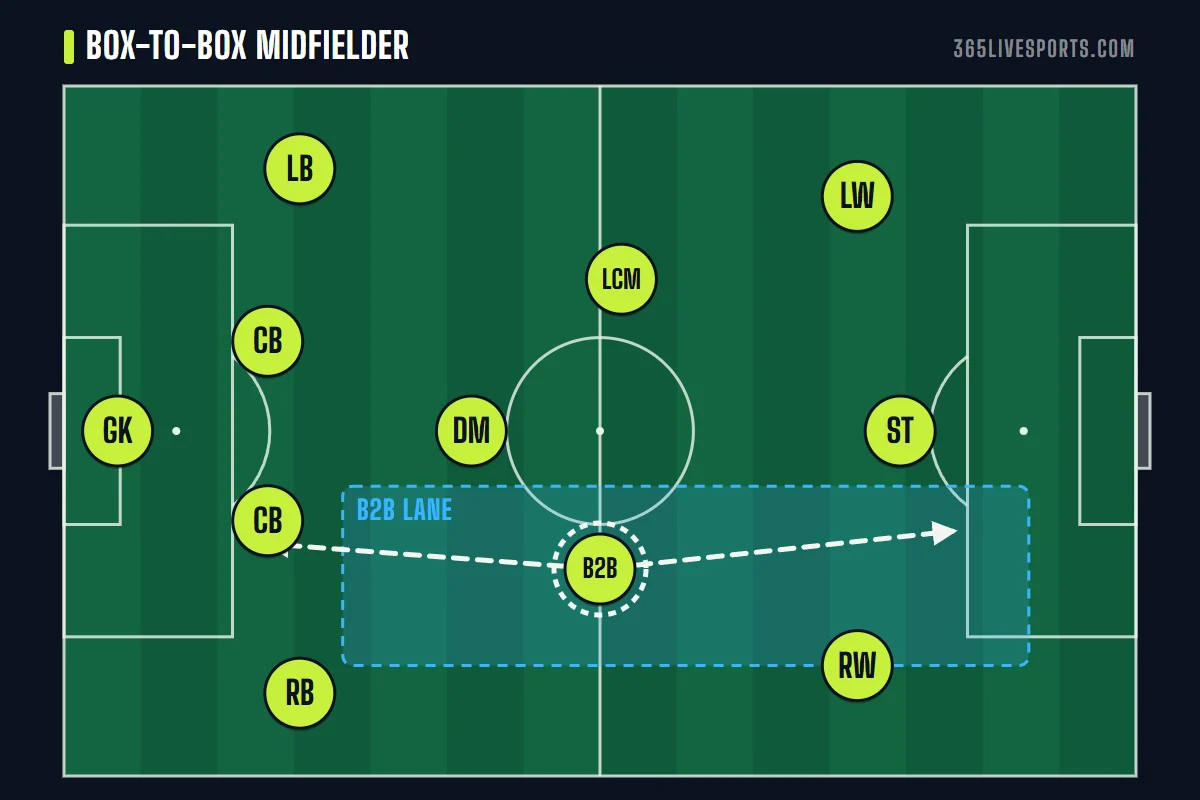
A box to box midfielder is a central midfielder who helps defend his own penalty area and then gets forward to attack the opponent's, covering the whole length of the field during a game. In most teams he wears number 8, plays in a midfield pair or three, and is the player you notice making a tackle near his own goal and then turning up for a shot a minute later.
The phrase is literal: from one penalty box to the other. It is less about a fixed spot on the field and more about range, energy and decision making. Here is what the job involves, how it differs from other midfield roles, and how a youth or amateur coach can develop a player for it.
Quick facts
Usual number
8, though teams and countries number players differentlyPlays in
Midfield two of a 4-4-2 or 4-2-3-1, or as one of the two 8s in a 4-3-3In possession
Carries the ball forward, combines, arrives late in the boxOut of possession
Presses, tackles, tracks runners back to his own areaKey quality
Repeated sprints with good choices about when to go and when to stayPairs well with
A disciplined holding midfielder who stays home
The box to box midfielder meaning, in one picture
Picture a corridor running the full length of the pitch, a little to one side of center. A box-to-box player lives in that corridor. When the opponent attacks, he drops just ahead of the two center backs or even into the penalty area to block a shot. Once the ball is won back, he is one of the first to break forward, either carrying it himself or running beyond the striker.
Most teams only have room for one or two of these players. If every midfielder bombs forward, nobody protects the defense. That is why the role is usually paired with a calmer partner who holds position.
A match through the eyes of a box-to-box player
The easiest way to understand the job is to follow one player through a single passage of play:
- Defending: the opponent's winger cuts inside. The B2B drops to block the passing lane to their number 10, then steps in to win the loose ball.
- Transition: he lifts his head, sees space ahead and drives 20 yards with the ball before releasing it wide.
- Support: he keeps running, staying behind the ball as an option if the winger needs to recycle possession.
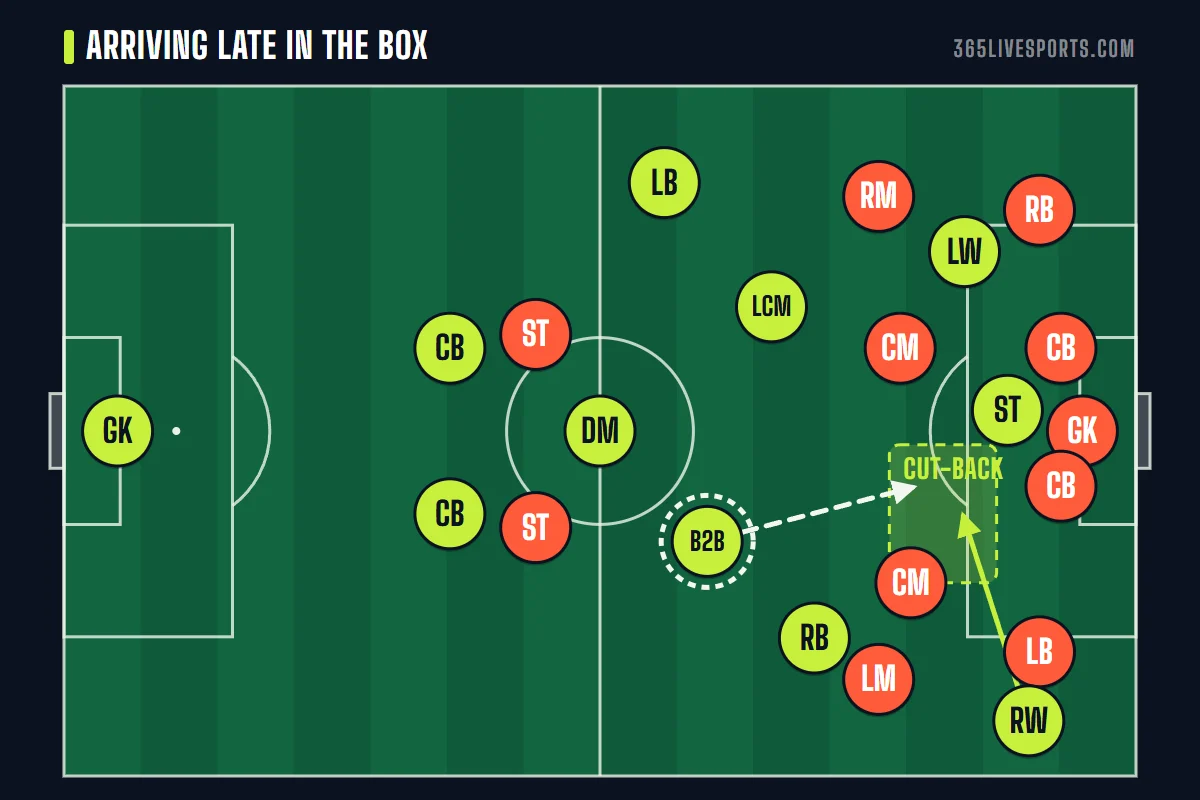
- Arrival: as the winger reaches the byline, the defenders sprint back toward their goal. The B2B slows slightly, then reaches the penalty spot just as the cut-back comes.
- Recovery: the shot is blocked, the opponent clears, and he is the first to turn and sprint back into position.
The late arrival in step four is where many goals come from. Defenders are watching the ball and the striker, and a runner from deep is hard to pick up.
Box-to-box vs holding midfielder vs number 10
Coaches often describe the central midfield in three jobs. Many players can do more than one, but the priorities differ.
| Holding midfielder (6) | Box-to-box (8) | Attacking midfielder (10) | |
|---|---|---|---|
| Main zone | Just ahead of the defense | The whole length of the central corridor | Between the lines, in front of the opposing back four |
| First thought on winning the ball | Keep it, pass safely | Go forward, carry or run | Find the final pass or shoot |
| Defensive duty | Highest: screens and covers | High: presses and tracks back | Lower: presses the opponent's deepest midfielder |
| Typical goals | Few, mostly from distance | Late runs, rebounds, second balls | Edge of the box, free kicks |
The midfield positions guide covers the wide midfielders as well. If you like the deep playmaking side of the 6 role, read about the regista.
What makes a good B2B
- Engine: not just running a lot, but repeating high-speed runs late in the game. A tired B2B who stops tracking back is a big problem.
- Ball carrying: the ability to break past a press by running with the ball, using the body to shield it.
- Tackling and timing: knowing when to step in and when to stay on his feet and delay.
- Reading second balls: being first to loose balls after headers and blocked shots.
- Shooting from 15 to 20 yards: the cut-back and the rebound tend to land around the penalty spot or the edge of the area.
- Discipline: going forward only when the partner midfielder has stayed.
Formations that need one
When the shape is a flat 4-4-2, the two central midfielders often split the job: one goes, one stays, and they swap as the game demands. With a 4-3-3, the two 8s flanking the holding midfielder are classic box-to-box positions, with the 6 giving them freedom. A 4-2-3-1 usually hands the role to one of its two deeper midfielders while the other screens.
Diamond shapes give the two outer central players lots of ground to cover, so a player with real stamina is needed there. In small-sided youth games the role is less defined, because every central player has to attack and defend anyway.
Where young B2Bs go wrong
| Mistake | What it causes | Fix |
|---|---|---|
| Running forward at the same time as the partner | Nobody screens the back four on a counter | Agree a rule: if one goes, the other stays |
| Arriving in the box too early | Gets marked and blocks the space for the cut-back | Time the run to reach the box as the cross is hit |
| Diving into tackles high up the pitch | Easily bypassed, team caught short | Delay, show the opponent wide, tackle only with cover |
| Walking back after a lost ball | Gaps open in midfield | First five steps back must be a sprint |
Drill: transition 6v6 with end zones
Play 6v6 on a field about 50 by 40 yards with small goals or end zones. Each team has one designated B2B in a different color bib.
- A goal stands only when the B2B has touched the ball in the attacking half during that move.
- When his team loses the ball, the B2B must get back behind the ball within five seconds or the opponent scores a bonus point.
- Play four minute games, then rotate the bib so every central midfielder has a turn.
The two rules force the player to do both halves of the job. The coach can freeze play and ask: "should you have gone forward there, or stayed?"
Is it the right position for your child?
The role is a good education. A player who learns it understands both defending and attacking, which makes switching positions later much easier. Parents can find more on how roles change by age in the youth soccer positions guide, and on the classic numbering in the positions by number page.
Questions players and coaches ask
What is a box to box midfielder?
A central midfielder who both defends and attacks, moving from near his own penalty area to the opponent's during the game. He tackles, carries the ball forward and gets into scoring spots with well-timed runs.
What does box to box midfielder mean?
The name describes the distance covered: from one penalty box to the other. It points to a player with stamina and range rather than one fixed spot on the field.
What number does a box-to-box midfielder wear?
Usually 8 in the classic numbering, though squad numbers vary a lot by team and country. The 6 is normally the holding midfielder and the 10 the attacking midfielder.
Is a box-to-box midfielder the same as a central midfielder?
It is one type of central midfielder. Others include the holding midfielder, the deep playmaker and the attacking midfielder. The box-to-box player is the one with the widest range of duties.
Can a box-to-box midfielder play as a holding midfielder?
Many can, especially experienced ones who read the game well. The adjustment is mostly mental: staying in position when every instinct says to run forward.