
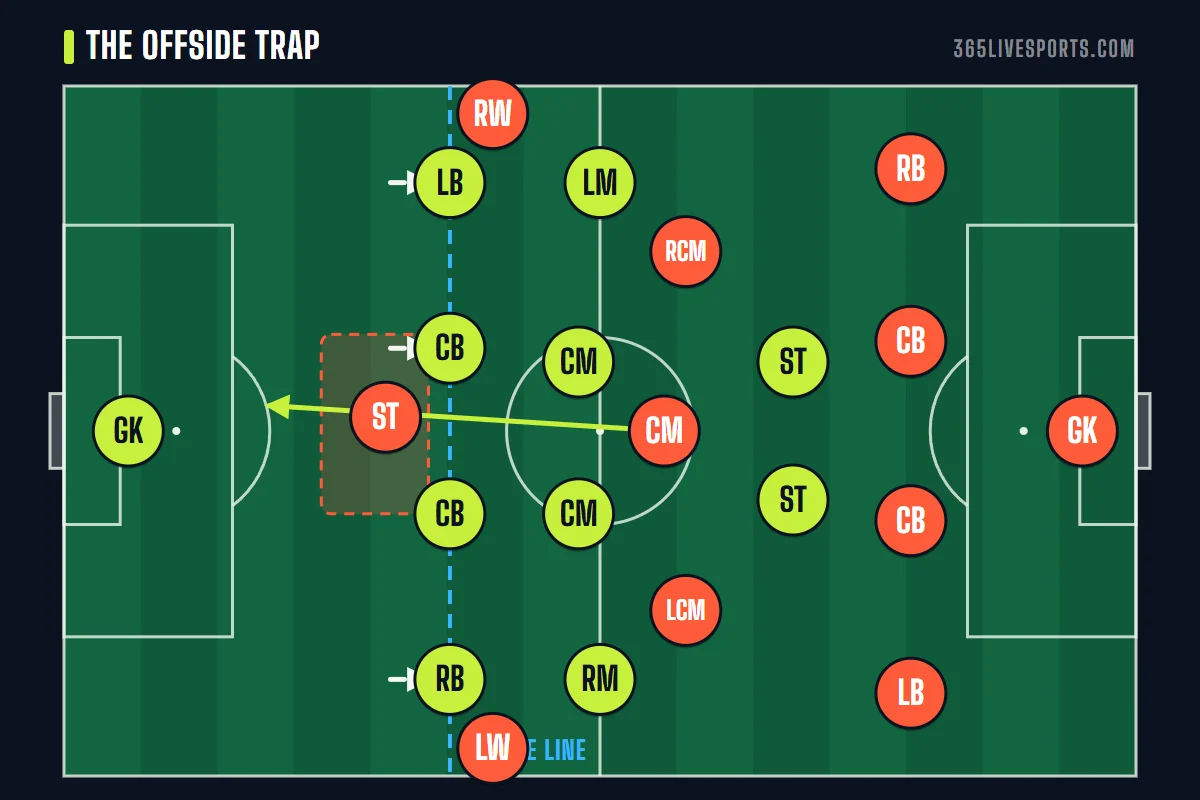
The offside trap is a defensive move in which the back line steps forward together just before an opponent passes, so that an attacker who stays still ends up in an offside position and the referee stops play. Done well, it wins the ball back without a tackle. Done badly, it leaves an attacker running clear at the goalkeeper.
To understand it you need the law first, so this page starts with offside in plain words. Then it covers how a back four sets the trap, who gives the signal, the risks, how good attackers beat it and a simple drill. Leagues and youth competitions may adapt some laws for younger age groups, so check your own rules.
Quick facts
What it is
The defensive line steps up together to catch an attacker offsideTiming
The step starts as the passer is about to strike the ballWho leads
Usually one center back, who calls the stepNeeds
A back line that moves as one and good communicationBiggest risk
One defender stepping late plays everyone onsideNo offside from
Goal kicks, throw-ins and corner kicks
What is the offside trap in soccer?
Picture the opponent's midfielder about to play a through ball to a striker standing level with your center backs. If your defenders stay where they are, the striker is onside and can run onto the pass. If all four step forward two or three yards a split second before the ball is played, the striker is now behind them, in an offside position, and the assistant referee raises the flag.
The trap is not a separate tactic you switch on and off. It is part of how a defensive line moves. Teams that defend with a high line use it constantly, while a deep team rarely needs it since the space behind it is small.
The offside law in plain words
Law 11 of the Laws of the Game has two parts: being in an offside position, and committing an offside offense.
- Offside position: an attacker stands offside when he is in the opposing half and some part of his head, body or feet is closer to the goal line he attacks than the ball and also closer than the second-last defender, goalkeeper included. Hands and arms do not count. Usually the goalkeeper is the last opponent, so the second-last is normally the deepest outfield defender.
- Level is onside. A player level with the second-last opponent, or with the ball, is not offside.
- Position is not an offense. The flag only matters once that attacker gets involved in active play: playing the ball, interfering with an opponent, or gaining an advantage.
- The moment that counts is when a teammate plays or touches the ball, not when the attacker receives it.
- No offside from a goal kick, a throw-in or a corner kick.
- A player in his own half cannot be in an offside position.
The full wording is on the IFAB website, which publishes the laws used around the world.
Setting the trap, step by step
- Hold a flat line. The back four stand level with each other, roughly 10 to 15 yards apart, watching the ball rather than the attackers.
- Read the passer. The signal is the passer's body: head down, hips opening, leg swinging back. If he has time and space to pick a pass, the trap is on.
- One voice calls it. The leading center back shouts a single agreed word, such as "up" or "step".
- Everyone steps at once. Two or three quick steps forward, together, squaring up so no one is deeper than the rest.
- Keep going if unsure. If the ball is played and the flag stays down, the defenders turn and chase; the goalkeeper must be ready to sweep.
Roles in the back line
| Player | Job |
|---|---|
| Leading center back | Watches the passer, makes the call, sets the height of the line |
| Partner center back | Stays level with the leader, covers if the trap fails |
| Full backs | Watch the center back and the ball, never stay deep on their own |
| Goalkeeper | Stands well off the line to sweep balls played in behind |
| Midfielders and forwards | Press the passer so he cannot pick a pass with time |
That last row matters more than most people think. A passer under no pressure can wait for the striker's run and beat any trap. The pressing guide explains how the front players take that time away.
Risks of the offside trap
The trap has a big downside: when it fails, the attacker is usually through on goal. The common ways it goes wrong:
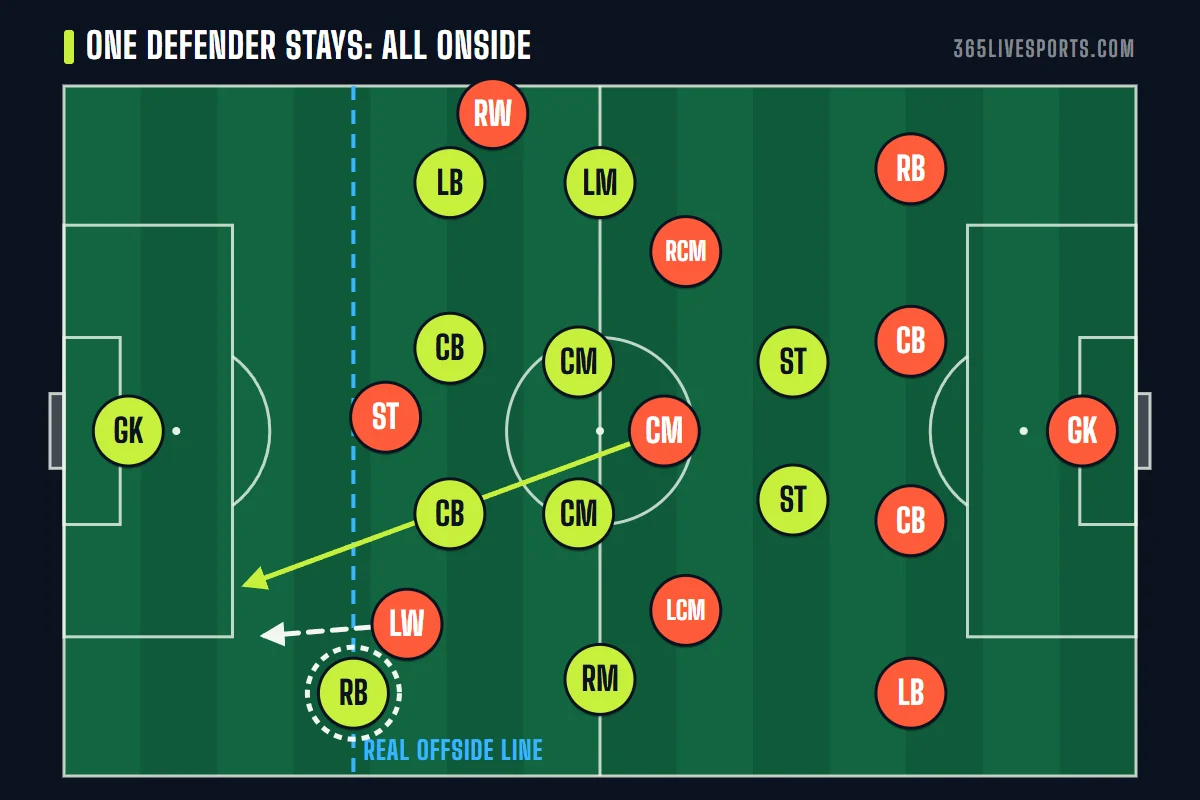
- One defender stays deep. As the second diagram shows, a full back who does not step plays every attacker onside.
- A runner from deep. A midfielder who starts behind the ball and runs past the line at the moment of the pass is onside.
- The dribbler. An attacker who carries the ball himself through the line cannot be offside.
- The officials miss it. At grassroots level there may be no assistant referees, and a close call can go either way.
How attackers beat it
If you are coaching forwards, teach them to stay level and curve the run: drift along the line, then bend the run behind the defender at the moment the passer strikes. Runs from a deeper starting point, arriving at speed, are even harder to catch. A striker can also drop short to pull one center back up, which changes the line and frees a teammate. And when the defense pushes up very high, a quick chip or a dribble through the gap often beats the trap outright.
Wingers who start wide and run diagonally inside are a constant problem for a high line, which is one reason the false nine movement works so well with fast wide forwards.
When to use the trap and when to drop
The trap suits teams that press high and want a short pitch, with the back line around halfway. It suits a quick defense with a goalkeeper who is comfortable far from his line. It suits poorly a slow back four or a team facing very fast forwards, where dropping deeper and protecting the space behind is safer. A team defending in a low block rarely sets a trap at all; its line is already close to goal.
Drill: one line, one voice
- Place a back four against three attackers and one passer in midfield, with a goalkeeper and a full-size goal.
- The passer dribbles toward the line, then plays a through ball whenever he likes.
- The center back calls the step; the line moves together. A coach or a spare player stands level with the line as an assistant referee.
- Each attacker caught offside earns the defenders a point; the attackers score by finishing.
- Once the line moves well, add a midfielder who presses the passer, and let the attackers start runs from deeper.
Film a few repetitions on a phone if you can. Seeing one defender a yard deeper than the rest explains the trap better than any talk.
Questions players and coaches ask
What is the offside trap in soccer?
A defending move: the back line steps forward together just before an opponent passes, leaving an attacker in an offside position. The referee then awards a free kick to the defending team.
Is the offside trap legal?
Yes. Defenders are free to move up the pitch at any time. The offside law only judges the attacker's position at the moment a teammate plays the ball.
Can you be offside from a throw-in or corner?
No. There is no offside offense if a player receives the ball directly from a goal kick, a throw-in or a corner kick.
Why is the offside trap risky?
If one defender steps up late or the attacker times the run perfectly, he is onside and through on goal with nobody behind the defense except the goalkeeper.
Is a player level with the defender offside?
No. Level with the second-last opponent, or level with the ball, is onside. The attacker has to be nearer the goal line than both to be in an offside position.
Should youth teams use the offside trap?
Teach the idea of a line that moves together, but do not build the whole defense on it. Many youth games have no assistant referees, and recovering runs are still the main skill to learn.