
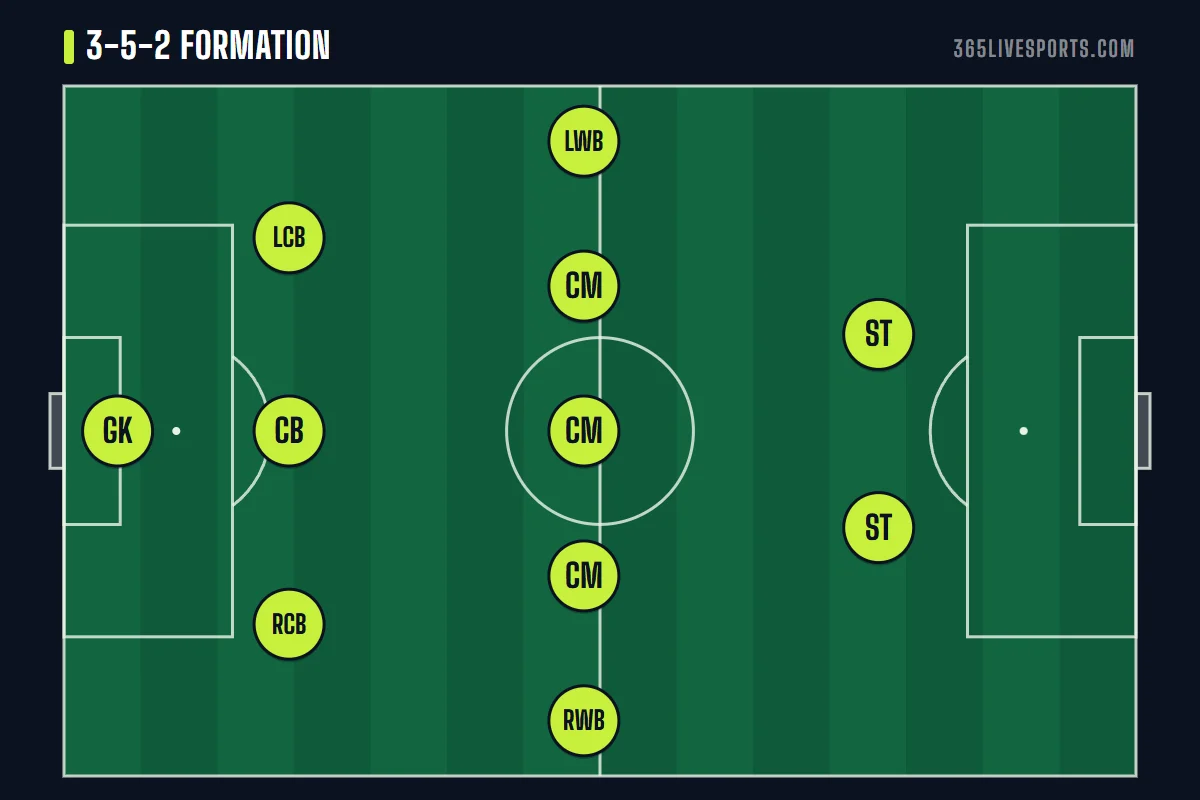
The 3-5-2 formation uses three center backs, a midfield five (one wing back hugging each touchline, a central trio between them) and a strike pair up front. Some coaching manuals write it as 1-3-5-2 so the keeper is counted.
What makes the shape special is the wing back. One player covers the entire flank, so the team gets the width of a back four's full back and a winger's attacking threat from a single body. That frees a spot for an extra center back and a second striker. When it works, the 3-5-2 owns the middle of the field; when the wing backs are pinned back, it turns into a deep 5-3-2. Below: both versions, each role, the soft spots, and drills to coach it.
Quick facts
Shape
A back three, a wing back on each side, a central trio and a front pair.Back line
A back three that becomes a back five when the wing backs drop.Best for
Winning central midfield and playing two strikers without losing cover.Weak spot
The flanks, when a winger and full back attack one wing back.Key players
The wing backs, who need the stamina to defend and attack the whole touchline.Good against
A 4-4-2, where the spare center back and midfield three both win their battles.
3-5-2 formation numbers and positions
Back three teams number their players less consistently than back four teams, so take this as one common version. Some sides keep 2 and 3 for the wing backs; others give those numbers to the outside center backs.
| No. | Role | Going forward | Protecting the goal |
|---|---|---|---|
| 1 | Goalkeeper | Passes into the back three or over the press | Sweeps behind the line, organizes the five |
| 4, 5, 6 | Three center backs | Outside two step into midfield or overlap; middle one stays | Middle one covers, outside two step out to wide forwards |
| 2, 3 | Wing backs | Give all the width, cross, arrive at the back post | Drop into the back line to make five |
| 8 | Holding midfielder | Takes the ball off the center backs and moves it to the far side | Sits in front of the middle center back |
| 7, 10 | Central midfielders | Run beyond the strikers, combine with the wing backs | Shuffle wide to help the wing backs, press the opposing midfield |
| 9, 11 | Strikers | One links play, one runs in behind; both attack the box | Press the center backs, split to block passes into midfield |
Open this shape on the interactive pitch near the top and push both wing backs up to the halfway line: you will see the back three left alone, which is exactly the moment the holding midfielder must stay put.
Attacking in a 3-5-2 formation
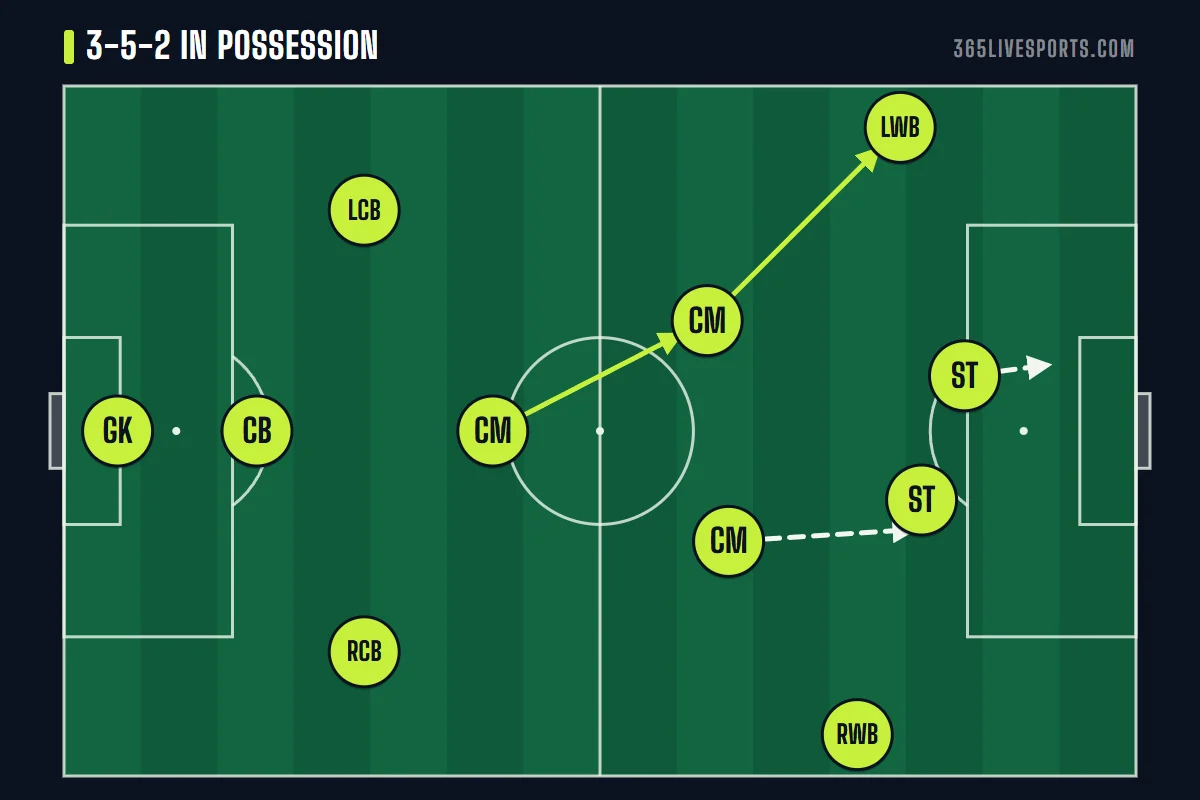
Going forward, the 3-5-2 wants five players across the front: the two wing backs on the touchlines, the two strikers in the middle, and one central midfielder arriving from deep. Behind them, the back three and the holding midfielder form a box that guards against counterattacks.
- Build with the back three. Against two strikers you have a free center back. Let the outside center back carry the ball into midfield until someone comes to stop him.
- Push the wing backs high. They should be level with the strikers by the time the ball crosses halfway. This pins the opposing full backs and stretches the back four.
- Overload one side. Wing back, the near central midfielder and one striker drifting wide create a 3v2 against their full back and wide forward.
- Cross for two. With two strikers and the far wing back, three players attack every cross, more than most shapes can manage.
- Keep the box behind. Three center backs and the holder never all go forward together.
Two strikers make a difference here. One can drop between the lines while the other runs, or both stay high to occupy two center backs and leave space for the midfielders to shoot from distance.
Is 3-5-2 a defensive formation? Defending as a 5-3-2
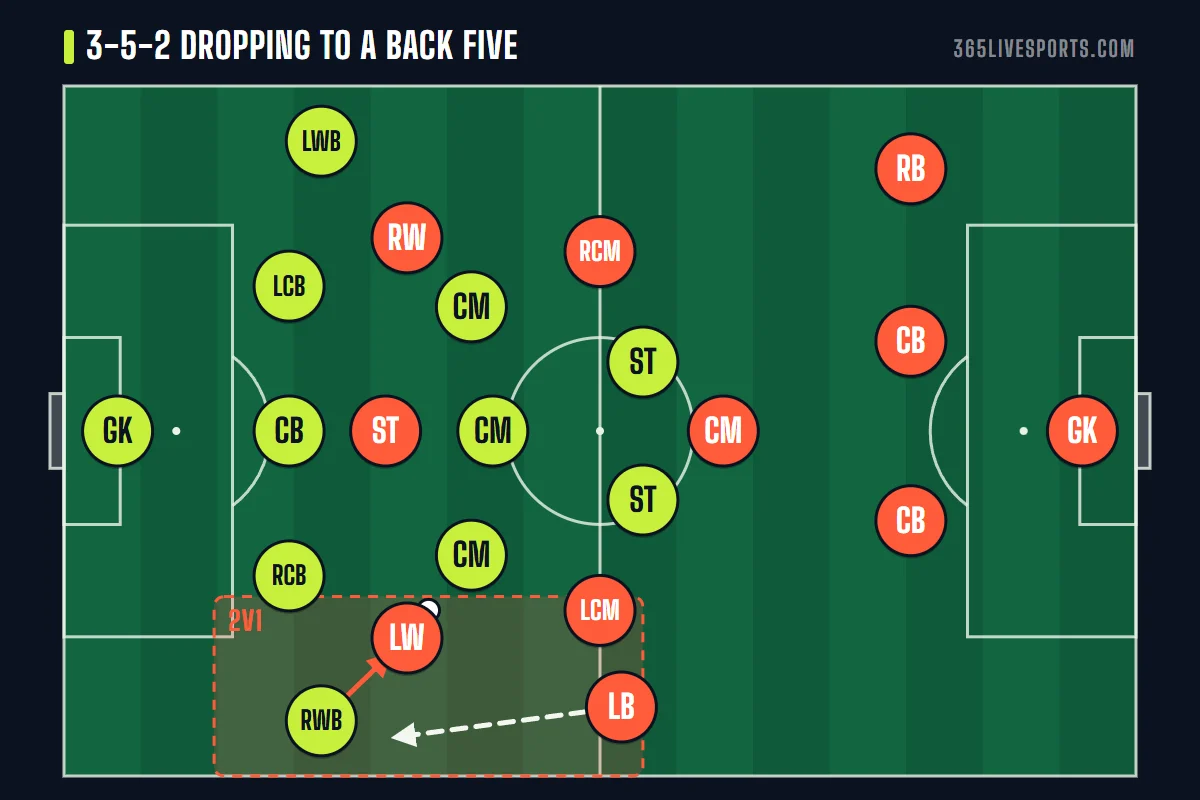
It can be either. The same eleven players can attack with five and defend with five, and how often the wing backs drop decides which. Against strong wingers, most 3-5-2 teams spend long spells as a 5-3-2, with the wing backs falling in beside the center backs, the midfield three slides across the pitch, and the two strikers stay up to start the counterattack.
- Who steps out: the outside center backs can follow a forward who drops into midfield, because two teammates are still covering the box. This is the big advantage of three center backs.
- Midfield sliding: three players cannot cover the full width, so they shift toward the ball and leave the far side to the far wing back.
- Strikers' job: they split to stop passes into the opposing holding midfielder and press only on a clear trigger, such as a back-pass to the keeper.
Variations of the 3-5-2
| Shape | How the midfield five sits | Choose it when |
|---|---|---|
| 3-1-4-2 | One anchor, then two eights level with the wing backs | You want the eights higher and one specialist screen |
| 3-4-1-2 | Two holders level with the wing backs, a 10 behind the strikers | You have a true playmaker |
| 5-3-2 | Wing backs stay deep almost all game | Protecting a lead or facing a much stronger side |
| 3-4-3 | One central midfielder becomes a third forward | You need goals and have quick wide forwards |
Inside the 3-5-2 itself, the biggest decision is the midfield triangle: one holder with two runners ahead (more attacking) or two holders with one runner (safer against counterattacks).
Strengths and 3-5-2 formation weakness
| Strengths | Weaknesses |
|---|---|
| Spare center back against a front two | Wing backs face 2v1s against a winger plus full back |
| Three central midfielders control the middle | A front three pins all three center backs, so nobody can step out |
| Two strikers stay high for counterattacks | Very demanding for the wing backs' fitness |
| Three players attack every cross | Gaps between wing back and outside center back on quick switches |
| Changes into a 5-3-2 without a substitution | Can become too deep and passive if the wing backs stop going forward |
Is 3-5-2 a good formation, then? Yes, if your three center backs are calm on the ball and your wing backs have big engines. Without those two runners it struggles badly.
Beating a 3-5-2: where to attack it
Attack the wing backs. Stack a winger plus a marauding full back on one side and the wing back has to pick one; switch play quickly so he never has time to get set. Play three forwards so all three center backs are busy and none of them can step out into midfield. And press the outside center backs when they receive, because they are often less comfortable on the ball than a full back would be.
The 4-3-3 is the most common answer, since its front three occupy the back three and its wingers pin the wing backs. Our best formation against each shape guide covers how to beat a 3-5-2 in more depth.
Coaching a back three and wing backs
- Talk across the three. The central one of the three runs the line. He calls when the line steps up and who goes with a dropping striker.
- Teach wing backs to read the far side. With play over on the opposite touchline, the far wing back tucks in almost to the back post. When it comes his way, he steps out.
- Give the holder one rule: never be in front of the ball when it is lost. That keeps the box behind the attack intact.
- Strike partners split the pitch. If both strikers chase the same ball, there is nobody to pass to when it is won.
Practice: wing back shuttles with a finish. On a full half pitch, a wing back receives from the outside center back, plays into a central midfielder, sprints the touchline and crosses for two strikers against two defenders. Then the defenders counter and the wing back must race back. Five reps each side shows you who has the engine for the job.
Should youth teams play a 3-5-2?
Usually not until players are comfortable in the full 11v11 game, which the US system introduces around under-13 once the small-sided years are done (check your league). Back threes do appear in the smaller games, especially nine-a-side, so players can learn to defend in a three early. See our 9v9 formations guide.
The wing back role is the hard part for young players: it needs stamina, defensive reading and good crossing all at once. Rotate several players through it rather than leaving one exhausted child on the touchline every week.
Questions players and coaches ask
What is a 3-5-2 formation in soccer?
Three center backs, a five-man midfield (two wing backs plus three central players) and a front two. The wing backs cover the whole flank, giving width in attack and dropping to make a back five in defense.
Is 3-5-2 a good formation?
It suits teams with strong center backs and fit wing backs. It controls the middle and lets you play two strikers. It is weaker against teams that attack the flanks with a winger and full back together.
Is 3-5-2 a defensive formation?
It can be. When the wing backs drop it becomes a 5-3-2, which is very defensive. When they push up it has five attackers across the front, so the shape is as attacking as the wing backs make it.
What are the 3-5-2 formation numbers?
One common version is 1 for the goalkeeper, 4, 5 and 6 for the center backs, 2 and 3 for the wing backs, 8 for the holding midfielder, 7 and 10 for the other central midfielders, and 9 and 11 for the strikers. Expect plenty of teams to number it differently.
Where is a 3-5-2 weakest?
The flanks. A wing back facing an opposing winger and an overlapping full back is outnumbered, and quick switches of play can catch the wing backs out of position. A front three can also pin all three center backs.
What is a 1-3-5-2 soccer formation?
It is the 3-5-2 with the goalkeeper written first. Coaching courses use this style to show the keeper as part of the team shape.