
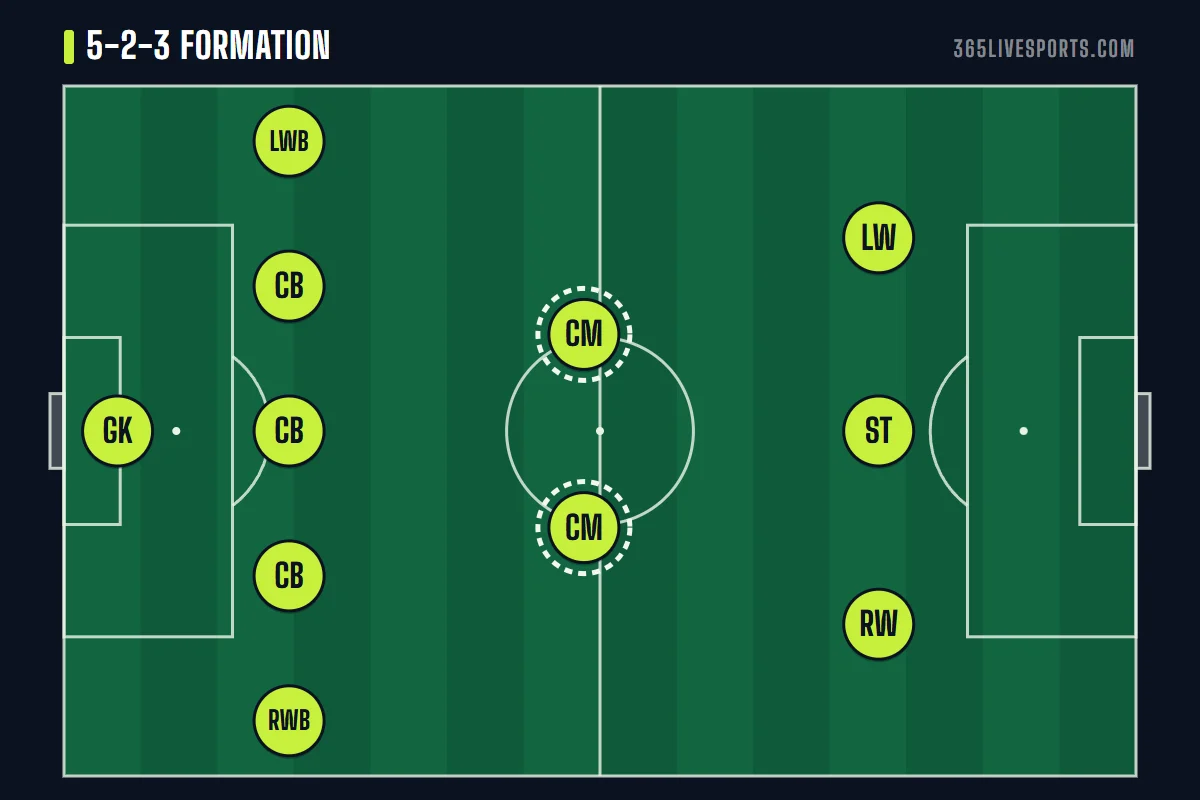
The 5-2-3 formation sets five defenders across the back (three center backs and two wing-backs), two central midfielders in front of them and three forwards up top. You will not find many teams listing it on the team sheet. It mostly appears as the defending picture of a wing-back system: a side that attacks as a 3-4-3 drops its wing-backs and becomes a 5-2-3 whenever the other team is in possession. It also shows up with youth teams that want a safe back line and three players left up for the counter. Here is how it is built, what each player does and why the midfield two is both its engine and its weakness.
Quick facts
Shape
3 center backs plus 2 wing-backs, 2 central midfielders, 3 forwardsSame players as
A 3-4-3, with the wing-backs sitting deeperBest for
Counter attacks with three forwards always readyWeak spot
Central midfield, where two players face threeKey players
The two central midfielders and the wing-backsHard matchup
A diamond, or any 4-3-3, flooding the middle
The 5-2-3 formation, line by line
Five defenders form the back line, with the wing-backs level with or just ahead of the three center backs. Two central midfielders stand about 10 yards in front of the defense and close to each other. Three forwards, a central striker and two wide forwards, stay high, often near the halfway line when the team is defending deep.
That leaves a long distance between the midfield two and the front three. Drag the forwards back a few yards on the board above and you will see the team become more compact, but less dangerous on the break.
Is it just a 3-4-3 by another name?
Mostly, yes. The same eleven players can be described three ways depending on where the wing-backs stand at that moment. That is why the 5 2 3 formation is rare as a label but common as a picture.
| Name | Wing-backs stand | When you see it |
|---|---|---|
| 5-2-3 | In the back line | Defending, especially against wide attacks |
| 3-4-3 | Level with the central midfielders | Balanced moments, midfield build-up |
| 3-2-5 | Level with the forwards | Full attack, pinning the opponent's back line |
If your team plays with wing-backs, you are already playing all three. Coaching the transitions between them is the real work.
Where the 5-2-3 soccer formation turns up
- Wing-back systems without the ball. A 3-4-3 side retreats to a 5-2-3 when pressed back, keeping its front three high.
- Protecting a lead with a sting. A coach who wants five defenders but refuses to give up on counters keeps three players forward.
- Youth soccer. At 11v11 some youth coaches use it to make the back line safe while giving three attackers plenty of space to run into.
- Against a strong wide team. Five defenders mean each opposing winger meets a wing-back and a wide center back.
Jobs across the team
Back three
The middle center back organizes and covers. The outside center backs are free to step out aggressively because there is always a teammate behind them.
Wing-backs
They defend the flank first, then push forward when the ball is won. Expect them to cover 60 yards of touchline many times a game.
Midfield two
One screens, one carries. Both must stay connected: never more than 15 yards apart, never both on the same side of the ball.
Front three
The striker holds the ball up and the wide forwards attack the space behind the opponent's full backs. Without the ball, they decide where the opponent can build: press the center backs or block passes into midfield.
Breaking forward from a back five
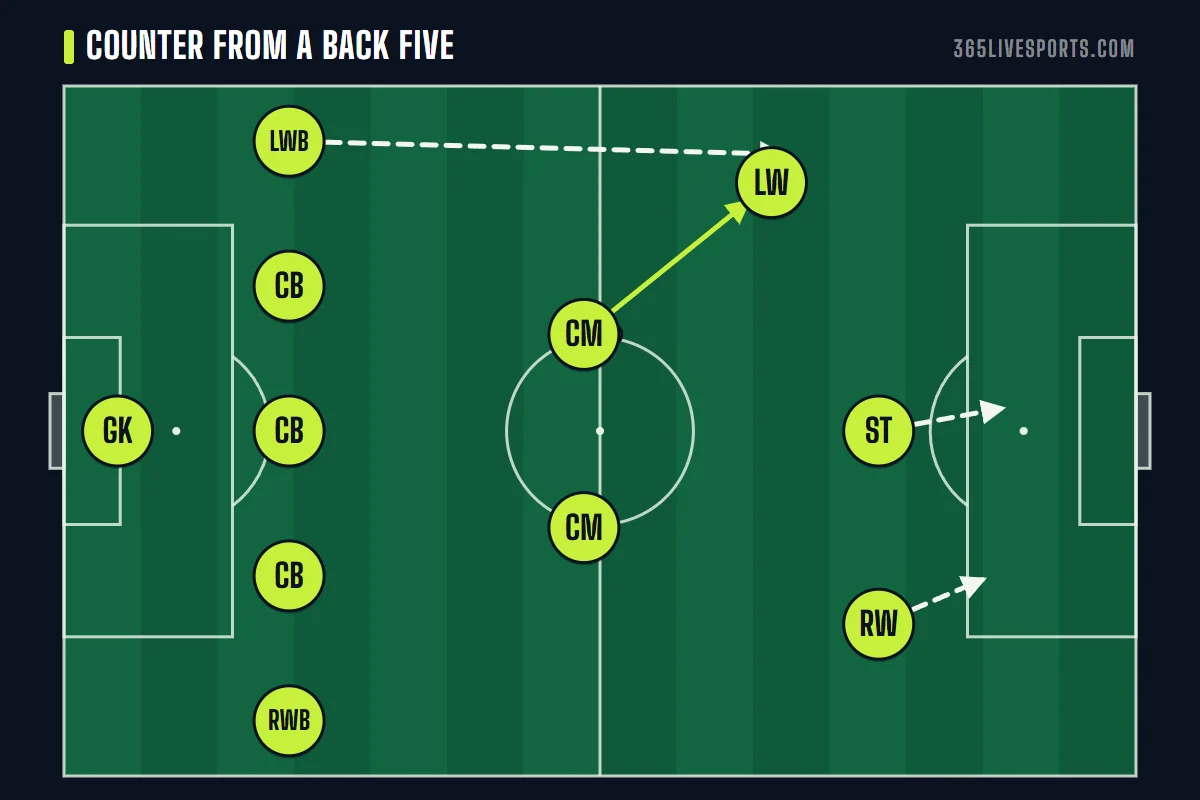
The best attacks in this shape are fast. The ball is won deep, a midfielder or center back plays it forward early, and three forwards attack a defense that is still moving. If the counter is not on, the team settles and the wing-backs push up, turning the shape into a 3-4-3 and then a 3-2-5.
One key movement: as the ball goes forward, the outside center back on the ball side steps up into midfield. That gives the team a third midfielder and stops the opponent from countering through the gap.
The midfield problem, and how to defend it
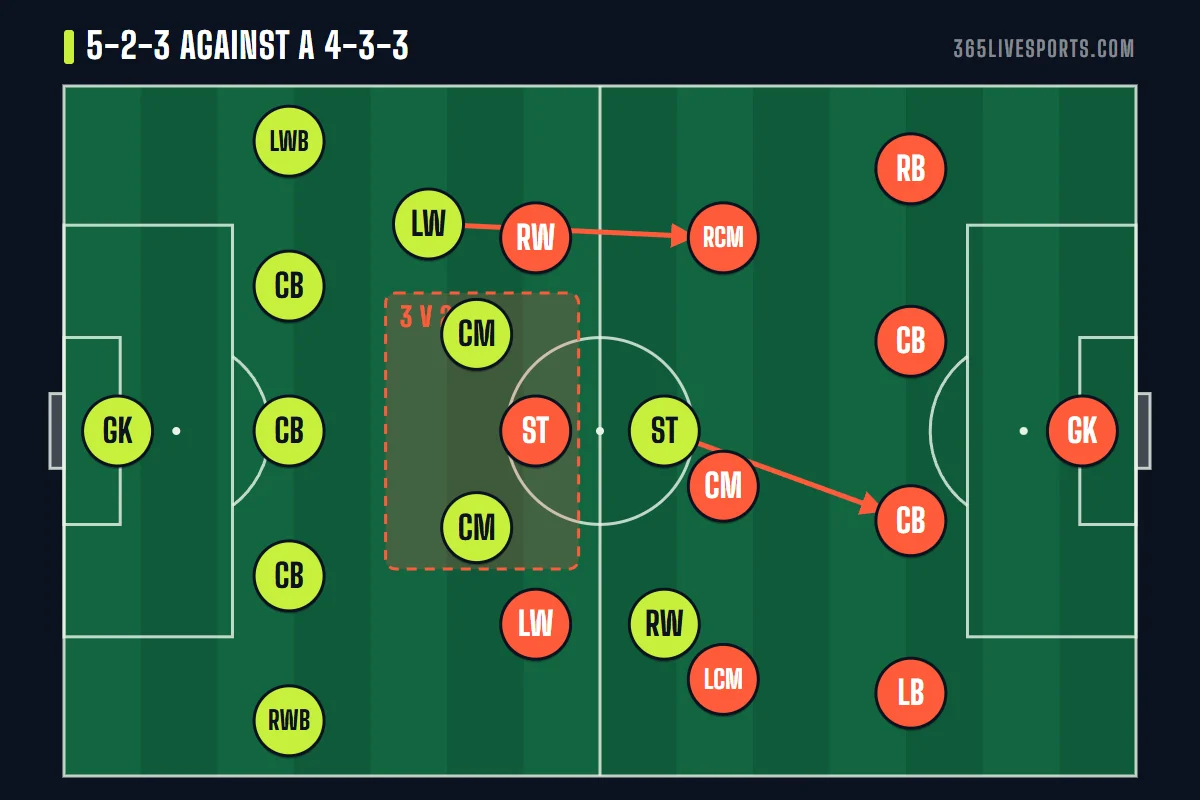
Against a midfield three, the 5-2-3 is outnumbered in the center. If the front three stay high, the opponent's 8s find space either side of your two midfielders. There are three common fixes:
- Drop one wide forward into midfield on the ball side, making a 5-3-2 shape for that phase.
- Let an outside center back step up into midfield when an opposing 8 receives between the lines, trusting the other four defenders to cover.
- If it keeps happening, switch to a 5-3-2 or a 5-4-1 and accept fewer counters.
Pros, cons and who should use it
Pros: five defenders cover the width of the box, three forwards are always ready to counter, and the back three can defend aggressively because there is always cover.
Cons: two central midfielders cover a huge space, the wing-backs get tired, and the team can be pushed back for long spells if the forwards cannot hold the ball.
Use it if you have three good center backs, two fit wing-backs and fast forwards. It suits teams that expect less possession. If your strength is a passing midfield, a 4-3-3, or perhaps a 3-5-2, will serve you better.
Questions players and coaches ask
What is a 5 2 3 formation?
Five defenders (three center backs and two wing-backs), two central midfielders and three forwards. It is mostly the defensive shape of a team that plays with wing-backs.
Is the 5-2-3 the same as a 3-4-3?
Yes, in terms of personnel. What changes is the height of the wing-backs: deep in the back line makes it a 5-2-3, level with the midfield makes it a 3-4-3.
Is the 5-2-3 soccer formation defensive?
The back line is defensive, with five players, but the front three keep it dangerous. It is best described as a counter attacking shape.
What is the weakness of the 5-2-3 formation?
The midfield. Two central midfielders face three in most opponents' shapes, so one forward or one center back must step into midfield to help.
Is the 5-2-3 formation soccer coaches use with kids?
Some youth coaches use it at 11v11 because the back line is safe and the forwards have space. Rotate players through every line so nobody learns only one job.