
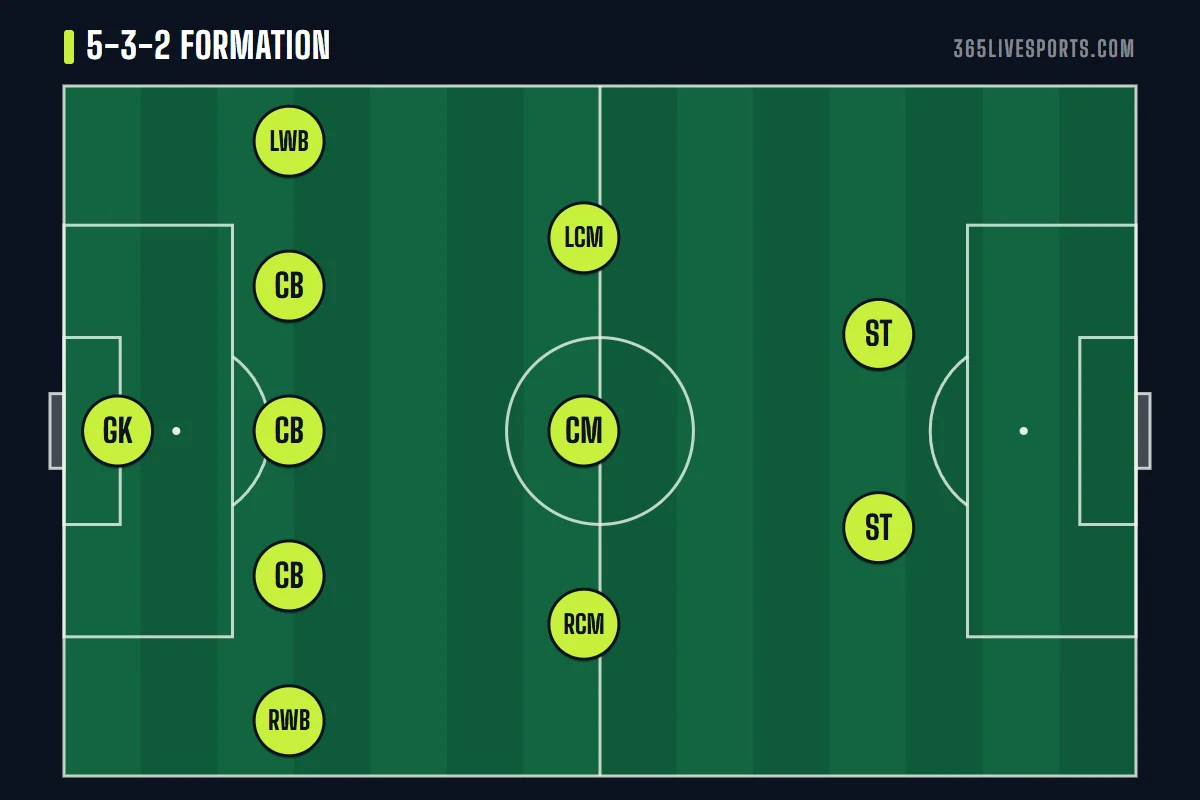
The 5-3-2 formation uses five defenders (three center backs plus a wing-back on each flank), three central midfielders and two strikers, so it is crowded in front of its own goal and dangerous on the break. Coaches reach for it when they expect to have less of the ball, when they want to protect a lead, or when their best players are defenders rather than creators.
People sometimes call it the defensive twin of the 3-5-2. On paper the players are identical; the difference is where the wing-backs live. In a 5-3-2 they start level with the center backs and only push on when the team is clearly in control. Below I go through each position, how the block defends, how it counterattacks, its weak points and how to coach it.
Quick facts
Shape
Back five (3 center backs, 2 wing-backs), midfield three, front twoPhilosophy
Defend the box first, then break quickly through the strikersBest for
Underdog matches, protecting a lead, teams with strong center backsWeak spot
Wide midfield areas in front of the wing-backs, and little pressure high upKey players
Wing-backs and a striker who can hold the ball upMatchup
Comfortable against two strikers; stretched by a wide 4-3-3
The 5-3-2 formation diagram explained
Count the outfield players from the goal outward: five, three, two. That makes ten, and the goalkeeper is the eleventh. The three center backs stand close together across the width of the penalty area. The wing-backs sit just outside them. In front, a midfield trio covers the middle third, and two strikers stay high so the opposition cannot push everyone forward.
Notice what is missing: no wingers. The space between the wing-back and the wide central midfielder is the first thing an opponent will look at. Move the shape around on the tactics board above the article, especially the wing-backs, and you will see how quickly a five turns into a three when they step up.
Positions in a 5-3-2 and what each player does
| Role | Defending | Attacking | Common mistake |
|---|---|---|---|
| Central center back (sweeper role) | Covers behind the other two, organizes the line | Plays the first pass, switches the point of attack | Dropping too deep and playing everyone onside |
| Outside center backs | Mark strikers, step into the channel when a wing-back goes | Carry the ball forward into midfield | Getting pulled to the touchline and leaving the box empty |
| Wing-backs | Defend the flank like full backs | Provide all of the team's width and crosses | Both attacking at once |
| Holding midfielder | Screens the center backs, blocks passes into the striker | Links defense to the front two | Chasing the ball into wide areas |
| Two shuttling midfielders | Slide across to the flank to stop crosses early | Arrive in the box late, support counters | Staying central and letting a full back walk forward |
| Target striker | Screens the deepest opposition midfielder | Holds the ball, wins headers, brings others into play | Drifting so far that clearances have no target |
| Running striker | Presses the center back with the ball | Spins in behind on the counter | Waiting for the ball instead of moving early |
For the general job descriptions behind each role, our defense positions page goes deeper.
Why coaches choose a defensive football formation like this
The 5-3-2 is one of the most reliable ways to shut down the zone around your own goal. With five across the back, crosses meet three center backs instead of two, and the wing-backs can mark wingers tightly because there is cover inside them. The Italian catenaccio tradition built a whole philosophy around this kind of extra defender, and the 5-3-2 is its modern, more practical relative.
It also makes life simple for the players. Each defender has a clear zone, the midfield three slide as one unit, and the two strikers know their job is to stay ready for the counter. Underdog teams like that clarity. If you want to understand the whole idea of defending deep, read our low block guide, since this back-five shape is how most sides set one up.
Holding the block when the opponent has the ball
Without the ball the 5-3-2 usually sits as a 5-3-2 mid block, with the front line about 10 yards inside the opposition half. The two strikers stay narrow and block passes into the middle; they let the opposition center backs have the ball wide.
The midfield three is where the work happens. Once a pass reaches their full back, the near-side midfielder slides out to him, the middle one covers the gap behind, and the far-side one tucks in. The wing-back then decides: step up to the winger if he receives with his back to goal, or hold if the winger is facing forward. Short distances matter here: keep about 10 to 12 yards between defenders and the same between the defense and midfield.

Breaking out: how a 5-3-2 attacks
Most goals in this system arrive on the counter. When the ball is won, the first look is forward to the strikers: one shows short to receive, the other runs into the space behind. A shuttling midfielder and the near wing-back sprint to support, which gives a 4v3 or 4v4 break before the opposition can recover.
In slower attacks the wing-backs move up to the halfway line or beyond, and the shape looks like a 3-5-2. One center back can step into midfield. The goal is to get the ball wide to a wing-back with time to cross, because two strikers plus a midfielder arriving late give three targets in the box.
- Counter in no more than four or five passes.
- Cross early when the opponent's defense is still turning.
- Leave three defenders back at all times as protection against their counter.

5-3-2 formation weakness and how teams exploit it
| Problem | Why it happens | The fix |
|---|---|---|
| Opponent full backs get free time | Only three midfielders to cover the full width | Shuttlers slide early; strikers block the inside pass so play goes wide slowly |
| No pressure on their build-up | Two strikers cannot press four defenders | Press only on a trigger, such as a bad touch or a pass back to the keeper |
| Strikers isolated | Team defends too deep, nobody supports them | Push the block up 10 yards; one shuttler must join every counter |
| Back five drops into the six-yard box | Fear of balls in behind | Keep the line near the top of the penalty box and let the keeper sweep |
The opponents that cause the most trouble are wide teams in a 4-3-3 who use full backs and wingers on both flanks to create 2v1s against the wing-back. Against a narrow 4-4-2 diamond, on the other hand, the 5-3-2 is very comfortable.
Telling a 5-3-2 from a 3-5-2
They are the same eleven players arranged with a different attitude. Call it a 5-3-2 when the wing-backs mostly defend and a 3-5-2 when they live in midfield. Many teams do both in one match: 3-5-2 when they have the ball, 5-3-2 when they do not. The 3-4-3 is the more attacking member of the same family, swapping a midfielder for a third forward.
Teaching the 5-3-2 to young players
Most US youth programs only reach 11v11 at around U13, after small-sided games, 7v7 around U9 to U10 and 9v9 at U11 to U12; leagues and clubs still set their own rules, so check yours. Even at 11v11 I would not make a young team play deep all game. Use the 5-3-2 as a second shape that players learn for the last part of a close match.
A good session to teach the block:
- Set up eight defenders (five plus three) against seven or eight attackers on a half pitch.
- The attackers try to score; the defenders win a point each time they get the ball through one of two small gates on the halfway line.
- Stop play often and check the distances: no more than about 12 yards between any two neighbors in the back five.
- Rotate players through the wing-back spots so everyone learns how much running the role demands.
Questions players and coaches ask
Is 5-3-2 a good formation?
It is a very good defensive formation, especially for a team that expects to have less of the ball. It is less suited to teams that want to dominate possession, because only three midfielders cover the full width.
What is the biggest 5-3-2 formation weakness?
The wide areas in midfield. Opposition full backs often get time on the ball, and if the wing-back steps out to them the back five becomes a back four with a gap in it.
Is the 5-3-2 a defensive formation?
Mostly yes. Five defenders and a midfield three make it hard to break down, but two strikers and attacking wing-backs mean it can still score, mainly on the counter.
What is the difference between 5-3-2 and 3-5-2?
The players are the same; the wing-backs play deeper in a 5-3-2 and higher in a 3-5-2. Many teams switch between the two during a game depending on who has the ball.
How do you beat a 5-3-2?
Stretch it with width on both flanks, use full backs to overload the wing-backs, and switch play quickly so the midfield three cannot slide across in time. Long-range shooting pays off too, because the block often sits deep.
Can youth teams play a 5-3-2?
Only once they play 11v11, which is usually from U13 in the US. Younger teams play small-sided formats where a back five does not exist, and even older youth players benefit more from learning to attack.