
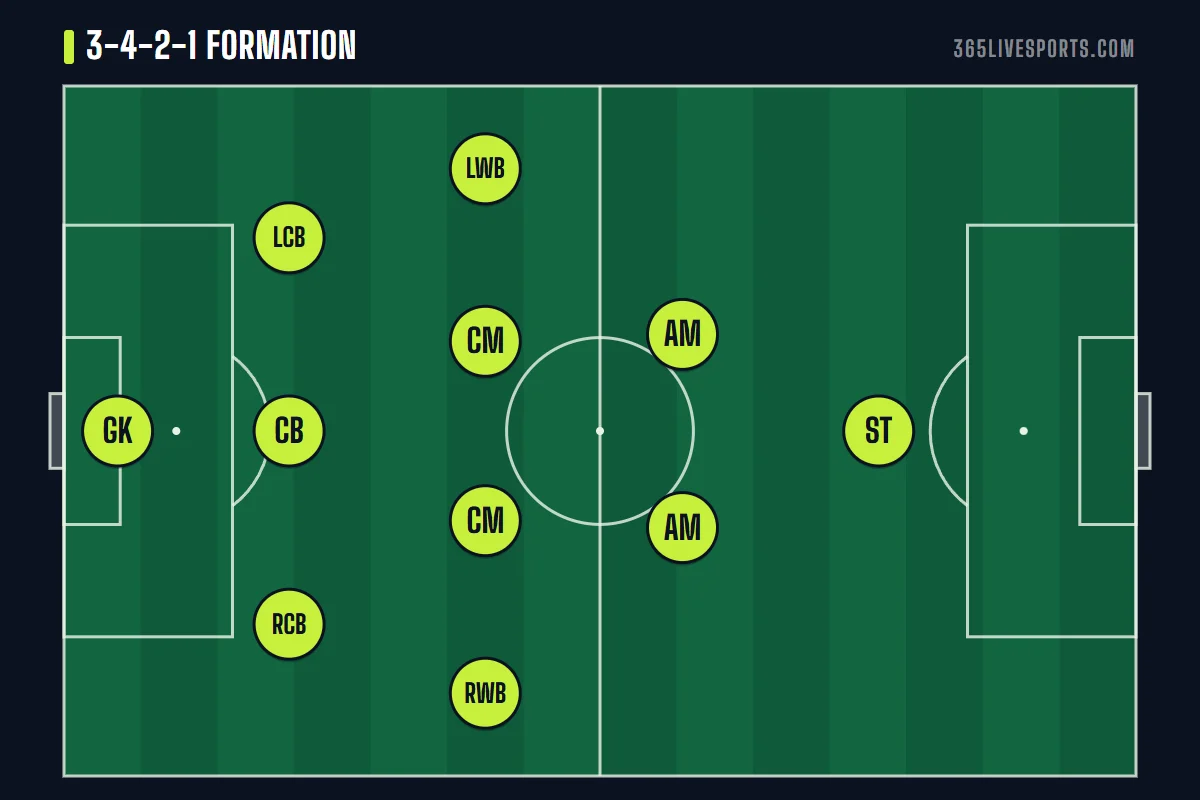
The 3-4-2-1 formation uses three center backs, four across the middle (two wing-backs hugging the touchlines, two central midfielders between them), then two attacking midfielders sitting just behind a single striker. Those two players in the second row are the heart of it: they live in the channels between the opposition full backs and center backs, which is why coaches sometimes call them inside forwards or twin tens.
On a team sheet it looks like a tidier version of the 3-4-3, and in many matches the two are hard to tell apart. The difference shows in the details: the 3-4-2-1 keeps its attackers narrower and closer to the striker, which helps combination play and makes it easier to drop into a compact 5-4-1. Below you will find the positions, the main patterns, the weak spots and practical coaching notes.
Quick facts
Shape
3 center backs, 2 wing-backs, 2 central midfielders, 2 tens, 1 strikerDefends as
5-4-1, with the tens dropping beside the midfield pairBest for
Teams with two clever inside attackers and tireless wing-backsWeak spot
Wide spaces behind the wing-backs and a lonely strikerKey players
The two tens and the wing-backsClose relatives
3-4-3, 3-4-1-2 and the 3-2-4-1 build-up shape
3-4-2-1 formation positions at a glance
Reading upward from the goalkeeper: a back three, a band of four across the middle, a pair of attacking midfielders and a center forward. That is 3 + 4 + 2 + 1, the ten outfield players. Shirt numbers vary a lot with this shape; a common way is 4, 5 and 6 in the back three, 2 and 3 as wing-backs, 6 or 8 in the double pivot, 10 and 7 or 11 for the tens and 9 for the striker.
Look at how the shape layers. Each line has a gap that the next line covers, so passes can travel diagonally from wing-back to ten to striker. Play with the board above this guide: pull one ten wide and the formation becomes a 3-4-3; drop both and you have the 5-4-1 it uses to defend.
Jobs for every player in the shape
| Player | In possession | Out of possession | Watch out for |
|---|---|---|---|
| Middle center back | Starts build-up, plays diagonals to the wing-backs | Organizes the line, covers behind | Stepping out and leaving the middle open |
| Outside center backs | Dribble forward into free space if nobody presses | Defend the channels when the wing-back is high | Being dragged to the corner flag |
| Wing-backs | Hold the width high up the pitch | Drop into a back five | Arriving late back after an attack |
| Central midfielders | One drops to help build, one supports the tens | Screen the center, win second balls | Both going forward together |
| Tens (inside forwards) | Find pockets inside, face goal, link with the 9, shoot | Drop beside the midfield pair, press the full backs | Drifting into the wing-back's lane |
| Striker | Pins the center backs, holds up, finishes | Presses alone, cuts passes into the opposition holder | Being isolated with no runner near him |
Each of these names is explained in plain words in our 11v11 positions guide.
Why the two tens make it work
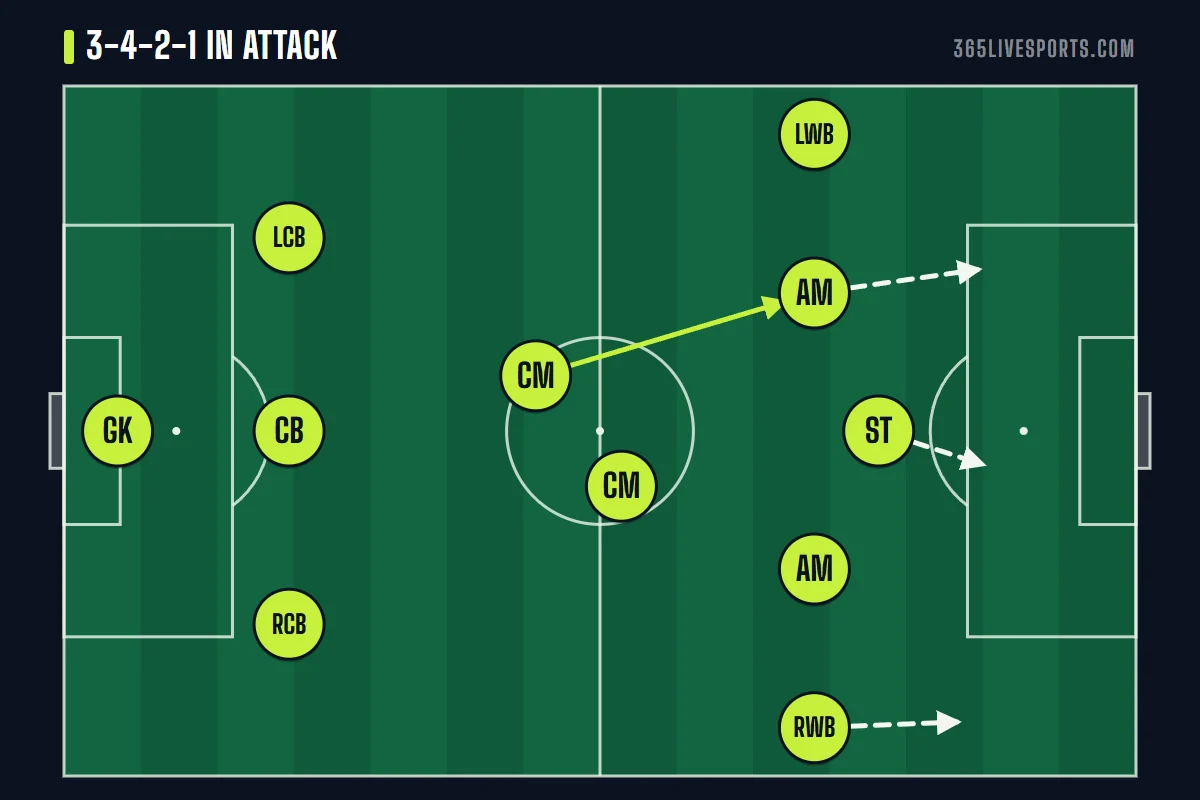
Most of the attacking threat comes from the pair behind the striker. Each one stands in the half-space, the lane separating their full back from their nearest center back. From there he can receive facing goal, run in behind the full back, or combine with the striker in a tight triangle.
Meanwhile the wing-backs pin the opposition full backs by staying wide and high. That creates a simple problem for the defense: if their full back steps inside to the ten, the wing-back is free; if he stays wide, the ten turns. Teaching the tens to read that choice is most of the coaching work.
- The ten on the ball side shows for the pass; the far ten attacks the box.
- The striker drops occasionally to drag a center back out, and a ten runs into the gap.
- Crosses come from the wing-backs; the tens and striker fill the near post, far post and penalty spot.
Defending in a 5-4-1 block
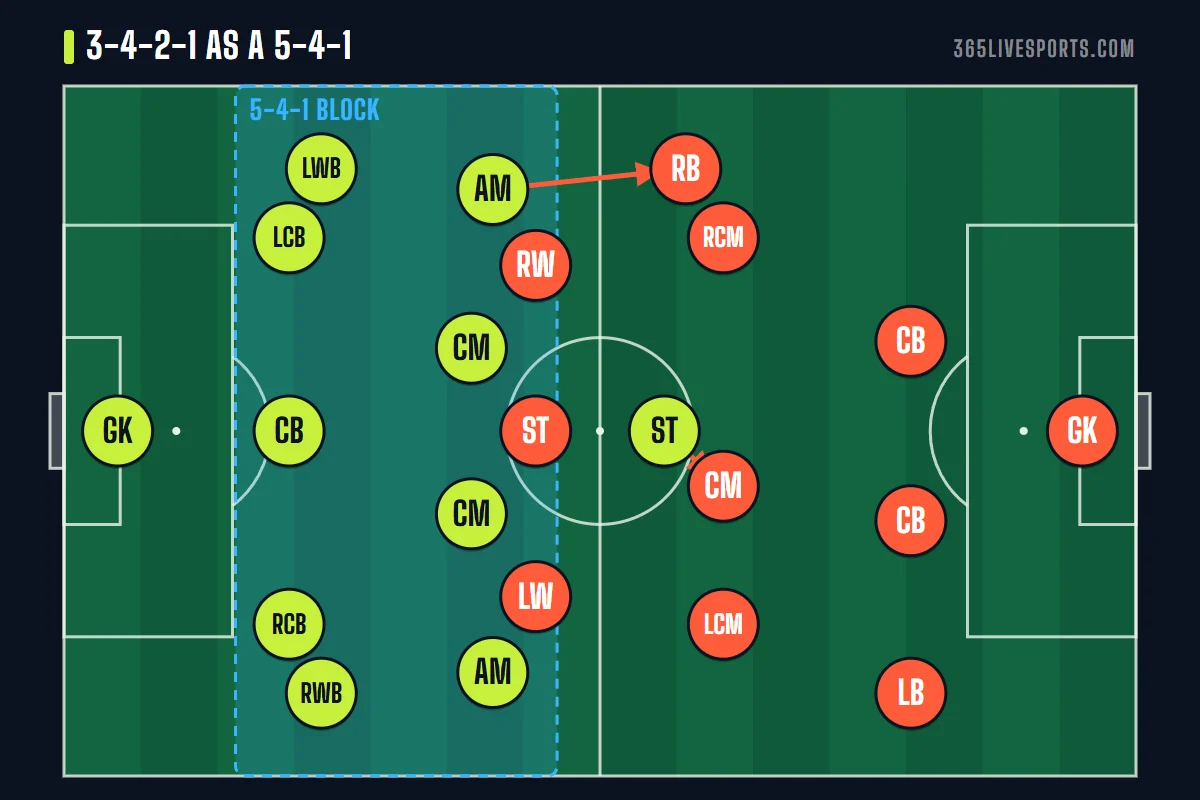
Once a counter-press fails, the 3-4-2-1 drops into one of the tidiest defensive shapes in soccer. The wing-backs join the back three to make five; the tens fall back beside the two central midfielders to make four; the striker stays up. Nine players behind the ball, all in compact lines.
The question is how high to defend. A deep 5-4-1 is very hard to break but leaves the striker alone, so counterattacks rarely work. Defending in a mid block, striker roughly at halfway, lets the tens press the opposition full backs and keeps them closer to goal when the ball is won. Our low block page explains how deep defending works in general.
3-4-2-1 formation weakness and how teams expose it
| Weakness | How opponents exploit it | Fix |
|---|---|---|
| Space behind the wing-backs | Quick switches and balls into the channel after you lose the ball | Outside center backs defend the channel; far wing-back stays deeper |
| Lone striker | Two center backs mark him, the third steps into midfield | A ten runs beyond him on every attack |
| Two central midfielders | A midfield three overloads the double pivot | One ten drops in to make three, or a center back steps up |
| Tired wing-backs | Fresh wingers attack them late in the match | Substitute early; agree that only one wing-back attacks at a time |
How the twin-ten shape relates to other back threes
The 3-4-3 plays its two wide attackers as true wingers near the touchlines; the 3-4-2-1 brings them inside. The 3-4-1-2 flips the front three, using two strikers with a single ten behind. And when a 3-4-2-1 team builds from the back with one midfielder dropping, it often looks like a 3-2-4-1 in possession. These are all close relatives, and good teams move between them during a match.
Coaching notes, from youth to adult teams
The full shape needs eleven players a side, which most US youth teams reach around U13 after small-sided play for the youngest, 7v7 in the U9 and U10 years and 9v9 in the U11 and U12 years; check with your own league, as formats are set locally. Nine-a-side teams can mimic it with three defenders, two midfielders, two tens and a striker.
A practice for the tens and striker:
- Mark out the final third with two half-space lanes in cones.
- Play 3 attackers (two tens and a striker) plus two wing-backs against four defenders and a goalkeeper.
- The tens may only receive inside their lane; a goal from a pass into a lane counts double.
- Rotate players through all five attacking roles every few minutes.
Questions players and coaches ask
Is 3-4-2-1 a good formation?
With two clever attacking midfielders and fit wing-backs, few back-three shapes are better balanced. It attacks with width and central combinations and defends as a compact 5-4-1.
Which 3-4-2-1 formation weakness do opponents target?
The spaces behind the wing-backs and the isolation of the lone striker. Opponents with three central midfielders may also swamp the double pivot unless one ten drops in to help.
How is the 3-4-2-1 different from the 3-4-3?
In the 3-4-3 the two attackers beside the striker play wide like wingers. In the 3-4-2-1 they play narrower, behind the striker in the half-spaces, while the wing-backs give the width.
What are the 3-4-2-1 formation positions?
Behind everything is the goalkeeper. Then come three center backs, left and right wing-backs, a central midfield pair, two tens and a lone number 9. People also call the tens inside forwards.
How does a 3-4-2-1 defend?
It drops into a 5-4-1: the wing-backs join the back three and the two tens drop beside the central midfielders. Only the striker stays high.