

The 3-2-4-1 formation puts three defenders at the back, two holding midfielders in front of them, a line of four attackers (two wide players and two playmakers in the inside channels) and one striker. Here is the honest part: very few teams kick off in it. It is mostly the shape a side moves into once it has the ball, usually from a back four, when one full back steps inside into midfield or stays back as a third center back while the other pushes up. Out of possession, the same team drops back into a 4-4-2, a 4-1-4-1 or similar. This page explains how that change happens, why coaches want it and where it breaks.
Quick facts
Shape
3 defenders, 2 pivots, 4 attacking midfielders and wide players, 1 strikerWhen you see it
In possession, built from a back four or from a 3-4-2-1Main idea
Five players behind the ball, five in front of itBest for
Possession teams that want protection against countersKey player
The full back who steps inside to join the pivotWeak spot
Space outside the back three when the press is beaten
The 3-2-4-1 formation in one picture
Join the dots in midfield and you get a square: two pivots at the bottom, a pair of attacking midfielders on top. That square is why the shape is often called the box. Around it, three defenders hold the back, two wide players stand on the touchlines and one striker leads the line.
Every player sits in a different vertical lane, so the opponent cannot block two passing options with one defender. Pull the players into a back four on the board above, then push them back into this layout, and you will see how few steps it takes.
A shape you move into, not one you line up in
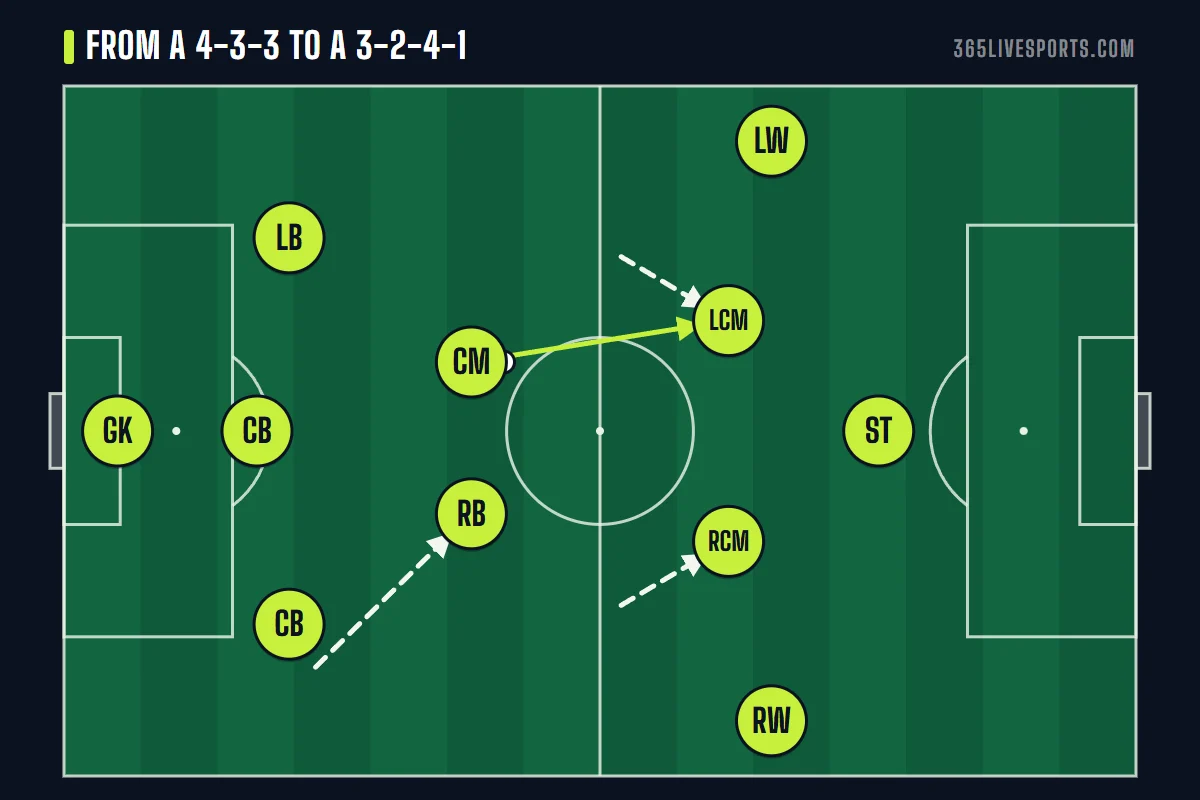
Most teams that attack in a 3 2 4 1 formation kick off with a back four, typically 4-3-3 or 4-2-3-1. When they win the ball and settle, players shift like this:
- One full back, often the right back, steps inside next to the holding midfielder. Now there are two pivots.
- The opposite full back holds his ground while the two center backs slide across, so the back four becomes a back three.
- The two central midfielders climb into the inside channels, between the opponent's full back and center back.
- The wingers stay wide and high, holding the width that the full backs used to give.
- The striker pins the center backs, so the four players behind him have room to receive.
Teams that already play a 3-4-2-1 reach the same shape more simply: one central midfielder stays deep with the other, while both wing-backs climb level with the two playmakers.
Who does what in the box
| Role | Usually played by | Job in possession | Job after losing the ball |
|---|---|---|---|
| Wide center backs | A center back and the full back who stayed | Carry the ball into midfield, cover the channels | Defend the wide space behind the wingers |
| Middle center back | A center back | Starts play, organizes the line | Marks the striker |
| Two pivots | Holding midfielder plus inverted full back | Receive under pressure, recycle, switch play | Counter-press at once or delay the counter |
| Two attacking midfielders | The 8s or a 10 | Receive between the lines, turn, slip passes | Press the nearest center back or pivot |
| Wide players | Wingers or wing-backs | Hold the touchline, go past their full back | Track back to restore the four-man defense |
| Striker | A 9 or a false nine | Pin defenders, link play, finish | Lead the press |
Why coaches like it: protection against counters
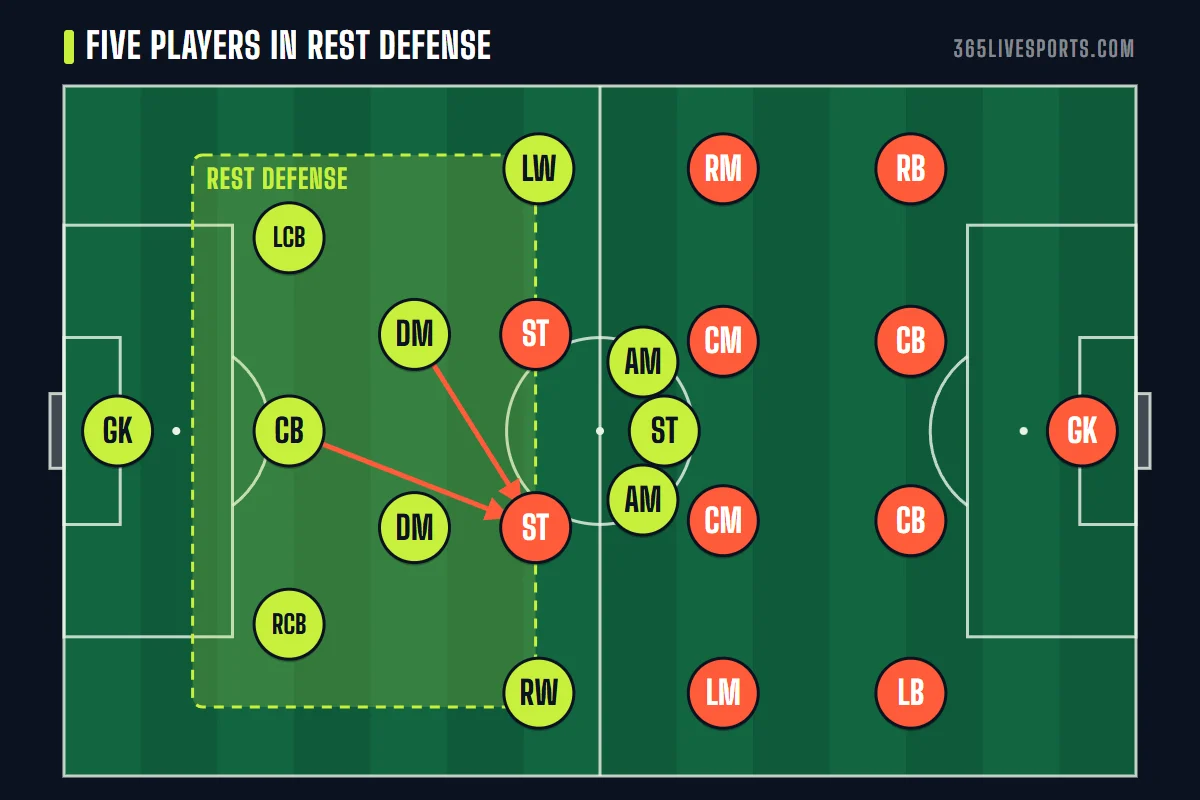
Coaches call the players left behind the ball the rest defense. In this shape it is five: three defenders and two pivots. When an attack breaks down, the opponent's counter usually meets a wall of five before it reaches the halfway line, and the two pivots can win the ball back within a few seconds.
That is the real attraction. You can push five players high (two wide, two inside, one central), which is enough to pin a back four, without leaving your center backs exposed to a two against two.
Strong points and soft spots
| Strong points | Soft spots |
|---|---|
| Five lanes filled, so the opponent cannot cover every passing line | Needs a full back who is comfortable in midfield |
| Five behind the ball keeps the team safe in transition | Space outside the wide center backs can be exposed by a quick switch |
| Two attacking midfielders between the lines create overloads | If the pivots are man-marked, build-up stalls |
| Easy to return to a back four without the ball | Takes coaching time; players must know exactly when to move |
How opponents beat it, and the answer
Two plans cause the most trouble. The first is to man-mark both pivots with a front two or a striker and a 10, which cuts the box off from the back three. The second is to steal possession and play it straight into the channel outside a wide center back, where a quick winger can run at a defender who is used to playing inside.
The fixes are simple to explain and hard to master. When the pivots are marked, one attacking midfielder drops into the space they have vacated, or the goalkeeper joins the build-up so the back three becomes a four. Against fast counters into the channels, choose a wide center back with pace and tell the nearest winger that his first job after losing the ball is a sprint back.
Should your team play a 3-2-4-1 formation
The 3-2-4-1 soccer formation suits teams that keep the ball and have at least one full back who reads the game like a midfielder. For most youth and amateur sides it is better taught as a progression: get comfortable with a 4-3-3 first, then add the single movement of a full back stepping inside.
For the attacking twin of this shape, with all five attackers in one line, read our page on the 3-2-5.
Questions players and coaches ask
What is the 3-2-4-1 formation?
Three defenders, two holding midfielders, four attacking players and a striker make up the layout. Most teams use it only when they have the ball, building it from a back four or a 3-4-2-1.
Is the 3 2 4 1 formation a real starting formation?
A few teams line up in it, but most move into it during build-up. On the team sheet the same side is usually listed as a 4-3-3 (sometimes a 4-2-3-1).
What is an inverted full back?
A full back who moves into central midfield when his side is in possession instead of running down the touchline. In a 3-2-4-1 that player becomes the second pivot next to the holding midfielder.
How is a 3-2-4-1 different from a 3-4-2-1?
They use the same players in nearly the same places. The difference is that in a 3-2-4-1 the wide players push up level with the two attacking midfielders, while in a 3-4-2-1 they sit level with the central midfielders.
What beats the 3-2-4-1 soccer formation?
A press that marks both pivots, combined with quick balls into the channels outside the back three. A team that counters fast with two wide forwards will test it most.
Can youth teams play the 3-2-4-1?
Older youth teams can, once they understand a back four. Start with one movement at a time and rotate players so several of them learn the inverted full back role.