
Youth soccer positions change with age: the youngest kids play tiny games with no fixed roles or goalkeepers, positions appear around U9 in 7v7, grow in 9v9, and reach the full set of 11 roles from about U13. The best youth programs keep moving kids around until their early teens instead of labelling them for good at seven.
As a coach of girls and boys teams from the youngest groups up to high school, I get the same question from parents every fall: "what position is my kid?" The honest answer for most ages is "several, and that is a good thing". This guide explains what children play at each stage, how to rotate them fairly and how to help them find a favorite role when the time comes.
Quick facts
Under 8
Small-sided games, usually 4v4 or smaller, no goalkeepersU9 and U10
7v7 with a goalkeeper: positions beginU11 and U12
9v9 with a goalkeeper: three linesU13 and up
11v11, the full adult layoutWho decides
Your league or club; national guidance is a starting pointGolden rule
Rotate positions until players are in their teens
Youth soccer positions start small
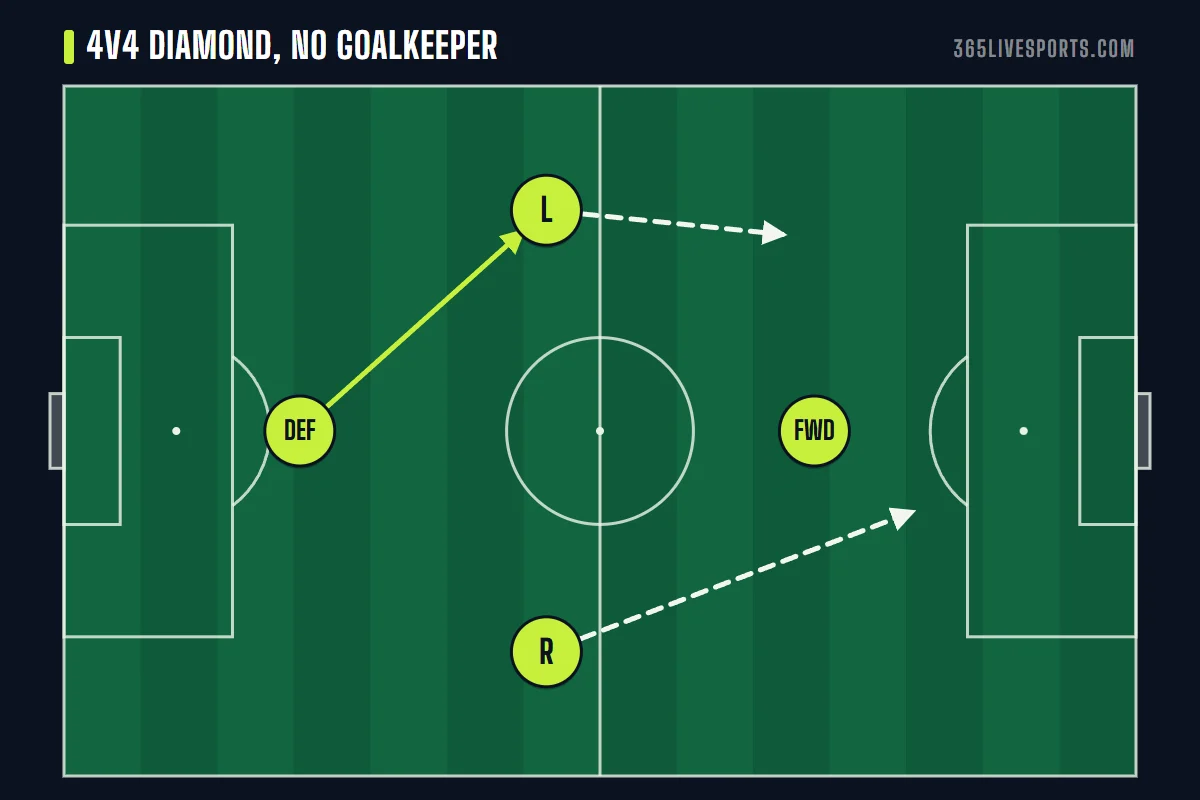
The youngest players do not play in formations at all. In 4v4 there is no goalkeeper, the field is small and every child is a defender and an attacker within the same ten seconds. Coaches who want a little structure use a diamond: one player at the back, one on each side and one at the front, with everyone rotating each game.
What matters at this age is touches on the ball. Small games mean every child gets dozens of them, makes decisions constantly and learns that soccer is about space and teammates, not standing on a spot.
Age groups and game formats
National small-sided guidelines in the United States follow a ladder. The format listed is the maximum, and smaller games are allowed at every age:
| Age group | Format | Goalkeeper | Positions to learn |
|---|---|---|---|
| U6 and younger | Small games such as 3v3 or 4v4 | No | None fixed: dribble, shoot, get the ball back |
| U7 and U8 | Up to 4v4 | No | Loose ideas of front, back and sides |
| U9 and U10 | Up to 7v7 (6 field players plus a keeper) | Yes | Defenders, midfielders, a forward and the keeper |
| U11 and U12 | Up to 9v9 (8 field players plus a keeper) | Yes | Three lines, wide and central roles |
| U13 and older | 11v11 | Yes | All the roles of the adult game |
Soccer positions for kids, stage by stage
U8 and younger
No keeper and no real positions. If you want a structure, use the diamond above and tell players "one of us stays back" so the team does not all chase the ball. Swap that player every few minutes.
U9 and U10 (7v7)
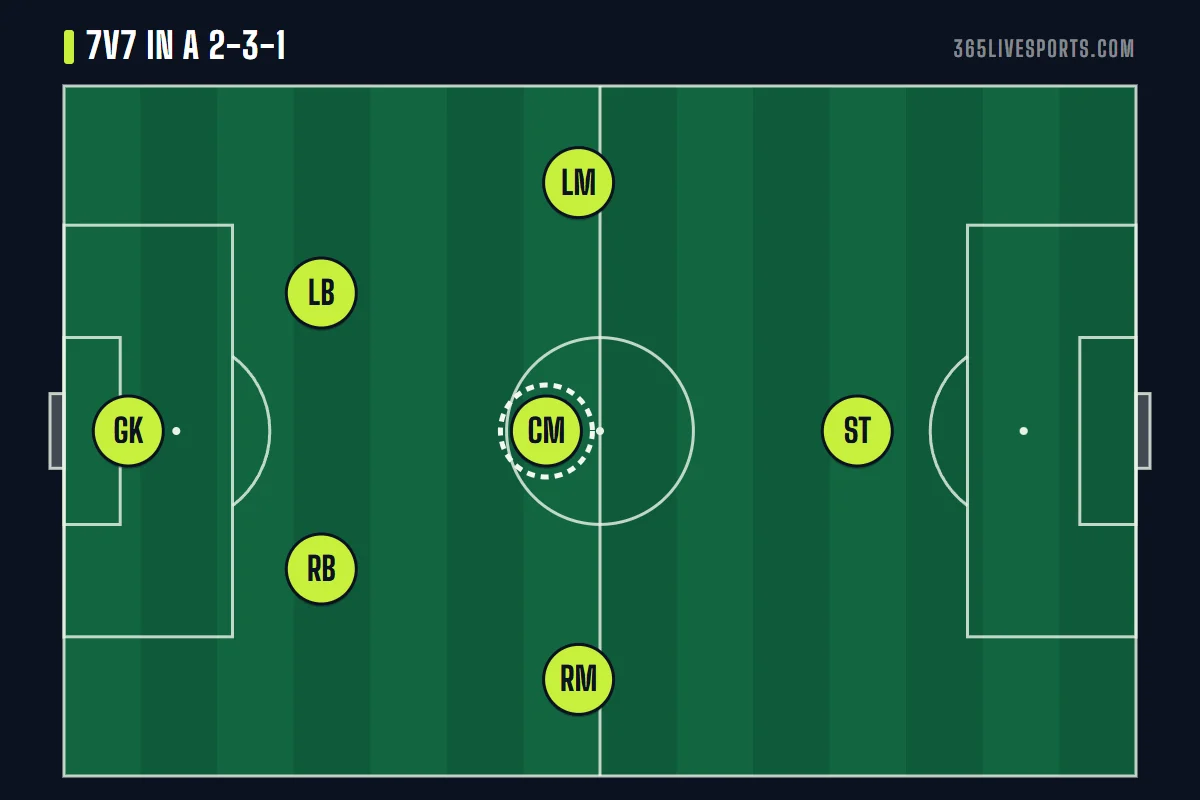
This is where positions start. A common shape is a 2-3-1: two defenders, three midfielders and a forward, plus the goalkeeper. The center midfielder in that shape touches the ball most and learns the most. Shapes, roles and alternatives are on our 7v7 formations page.
U11 and U12 (9v9)
With eight field players, teams can use three clear lines, for example a 3-2-3, or a 3-3-2 with two strikers. Kids start to understand full backs, center backs and wingers, and the idea of holding width. Details on our 9v9 formations page.
U13 and older (11v11)
The full adult layout arrives, usually with a back four. The jump is bigger than it looks, which is why we wrote a separate guide to 11v11 soccer positions for teams making the move.
Middle school and high school
High school soccer is played 11v11, and middle school teams often are too, though some use smaller games. Roles start to settle at this level, but good coaches still move players when the team needs it.
Why rotating positions matters
Rotating means every player spends real time in at least two or three lines during the season. Some parents worry this costs games. In my experience it rarely does, and it pays back hugely later:
- Better all-round players: a forward who has defended knows how to beat a defender.
- Late developers are not written off: the small, slow U10 defender can be the quick, strong U15 winger after a growth spurt.
- Kids stay interested: nobody wants to spend three years only marking the corner flag.
- Coaches learn more: you only find hidden talent by trying players in new spots.
A simple way to do it for a 7v7 team with ten kids: plan each game in quarters, give each child at least one quarter in defense and one in midfield or attack, and keep a notebook so the goalkeeper job is shared fairly across the season.
Girls soccer positions: the same as the boys
There is no difference in positions between girls and boys soccer, at any age or level. The roles, formations, rules and skills are the same, and so is the advice: rotate early, specialize later. Women's soccer at the top level uses the same shapes as the men's game.
What does differ is timing. Kids of both sexes grow at different speeds, and girls often hit growth spurts earlier than boys. Coaches should avoid picking positions on size alone around ages 10 to 14, because the biggest player on the team this year may not be next year.
How to help a child choose a position
- Wait until about U11 or U12 before thinking about a "best" position. Before that, broad experience wins.
- Watch what they do naturally. Do they love tackling, dribbling, passing or shooting? Do they talk and organize?
- Ask them. Kids often know where they feel comfortable, and enjoyment keeps them playing.
- Talk to the coach about trying a new spot in practice first, then in a game.
- Read up together. Our main soccer positions guide explains every role in plain words, and the numbers guide decodes what coaches mean by a 6 or a 10.
What parents should know
- Playing time matters more than position for development under 12.
- Defending is not a punishment. Many coaches put their smartest players in the back line.
- Do not coach from the sideline. Shouting "stay back" when the coach asked your child to push up confuses everyone.
- Learn the basics yourself. Knowing what a full back or a holding midfielder is supposed to do lets you praise the right things after the game.
- Spanish-speaking family? Our positions in Spanish page has a bilingual table.
Indoor soccer positions and 5v5
Indoor soccer and futsal are usually five a side, a goalkeeper and four outfield players, or six a side on some indoor fields. The common positions in a 5v5 are:
| Position | Futsal name | Job |
|---|---|---|
| Goalkeeper | Goalkeeper | Shot stopping and quick throws to start attacks |
| Defender | Fixo | Last field player, organizes and recycles the ball |
| Left and right | Alas | Wide players who attack and defend the sides |
| Forward | Pivot | Target player who holds the ball up and finishes |
Small indoor games are a great way for beginners to learn tactics, because every player touches the ball constantly and must defend and attack. The short passing style of tiki-taka grew partly from this kind of tight-space play.
Questions players and coaches ask
What position should my kid play in soccer?
Under about U11, the best answer is several. Rotating through defense, midfield and attack builds better players and keeps kids interested. Around U12 and later, combine what they enjoy with what they do well.
What are U10 soccer positions?
Most U10 teams in the US play 7v7: a goalkeeper plus six field players, often two defenders, three midfielders and a forward in a 2-3-1. Your league may use a different format, so check its rules.
Are there different soccer positions for girls?
No. Girls and boys soccer use exactly the same positions, formations and rules. Advice about rotating positions and waiting to specialize applies equally to both.
At what age should kids play a set position?
Most coaches start giving players a main position around U12 or U13, when the full 11v11 game begins. Even then, a second position keeps options open as players grow.
Should young kids play goalkeeper?
Most guidelines do not use goalkeepers until 7v7, around U9. After that, let several children try it, and avoid making one child the only keeper until they are older and want the role.
What are high school soccer positions?
High school soccer is played 11v11 with the same positions as the adult game: goalkeeper, defenders, midfielders and forwards. Teams there most often line up with four at the back.