
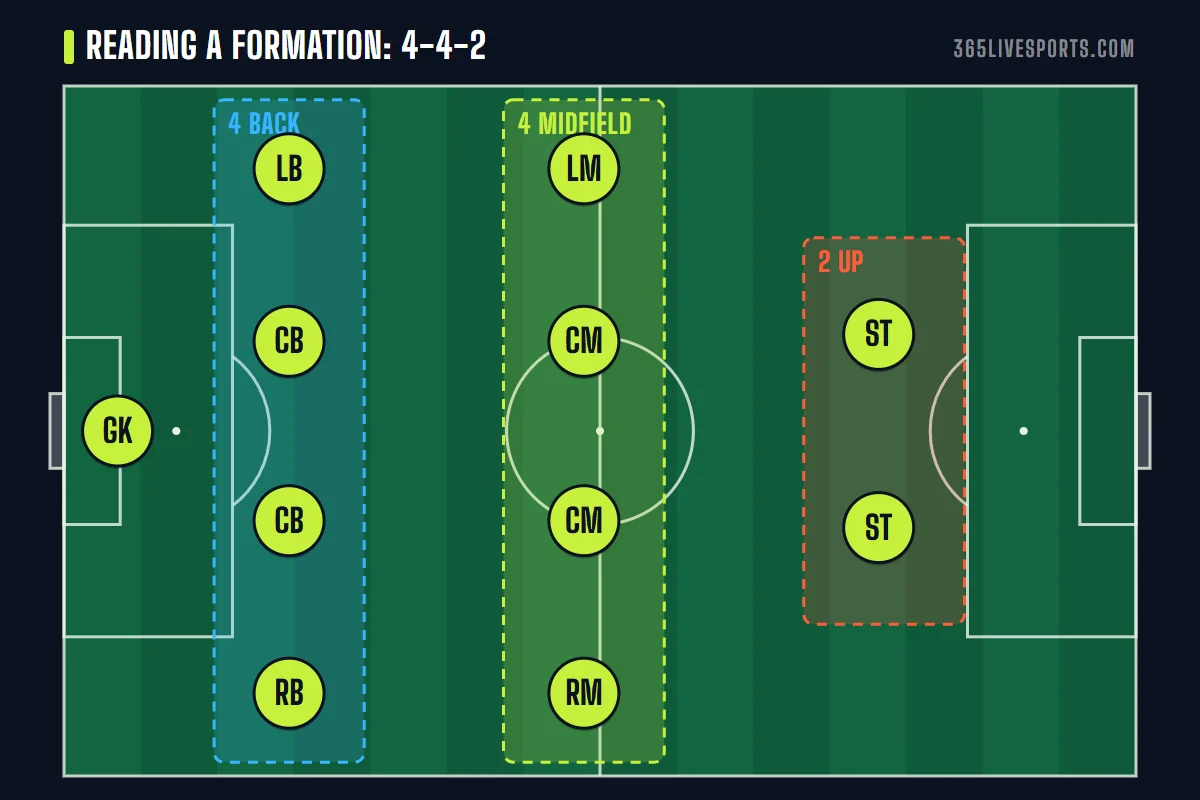
Football formations explained in one line: the numbers list how many outfield players stand in each line, from the back four (or three, or five) to the front, and they always add up to 10 because the goalkeeper is left out. A 4-4-2 means four defenders, four midfielders and two strikers; with the keeper that makes 11.
This hub lists every formation on the site, compares them in one table and helps you pick one for your team. Each shape has its own page with roles, diagrams and a tactics board loaded with that formation.
Quick facts
How to read it
Defense first, attack last, outfield players only.The total
Always 10 in 11v11; 6 in 7v7 and 8 in 9v9.Most common today
The 4-3-3 first, then the 4-2-3-1; 4-4-2 and 3-5-2 sit close behind.Shape vs plan
Most teams change shape with and without the ball.Keeper first
Some coaches write 1-4-3-3; the leading 1 is the goalkeeper.
Football formations explained: reading the numbers
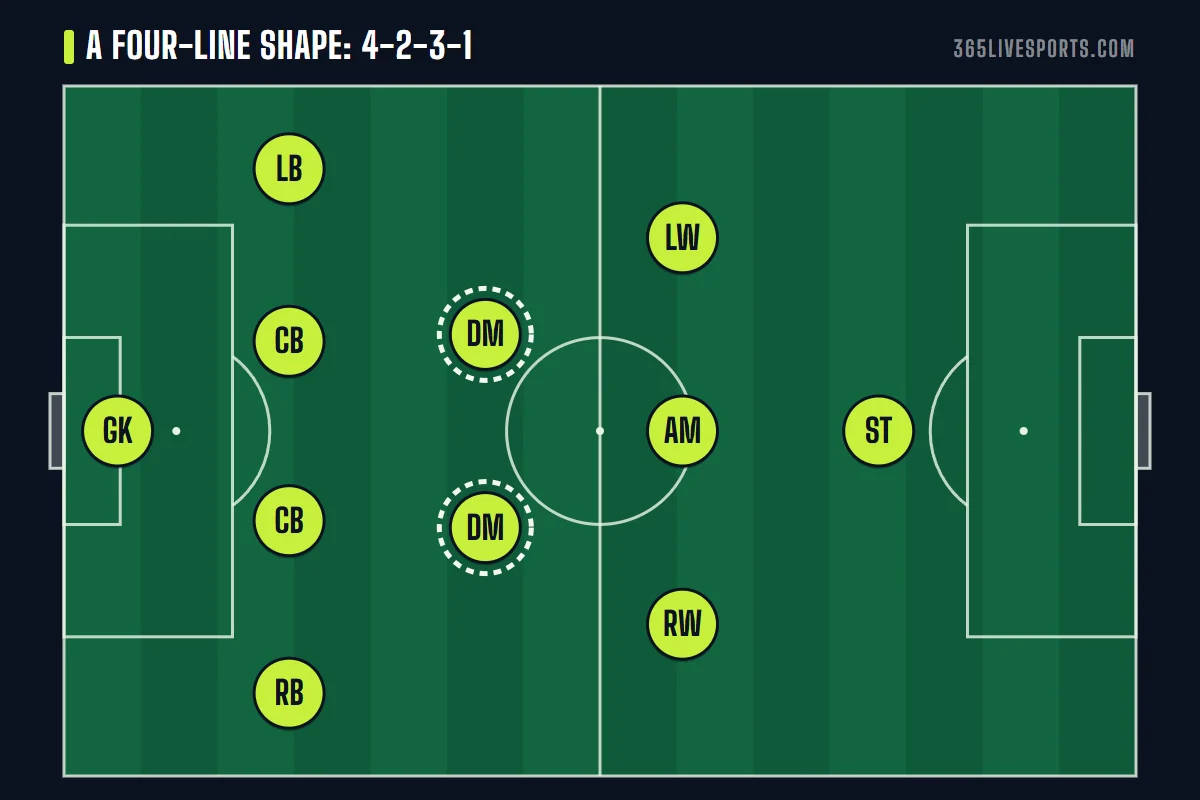
Read a formation from your own goal outward. The first number is the back line, the last number is the forward line, and anything in between is midfield. Three numbers (4-4-2) means one midfield line; four or five numbers (4-2-3-1, 4-1-2-1-2) means the midfield is split into layers, usually a holding layer and an attacking layer.
The goalkeeper is never in the count, so the digits must add up to 10 in an 11v11 game. Some coaching courses put the keeper in front, writing 1-4-3-3 or 1-3-5-2; it is the same shape. In small-sided youth soccer the total drops: six outfield players in 7v7, eight in 9v9.
The numbers describe a starting position, not a cage. Players move as the ball moves, and a good formation is one where every player knows the space they cover and the space they attack.
Every formation compared in one table
Use this table to compare shapes at a glance, then open the page for the one you need. The back line, midfield and forward columns show the starting picture; the last column is where the shape is most useful.
| Shape | Back line | Midfield | Forwards | Best for |
|---|---|---|---|---|
| 4-3-3 | 4 | 3 (often one holder and two eights) | 3: two wingers, a striker | Pressing high, keeping the ball, wide attacks |
| 4-2-3-1 | 4 | 2 holders plus 3 attacking midfielders | 1 striker | Balance; a strong number 10 |
| 4-4-2 | 4 | 4 in a flat line | 2 strikers | Compact defending, crossing, simple roles |
| 3-5-2 | 3 | 5: two wing backs, three central | 2 strikers | Winning the middle, playing two up front |
| 3-4-3 | 3 | 4: two wing backs, two central | 3 | Attacking width and a front three press |
| 5-3-2 | 5 (three center backs, two wing backs) | 3 | 2 | Protecting a lead, counterattacks |
| 5-2-3 | 5 | 2 | 3 | Deep defending with fast breaks |
| 4-3-2-1 | 4 | 3 | 2 inside forwards behind 1 striker | Crowding the center |
| 4-2-4 | 4 | 2 | 4 | Chasing a goal, very attacking youth teams |
| 4-2-2-2 | 4 | 2 holders, 2 playmakers (a box) | 2 | Quick central combinations |
| 4-1-2-1-2 | 4 | Diamond: holder, two shuttlers, a 10 | 2 | Packing the middle; full backs supply the width |
| 4-1-3-2 | 4 | 1 holder, 3 across | 2 | Two strikers without losing midfield cover |
| 4-3-1-2 | 4 | Flat 3 plus a 10 | 2 | A playmaker feeding a strike pair |
| 4-2-1-3 | 4 | 2 holders and a 10 | 3 | A safer 4-3-3 with a double pivot |
| 3-4-2-1 | 3 | 4 plus 2 attacking midfielders | 1 | Two creators feeding one center forward |
| 3-4-1-2 | 3 | 4 plus a 10 | 2 | Wing back width with a strike pair |
| 3-1-4-2 | 3 | 1 anchor, 4 across | 2 | A screened back three |
| 3-2-4-1 | 3 | 2 holders, 4 attacking midfielders | 1 | Possession build-up with a box midfield |
| 3-2-5 | 3 | 2 | 5 across the front | Attacking shape for pinning a back four |
| 3-3-4 | 3 | 3 | 4 | All-out attack, small-sided practice |
| 2-3-5 | 2 full backs | 3 half backs | 5 | History: the early pyramid |
The youth shapes have their own pages: 7v7 formations for six outfield players and 9v9 formations for eight.
Shapes that add up to the wrong number of players
Many searches are for formations that cannot exist in an 11v11 game because the digits do not make 10. The usual cause is counting the goalkeeper by mistake, or mixing up two real shapes.
| Searched shape | Outfield total | What it probably is |
|---|---|---|
| 4-4-3, 4-3-4, 3-4-4 | 11, one too many | Mostly a 4-3-3 (now and then a 4-4-2) where the keeper got counted in a line |
| 4-5-2, 5-4-2, 5-3-2-1 | 11, one too many | A 4-5-1, 5-4-1 or 5-3-2 |
| 4-2-3-2, 4-2-4-1, 3-3-4-1 | 11, one too many | Usually a 4-2-3-1, sometimes a 3-3-4 |
| 4-3-2, 4-2-3, 3-4-2, 4-2-1-2, 4-1-3-1 | 9, one short | A shape for 10v10, or a real formation with one player left off the sheet |
| 2-4-4, 2-5-3, 2-3-4-1 | 10, correct | Real but very old or very attacking; only two at the back |
Longer strings such as 4-1-2-2-1, 4-2-1-2-1, 4-1-3-1-1 or 4-2-2-1-1 are valid totals. They spell out which midfielders sit deeper and which push on; underneath, they are the familiar one-striker and three-forward shapes.
Back four formations
Four defenders (a central pair flanked by full backs) is the most common base in the modern game because it covers the width of the pitch with the fewest bodies. The differences are all in front of it.
- A front three: the 4-3-3, its safer cousin the 4-2-1-3, and the all-out 4-2-4.
- A lone striker: the 4-2-3-1, which leans on a number 10, plus the narrow 4-3-2-1 with its two inside forwards.
- Two strikers: the flat 4-4-2; a midfield diamond (sometimes listed as 4-1-2-1-2); then a box midfield (4-2-2-2); one screen behind three, the 4-1-3-2; and a playmaker behind the pair, the 4-3-1-2.
Narrow back four shapes need full backs who can cover the whole flank. Wide ones need wingers who track back.
Back three and back five formations
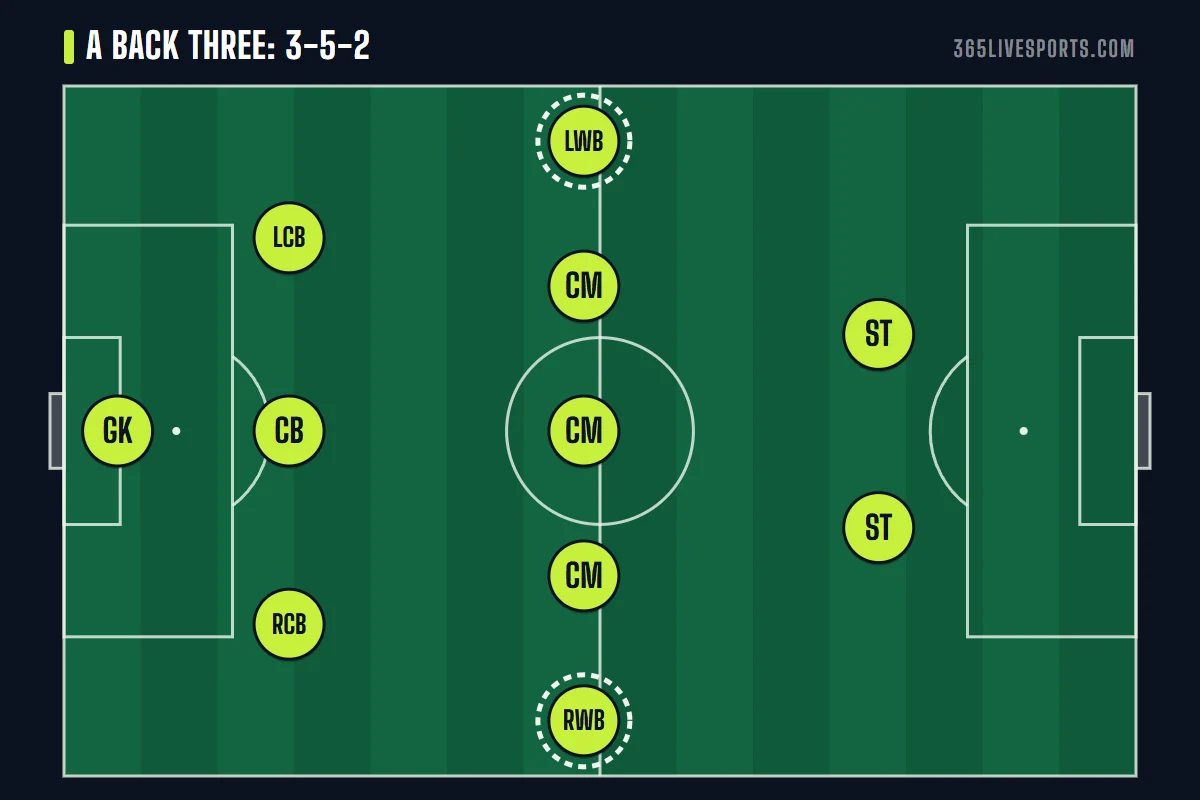
With three center backs, the wide defenders become wing backs who cover the whole flank. When those wing backs drop, the back three becomes a back five, so these shapes are really one family.
- Two strikers: the 3-5-2, the 3-4-1-2 and the 3-1-4-2.
- Three forwards or creators: the 3-4-3, the 3-4-2-1 and the 3-3-4.
- Possession structures: the 3-2-4-1 and the 3-2-5, which many back four teams turn into when they have the ball.
- Five at the back: the 5-3-2 and the 5-2-3.
A back three is strong against two strikers (three defenders on two) but can be stretched by a front three that pins all three center backs and a winger who isolates a wing back.
Football defensive formations explained
A defensive formation is the shape a team takes without the ball, and it is often different from the team sheet. The most common ones are:
- 4-4-2 block: two banks of four with the strikers screening the opponent's midfield. Plenty of teams that start with a lone striker or a front three defend this way.
- 4-5-1 or 4-1-4-1: the wingers of a 4-3-3 drop into the midfield line.
- 5-4-1 and 5-3-2: the wing backs of a back three drop beside the center backs.
The shape matters less than the distances inside it. Keep the lines close together, slide toward the ball as a group, and protect the middle first. Our low block guide covers deep defending in detail, and which formation to use against each shape covers the matchups.
Formations for youth soccer
US guidance for youth soccer puts the very young in small-sided games, then seven-a-side for under-9 and under-10 players, nine-a-side for under-11 and under-12 players, and the full eleven from under-13. Your league's rulebook has the final word on formats and ages.
Pick youth shapes that look like the 11v11 shape you will grow into. A 2-3-1 in 7v7 becomes a 3-2-3 in 9v9 and a 4-3-3 at 11v11; a 3-3-2 in 9v9 grows into a 4-4-2. Rotate players through lines and keep the roles simple: one defender always stays, the wide players give width, the striker stays high.
How to choose a formation for your team
- List your best five players and where they play best. Build the shape around them, not the other way round.
- Check your width. Quick wide players point to wingers (4-3-3, 4-4-2). If your full backs are your best runners, use wing backs or a narrow shape.
- Count your central midfielders. Two good ones fit a flat 4-4-2, or the double pivot behind a number 10; three suit a 4-3-3 or 3-5-2.
- Decide how you want to defend. A high press needs a front three or a compact front two; a deep block suits five at the back.
- Test it on the board. Drag the shape onto the tactics board, add your next opponent and look for spare players on each side.
Formation football tactics: why the numbers move
The team sheet shape is often just the defending shape. With the ball, full backs push on and a midfielder drops, so a 4-3-3 can turn into a 3-2-5 or a 2-3-5, almost the old pyramid. Without the ball, the same team may drop into a 4-5-1. That is why analysts describe a team's shape with the ball and its shape without it as two separate things.
When you watch a match, check three moments: when the goalkeeper has the ball (build-up shape), when the other side's center back is on the ball (pressing shape), and when the ball is near your box (defending shape). Each formation page on this site shows at least two of those pictures.
How formations evolved
The 2-3-5 pyramid ruled football's first organized era. A change to the offside law gave forwards more room, and teams dropped a half back into defense, creating the W-M. Later came the back four of the 4-2-4, then the 4-3-3 and 4-4-2 as wingers were pulled back to defend. The modern game brought the 4-2-3-1, back threes again, and fluid in-possession shapes. The trend is always the same: more players behind the ball, and more players expected to both attack and defend.
Questions players and coaches ask
What is the best football formation?
No formation is best for every team. A 4-3-3 suits teams with fast wingers and a strong midfield three, a 4-4-2 suits teams that want to defend compactly with two strikers, and a 3-5-2 suits teams with three good center backs. Pick the shape that fits your best players.
Is there a 4-4-3 formation?
Not in an 11v11 game. 4-4-3 adds up to 11 outfield players, so with a goalkeeper you would have 12. People searching for it usually mean a 4-3-3 or a 4-4-2.
What is a 2-5-3 formation?
A 2-5-3 adds up to 10, so it is legal on paper, but it leaves only two defenders. It is mostly seen in youth practice games or when a team is chasing a goal late on.
What is a 4-2-1-2-1 formation?
It is a detailed way of writing a narrow 4-2-3-1: four defenders, a pair of holding midfielders, one attacking midfielder, two players just behind the striker, and the striker. In practice it plays much like a 4-2-2-2 or 4-2-3-1 with inside forwards.
What is the most attacking formation?
Shapes with four or five forwards, such as the 4-2-4, the 3-3-4 or the 3-2-5, are the most attacking on paper. They leave few players behind the ball, so most teams only use them in possession or late in a game they are losing.
Why do formations add up to 10 and not 11?
Formation numbers count outfield players only. The goalkeeper is always there, so leaving them out keeps the numbers short. Add one for the keeper and you get the 11 players on the field.