
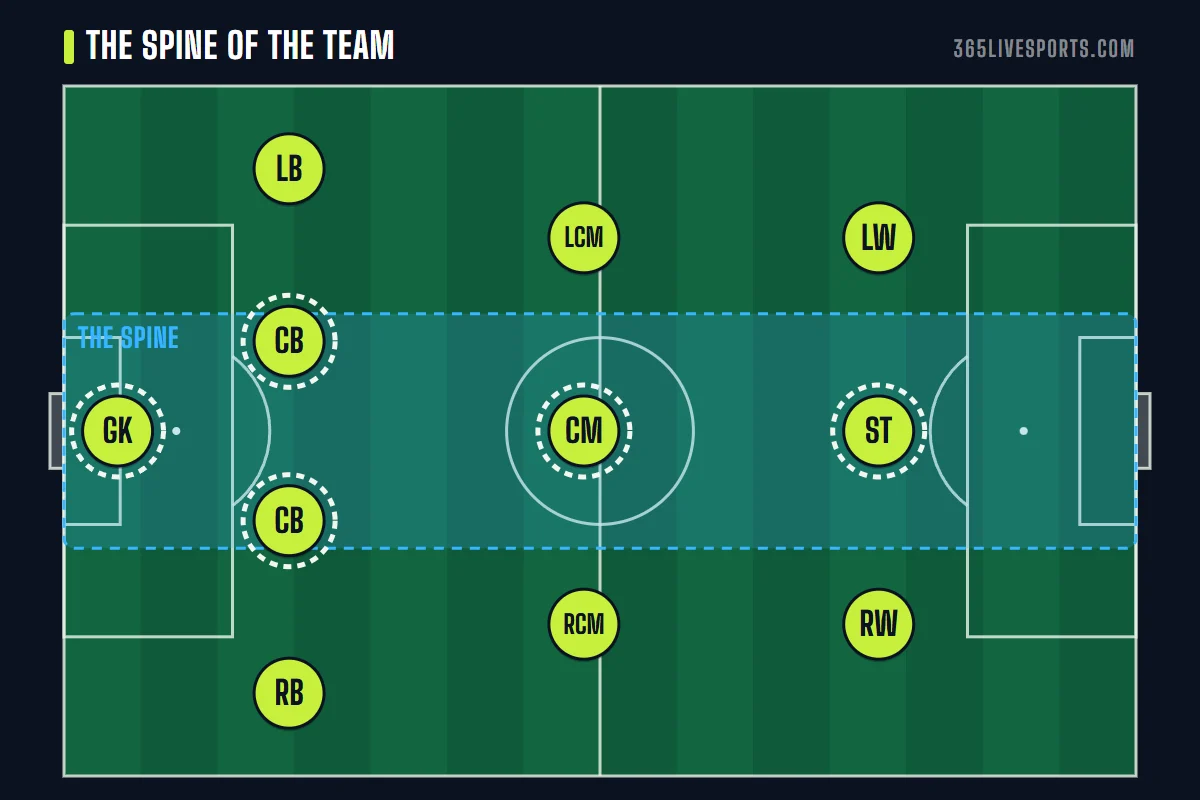
The most important soccer positions are the four that make up a team's spine: goalkeeper, center back, central or defensive midfielder and striker, because they sit in the middle of the field where goals are scored and conceded. The hardest position to play is usually central midfield, closely followed by goalkeeper, but "hardest" and "most important" are not quite the same question.
Every position matters, and a team with one weak link gets exposed. Still, players and parents ask this all the time, so here is an honest answer built on what each role demands rather than on which players get the headlines.
Quick facts
Most important group
The spine: GK, CB, central midfield, STHardest overall
Central or defensive midfieldHighest cost of error
GoalkeeperMost running
Wing-back and box-to-box midfielderMost mental pressure
Goalkeeper and strikerBest for beginners
Full back or wide midfield
The most important soccer positions: the spine
Coaches build teams down the middle. The goalkeeper, the center backs, the central or holding midfielder and the striker stand in a line from goal to goal, and the ball passes through that line more than any other. If the spine is strong, wide players can be average and a team still competes. If the spine is weak, the best wingers in the league will not save you.
Why the middle? Most goals are scored from central areas inside the penalty box. The players who protect that space and the players who attack it have the most direct effect on the score.
How we judged each position
To rank positions fairly, I scored each one on five demands, based on years of coaching youth and amateur soccer:
- Decisions: how many choices the player makes per minute, and how little time they have.
- Physical load: distance covered, sprints, duels in the air and on the ground.
- Technical range: how many different skills the role needs to do well.
- Cost of error: what happens when the player gets it wrong once.
- Replaceability: how easy it is to find another player who can step in.
No method is perfect, and a formation can shift the scores. A full back in a team that attacks through the flanks does more than one in a defensive side. Treat the ratings as a guide for typical back-four shapes like the 4-3-3 or the 4-4-2.
Ratings: the hardest soccer positions compared
| Position | Decisions | Physical | Technical | Cost of error | Total |
|---|---|---|---|---|---|
| Defensive midfielder | 5 | 4 | 4 | 4 | 17 |
| Central midfielder | 5 | 5 | 4 | 3 | 17 |
| Goalkeeper | 4 | 3 | 4 | 5 | 16 |
| Center back | 4 | 4 | 3 | 5 | 16 |
| Wing-back | 3 | 5 | 4 | 3 | 15 |
| Striker | 3 | 4 | 4 | 3 | 14 |
| Attacking midfielder | 4 | 3 | 5 | 2 | 14 |
| Full back | 3 | 4 | 3 | 3 | 13 |
| Winger | 3 | 4 | 4 | 2 | 13 |
| Wide midfielder | 3 | 4 | 3 | 2 | 12 |
The hardest positions in soccer, explained
1. Central and defensive midfield
Pressure comes from every direction, the ball arrives with opponents close by, and every touch either keeps an attack alive or starts a counter against you. These players also cover the most ground. Read more in our midfield positions guide.
2. Goalkeeper
Long quiet spells followed by one moment that decides the game. Keepers need different skills from everyone else, must stay focused for the whole match and carry the mental weight of mistakes that end up in the net. Few positions are as lonely after a bad day.
3. Center back
One misjudged bounce or a step in the wrong direction and the striker is through on goal. Center backs must read the game, organize the line and, in the modern game, pass under pressure. The defense positions page goes deeper.
4. Wing-back
The most physically punishing job on the field: defending like a full back and attacking like a winger along the whole touchline, again and again for the full game.
5. Striker
Technically narrower than midfield, but mentally brutal. A striker may get two chances in a match and is judged almost entirely on them, while being kicked by center backs the rest of the time. Strikers get their own breakdown on the offense positions page.
Which positions matter most for winning?
It depends on the level. In young and recreational soccer, the goalkeeper and the quickest attacker often decide games, because many goals come from simple shots and breakaways. A confident keeper who catches cleanly is worth several goals a season.
As players get older and better, the middle of the field takes over. Teams that control central midfield control possession, and the team with the ball creates more chances. At that level a calm holding midfielder or a center back who passes well can be the most valuable player on the field, even if spectators barely notice them.
The safest summary: build from the spine, then add width. That rule holds in almost every formation on our formations page.
The best soccer positions for different players
The best position for you is the one that fits your strengths. Use this as a starting point:
| If you are... | Try | Why |
|---|---|---|
| Fast and brave with the ball | Winger | One against one duels on the flank reward pace and nerve |
| Tall, strong, good in the air | Center back or target striker | Headers and physical duels decide both boxes |
| Calm, a good passer, always scanning | Defensive or central midfield | The team runs through you |
| Tireless and willing to defend | Full back or wing-back | Repeated sprints both ways |
| Creative and skillful in tight spaces | Attacking midfielder | Space is small between the lines |
| Loud, focused, good hands | Goalkeeper | Organizing and shot stopping |
Still unsure? The step-by-step method on our soccer positions hub helps, as does the age-group advice in youth soccer positions.
Myths about important and unimportant positions
- "The best player should play striker." Often the best player is more useful in central midfield, where they touch the ball far more.
- "Defense is for weaker players." Weak defenders lose games. Put smart, brave players at the back.
- "Goalkeeper is for the kid who cannot run." Modern keepers need footwork, agility and the courage to come off the line.
- "Wide players do not matter." They matter less than the spine, but a winger who never tracks back can sink a full back on their own.
Questions players and coaches ask
Which soccer position is the hardest to play?
Central and defensive midfield usually rate as the hardest, because of the pressure, the decisions and the distance covered. Goalkeeper is a close second, mainly because mistakes almost always lead to goals.
What are the most important positions in soccer?
The spine: goalkeeper, center back, central or defensive midfielder and striker. These players protect and attack the middle of the field, where most goals happen.
What is the best position in soccer for a beginner?
Full back or wide midfield is a good start, since the touchline reduces the angles a player must cover. Try several spots before settling on one.
Which soccer position runs the most?
Box-to-box central midfielders and wing-backs usually cover the most ground. Goalkeepers run the least but need explosive bursts and agility.
Is goalkeeper the most important position?
It has the highest cost of error, and in youth soccer a good keeper can swing many games. At higher levels, central midfield and center back carry similar weight.
What are the hardest soccer positions to play well?
Defensive midfield, goalkeeper and center back, followed by wing-back for its physical demands. Each asks for a different mix of decisions, technique and nerve.