
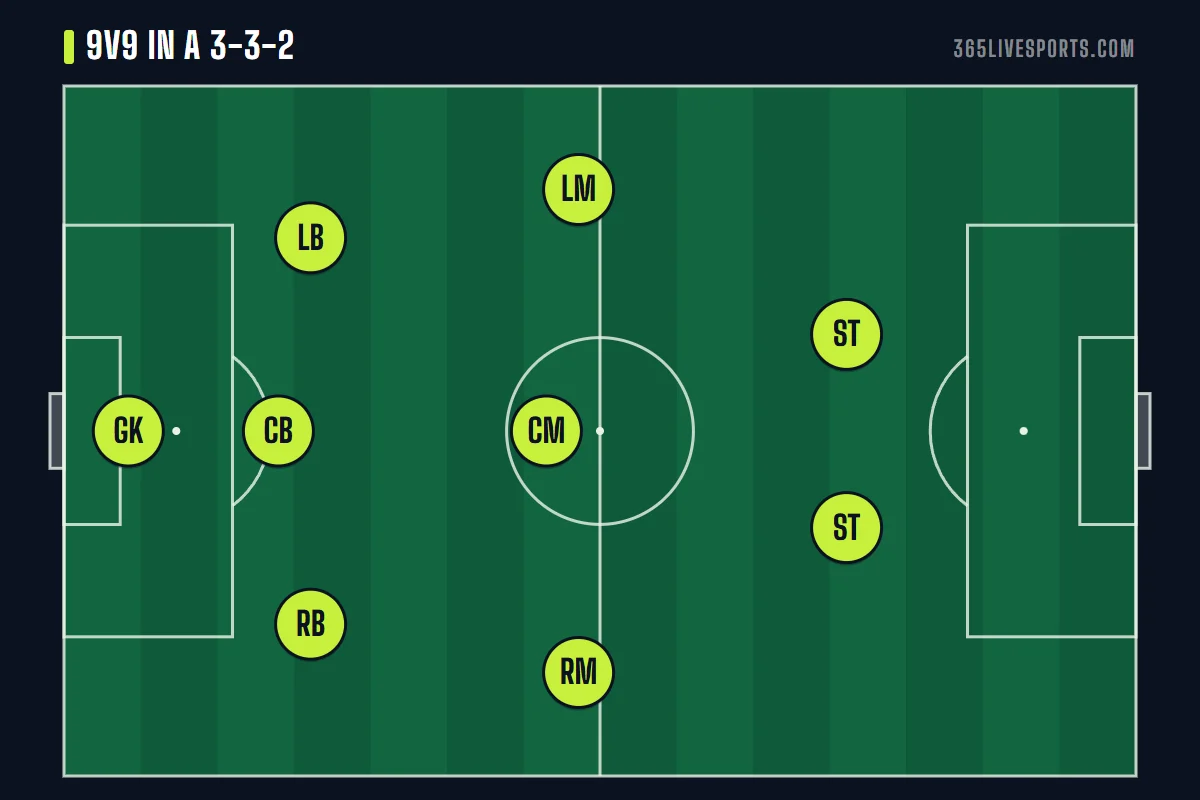
The 9v9 soccer positions cover one goalkeeper and eight field players, who usually line up as three or four defenders, two to four midfielders and up to three forwards. The most common shapes are the 3-3-2, the 3-2-3 and the 2-3-3, with 4-3-1 and 4-2-2 used by more defensive teams. In the United States, 9v9 is the format for roughly U11 and U12 players, the step between 7v7 and the full game. This guide walks through every position, compares the formations with diagrams and gives a simple plan for rotating kids so they learn more than one job.
Quick facts
Players
9 per side: 1 goalkeeper and 8 field playersUsual ages (US)
Around U11 and U12; leagues and clubs set their own rulesMost common shapes
3-3-2, 3-2-3, 2-3-3Defensive options
4-3-1, 4-2-2, 3-4-1Formation numbers
Count field players only, back to front, and add up to 8Next step
11v11, usually from U13
9v9 soccer positions at a glance
A 9v9 team has the same basic jobs as a full team, just fewer people doing them. Here are the positions you will see on almost every 9v9 roster:
- Goalkeeper: the only player allowed to handle the ball inside the penalty area.
- Center back: the middle defender, the organizer of the back line.
- Outside backs: left and right defenders who guard the flanks and join attacks.
- Center midfielder: links defense and attack, covers the most ground.
- Wide midfielders: left and right players who defend and attack along the sidelines.
- Forwards: one, two or three strikers and wingers whose main job is scoring.
A formation simply says how many of those eight field players stand in each line. In a 3-3-2, three defend, three play midfield and two attack.
Who plays 9v9, and why the format exists
US Soccer's small-sided standards set 9v9 as the maximum format for U11 and U12 players. Younger groups play smaller games (4v4 for the youngest and 7v7 around U9 and U10), and the full 11v11 game usually starts at U13. The idea is more touches, more decisions and more involvement for every child than on a full-size field.
Many US leagues that use a build-out line in 7v7 drop it at 9v9, and most apply the normal offside law. That makes 9v9 the first format where back lines really have to hold a line together.
What each 9v9 position does
Goalkeeper
Stops shots, commands the box and starts attacks. At this age, ask keepers to play short to a defender whenever it is on, rather than kicking long every time.
Center back
Stays central, talks constantly and covers behind the outside backs. The best youth center backs are calm, not necessarily the biggest.
Outside backs
Defend the flank first. When the team has the ball, they move wide and up to give the keeper and center back an easy pass.
Center midfielder
The hub. Wants the ball, looks over the shoulder before receiving and helps on defense. Usually the fittest player.
Wide midfielders
Run up and down the sideline: track the opposing wide player, then attack the space in front of them.
Forwards
Score, but also press the defenders and drop back toward midfield after a turnover. In a two-forward shape, one runs behind while the other comes short.
For the same positions in the full game, see soccer positions explained.
Common 9v9 formations compared
| Formation | Shape | Good for | Watch out for |
|---|---|---|---|
| 3-3-2 | 3 defenders, 3 midfielders, 2 forwards | Balance; easy to teach | Wide mids get tired |
| 3-2-3 | 3 defenders, 2 central midfielders, 3 forwards | Width in attack, high pressing | Only two in midfield |
| 2-3-3 | 2 defenders, 3 midfielders, 3 forwards | Very attacking, skilled teams | Only two at the back |
| 3-4-1 | 3 defenders, 4 midfielders, 1 forward | Controlling midfield | Lone forward can be isolated |
| 4-3-1 | 4 defenders, 3 midfielders, 1 forward | Defensive solidity | Few attackers near goal |
| 4-2-2 | 4 defenders, 2 midfielders, 2 forwards | Simple, solid structure | Midfield can be overrun |
| 2-4-2 | 2 defenders, 4 midfielders, 2 forwards | Wide play, lots of midfield runners | Exposed at the back |
| 4-1-2-1 | 4 defenders, a holder, 2 midfielders, 1 forward | A diamond feel with a safe back four | Little width up front |
Every number line adds up to eight because the goalkeeper is not counted.
The 3-2-3 and the numbering behind it
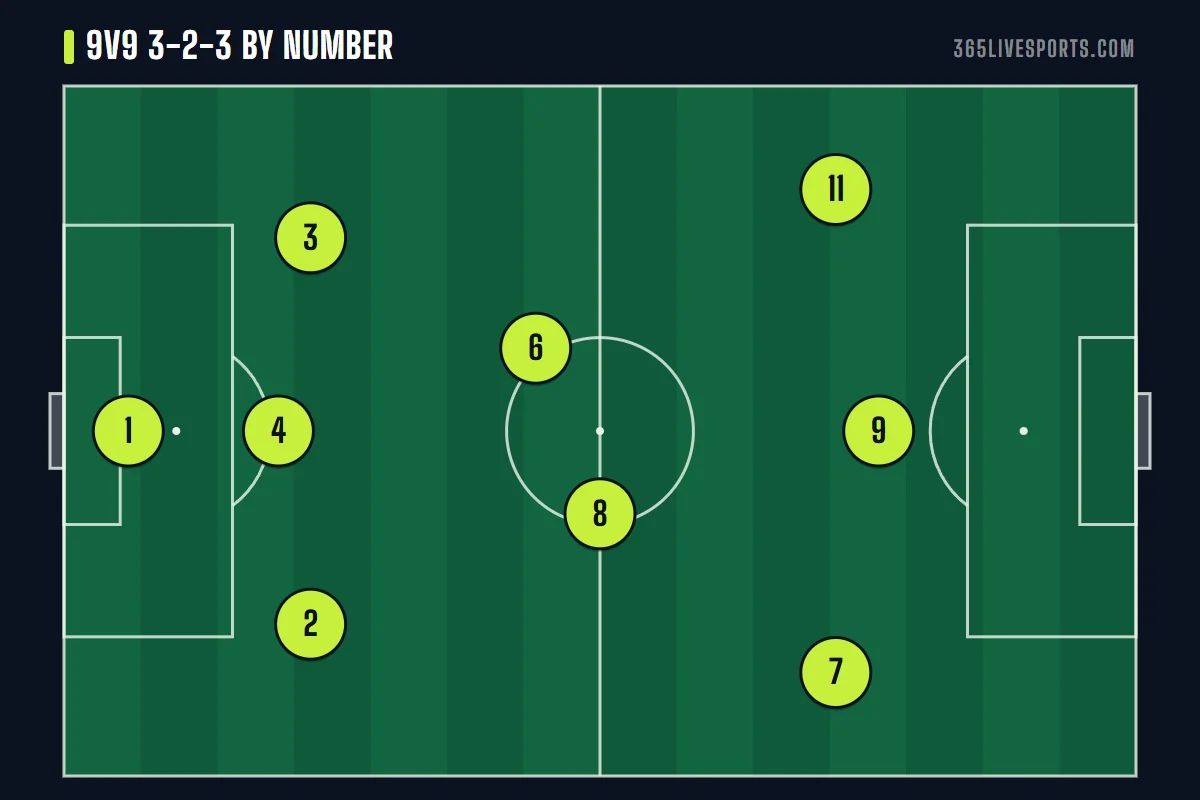
The 3-2-3 puts three forwards across the front: two wingers and a central striker. Two central midfielders work behind them, one more defensive and one more attacking. It suits teams that want to press high and use wingers, and it is a natural step toward the 4-3-3 many teams play at 11v11.
Coaches who use soccer positions by number in 9v9 usually borrow the full-game numbers and skip a couple. One common pattern is shown below: the keeper wears 1, the right back 2, the left back 3, a center back 4 or 5, the central midfielders 6 and 8, the right winger 7, the striker 9 and the left winger 11. The 10 is often missing. Numbering varies from club to club, so treat it as a convention.
Four at the back: the 4-3-1 and the 4-2-2
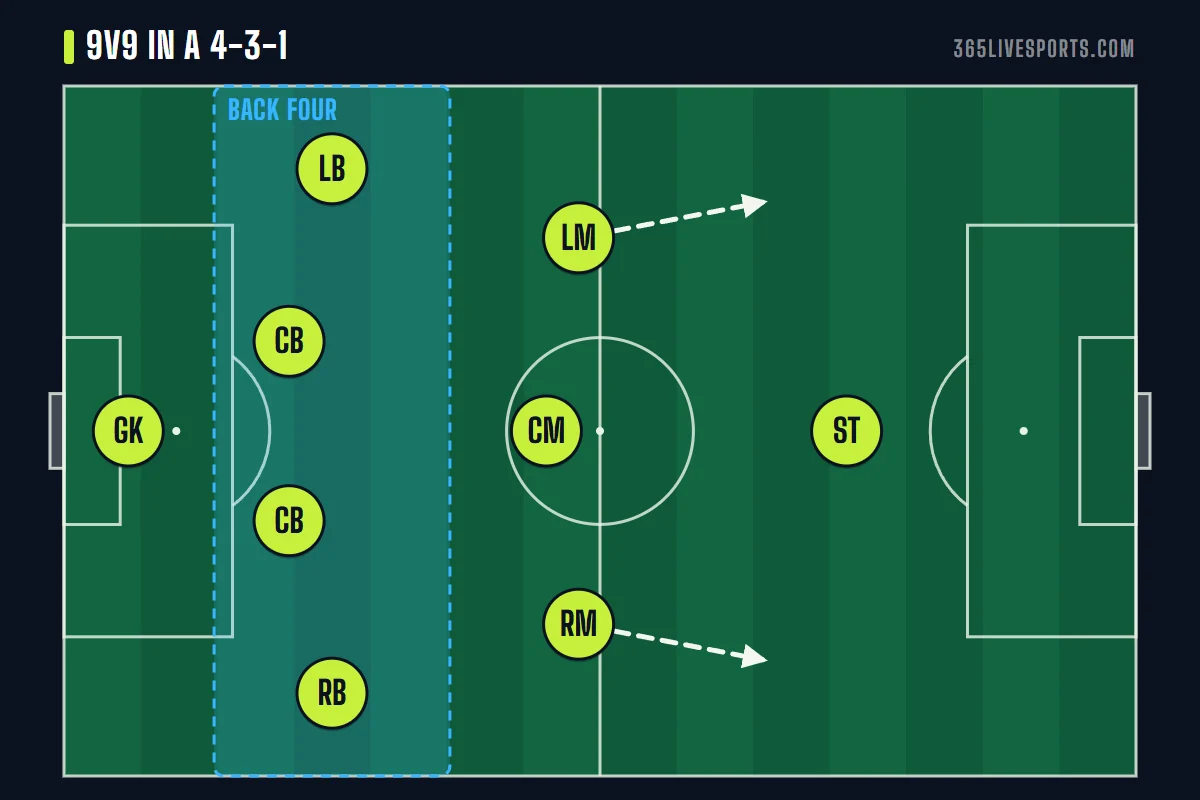
Some coaches prefer a back four because it looks like the 11v11 back line. The 4-3-1 formation adds a midfield three and a lone forward. It is hard to score against but needs the midfielders to join attacks, or the striker ends up alone. The 4-2-2 soccer formation keeps two forwards but only two central players, so it works best for teams that play direct.
The 4-1-2-1 is a variation of the 4-3-1 with one holding midfielder and two players ahead of him in a small triangle. It gives a nice diamond shape in the middle, but very little width in attack, so the outside backs must overlap.
Rotating players so everyone learns
At U11 and U12, positions should not be fixed. Kids change a lot from one season to the next, and the late developer playing defense today may be your best forward in two years. A simple rule: every player tries at least two lines (defense, midfield, attack) each season, and anyone who wants to try goalkeeper gets a half in goal.
| Player | Game 1 | Game 2 | Game 3 | Game 4 |
|---|---|---|---|---|
| Player A | Center back | Center mid | Forward | Center back |
| Player B | Wide mid | Outside back | Wide mid | Forward |
| Player C | Forward | Wide mid | Outside back | Center mid |
| Player D | Outside back | Forward | Center mid | Goalkeeper (one half) |
Getting ready for 11v11
The jump to the full game adds two field players, a bigger field and usually a full back four. Teams that played a 3-3-2 or 3-2-3 adapt quickly, because each line just gains one player. Start introducing ideas such as holding the back line and switching play in the final 9v9 season.
For the full picture, read our guides to 11v11 soccer positions and to youth soccer positions across all ages.
Questions players and coaches ask
What are the positions in 9v9 soccer?
A goalkeeper and eight field players, typically split into defenders (center back and outside backs), midfielders (center and wide) and forwards. The formation sets how many play in each line.
What is the best 9v9 formation?
There is no single best one, but the 3-3-2 is the most popular because it is balanced and easy to teach. Quick wingers make the 3-2-3 a good option, while the 4-3-1 helps teams that need to defend first.
What age plays 9v9 soccer?
In the United States, US Soccer's small-sided standards set 9v9 for U11 and U12. Leagues and clubs set their own rules, so some use it for slightly different ages.
How does a 4-3-1 formation work in 9v9?
Four defenders, three midfielders and one forward. It is solid defensively, but the wide midfielders must push forward to support the striker, or the team will struggle to score.
Is there offside in 9v9 soccer?
In most US 9v9 leagues, yes, using the normal offside law. Some recreational programs relax it, so check your league rules.
Should kids play the same 9v9 position every game?
No. At this age, rotate players through different lines so they learn the whole game. Specializing too early can hold back a player who later grows into a different role.