
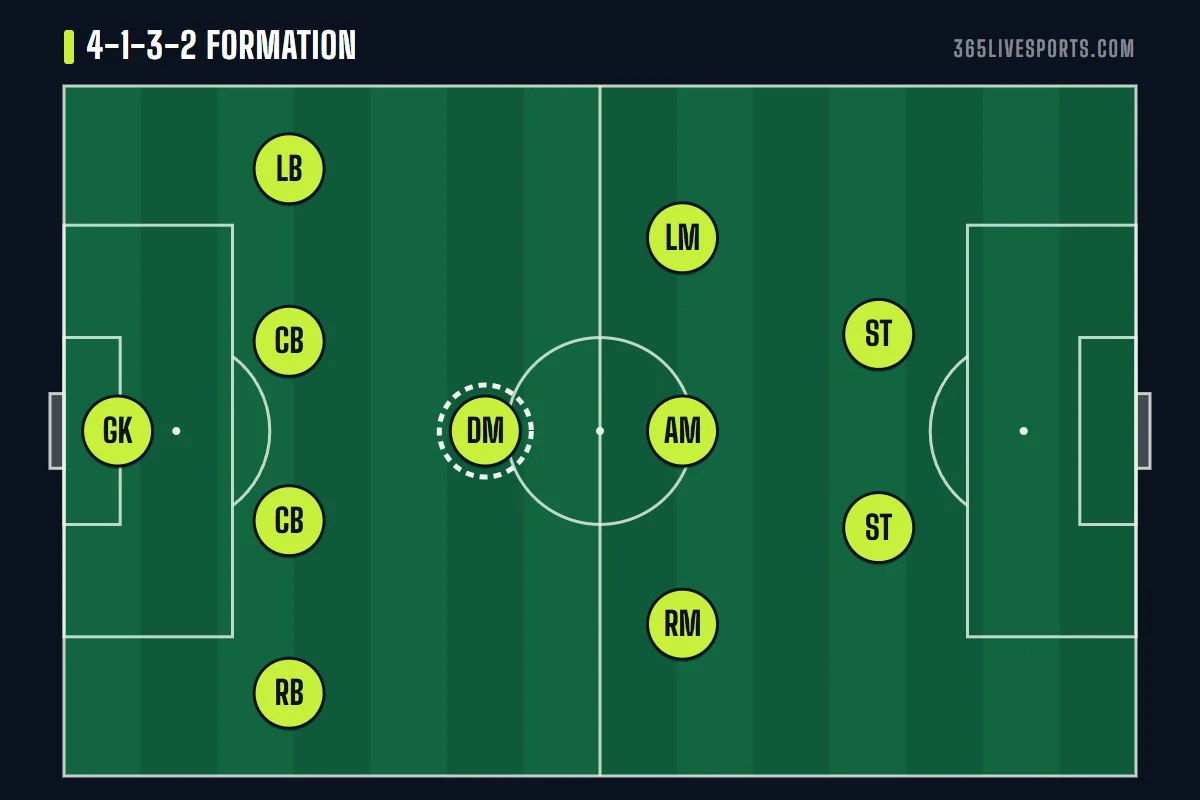
The 4-1-3-2 formation sets a back four behind one holding midfielder, then a line of three attacking midfielders (left, central and right) and two strikers up front. In effect it is a 4-4-2 with the midfield split into a lone anchor and three more adventurous players ahead of him.
Compared with the diamond, the three in the middle line spread wider, so the team keeps some natural width while still playing with a strike pair. That makes it a popular soccer choice for coaches who like two forwards but do not want to give up the flanks. The catch is the space around the single holder, and most of this page is about protecting it.
Quick facts
Shape
Back four, one holder, three midfielders across, two strikersFeel
Attacking: six players regularly ahead of the ballBest for
Teams with a strong anchor and two strikers who link wellWeak spot
The spaces either side of the single holding midfielderKey player
The holding midfielder, who covers aloneMatchup
Hurt by a ten who drifts beside the holder; strong against a back three with one striker
Is 4-1-3-2 a good formation? The short answer
It is a good choice when three things are true: you have a disciplined defensive midfielder, your three attacking midfielders will work back, and your two strikers complement each other. Lacking the first, opponents walk through the middle. Without the second, it is outnumbered every time the ball is lost. Without the third, you would be better off with one striker and an extra midfielder.
Many amateur teams drift into a 4-1-3-2 without planning it: a 4-4-2 whose wide players play inside and whose central pair splits into a holder and a runner. Drawing it clearly helps everyone know their job. This page's tactics board loads this exact shape, so try nudging the holder sideways and see which zones open up behind him.
The 4-1-3-2 formation, player by player
| Player | Shirt number (classic) | When we have the ball | When they have the ball |
|---|---|---|---|
| Goalkeeper | 1 | Short distribution to the center backs or holder | Organizes the back four, sweeps |
| Center backs | 4, 5 | Split, find the holder or the strikers | Defend the box; one steps out to a ten |
| Full backs | 2, 3 | Overlap when the wide midfielder comes inside | Defend the wingers |
| Holding midfielder | 6 | Takes the ball under pressure, plays forward | Screens, never leaves the middle |
| Left and right midfielders | 7, 11 | Attack the half-spaces or hug the line, cross | Drop beside the holder to make a four |
| Central attacking midfielder | 10 | Links midfield and strikers, shoots from distance | Blocks the pass into their holding player |
| Strikers | 9 and 8 or 10 | One stretches the line, the other drops | Press in a pair, force play to one side |
Numbers differ between countries and clubs; our positions by number page explains the variations.
4-1-3-2 formation tactics with the ball
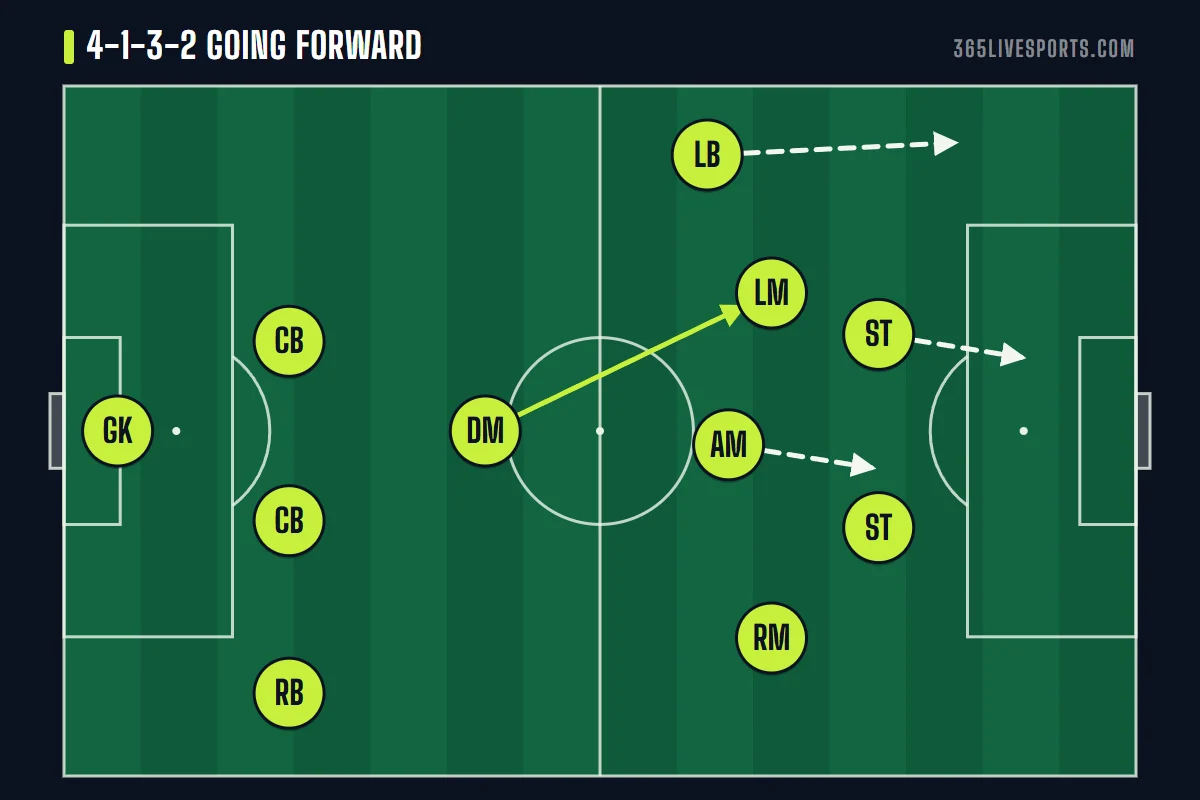
The attacking idea is to overload the front of the opposition defense with five players: three attacking midfielders and two strikers. The holder and the center backs start the move, and the full backs join when the wide midfielders come inside.
Common patterns I have used:
- Inside and outside: the left midfielder drifts infield and takes the ball in the gap between their lines; the left back overlaps to cross.
- Ten to strikers: the central midfielder plays a quick one-two with the dropping striker while the other striker spins behind.
- Switch through the holder: when one side is blocked, the ball goes back to the holder and out to the far full back in two passes.
Defending the space around the lone holder
Out of possession the usual shape is a 4-4-2, with both wide midfielders dropping level with the holder while the central attacking midfielder steps up beside him or joins the strikers in the press. Other coaches like a 4-1-4-1 with one striker dropping, which protects the middle better.
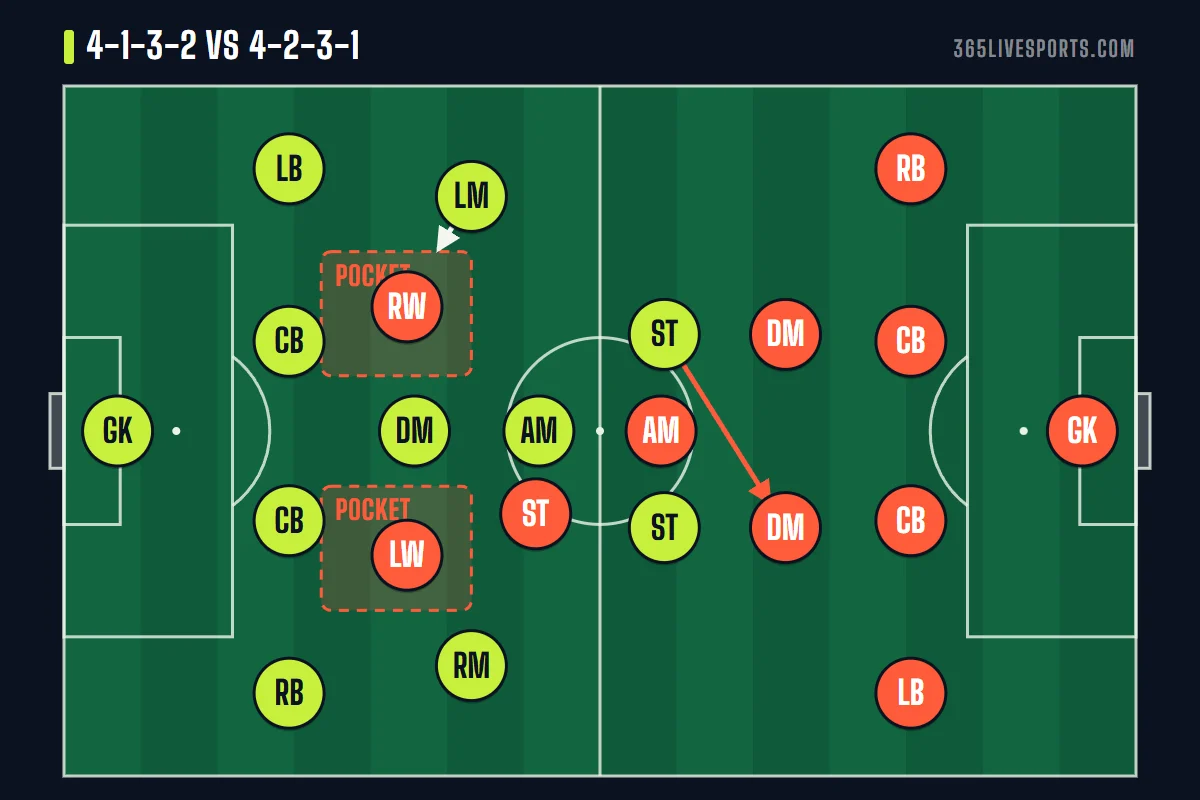
The danger is an opposition ten or a pair of attacking midfielders standing in the pockets beside your holder. He cannot cover both sides, and if a center back steps out, the back line opens. The picture shows a 4-2-3-1 doing exactly that.
- Wide midfielders drop inside quickly, not just straight back.
- The holder takes the most central threat; the nearest midfielder covers the other pocket.
- Strikers block the pass into their deepest midfielders so the ball goes wide, where you can trap it.
Strengths, weaknesses and the counter-moves
| Strength | Weakness | What the opponent does | Your answer |
|---|---|---|---|
| A strike pair keeps both center backs busy | Single holder can be overloaded | Plays a ten in each pocket | Drop the central attacking midfielder alongside the holder |
| Five attackers in the final third | Gaps when the ball is lost high | Counters through the middle | Holder stays deep; one full back stays home |
| Some natural width from the wide midfielders | Wide players may drift inside and leave the flank | Overlaps on your full back | Agree who tracks the overlap before the game |
For a narrower version with no wide midfielders, our 4-1-2-1-2 page covers the narrow diamond. For the version with two holders and one striker, look at the 4-2-3-1.
How it compares with the 4-4-2 family
Every shape with four defenders and two strikers belongs to the same family. The 4-4-2 keeps two central midfielders side by side. The 4-1-3-2 splits them into an anchor and a playmaker and pushes the wide players higher. The diamond pulls the wide players into the middle. The box shape, written 4-2-2-2, uses two holders and two narrow tens.
Coaching the 4-1-3-2 at youth and amateur level
In American youth soccer the eleven-player game usually arrives at U13. Before that come mini-games for the smallest children, 7v7 for most U9 and U10 teams and 9v9 for most U11 and U12 teams, and clubs and leagues can vary all of it. A 9v9 team can copy the idea with a 3-1-2-2.
For the holding player, try a shadow-play exercise: the team walks through attacks without opponents, and each time the coach shouts "lost", the holder must find the most dangerous gap ahead of his back line within three seconds while the wide midfielders sprint inside. Repeat it until the reaction is automatic. More ideas for this role are on our midfield positions page.
Questions players and coaches ask
Is 4-1-3-2 a good formation?
Used by a squad with a disciplined holding midfielder and hardworking attacking midfielders, it works well. Without a strong anchor, opponents play through the space around him far too easily.
How does 4-1-3-2 differ from 4-1-2-1-2?
This shape puts its three attacking midfielders in a line, with the outside two fairly wide. The diamond keeps the two side midfielders narrower and deeper, with only one player at the tip.
How does a 4-1-3-2 defend?
Usually as a 4-4-2, with the wide midfielders dropping beside the holder and the central attacking midfielder pressing with the strikers. Some teams drop one striker instead to make a 4-1-4-1.
What does the holding midfielder do in a 4-1-3-2?
He screens the back four, collects passes from his defenders and changes the angle of attack. He must stay central, because nobody else covers the middle when the team loses the ball.
Is the 4-1-3-2 an attacking soccer formation?
Yes. With three attacking midfielders and two strikers, five players can attack the opposition back line. The balance comes from the holder and the full backs taking turns to stay back.